Two years ago, Europe sent a spacecraft on a mission to investigate the aftermath of a human-instigated cosmic collision. Now, Hera is closing in on its destination, and it just sent back the first close-up view of its target.
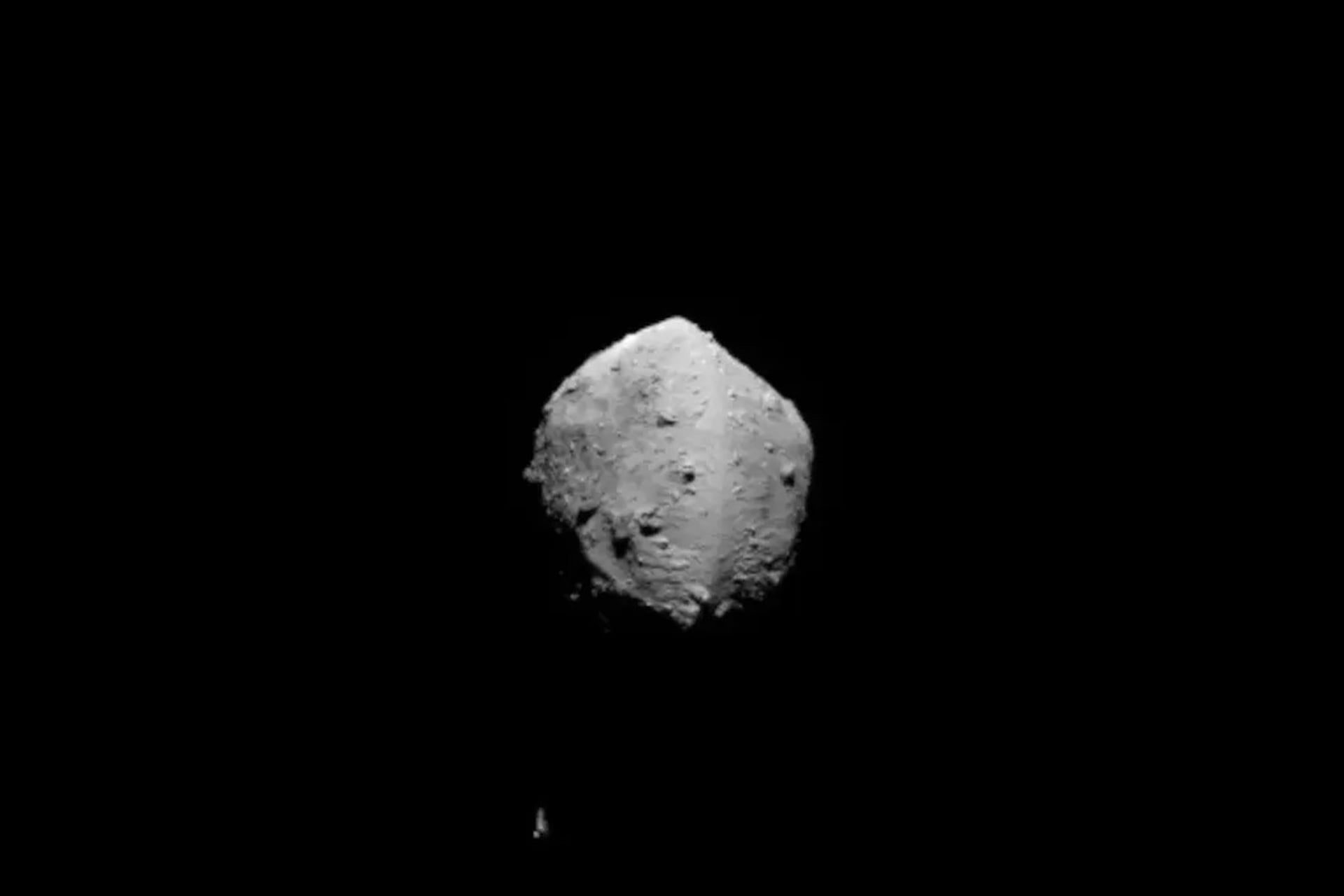
The European Space Agency’s (ESA) Hera mission snapped an image of the Didymos asteroid system from about 37 miles (60 kilometers) away. The black-and-white photo shows the side of Didymos that NASA’s DART spacecraft never got to see before it crashed into its smaller companion, Dimorphos. And, according to the team behind the mission, the asteroid looks very different from this side, with some features that may have been created in the aftermath of the impact.
“The first thing we said was wow!” Patrick Michel, Hera principal investigator, said in a statement. “This feels like looking at a whole new world.”
Crash site
In September 2022, NASA crashed a 1,260-pound (570 kilogram) spacecraft into Dimorphos, a 558-foot-wide (170-meter) space rock that orbits its larger 2,625-foot-wide (800-meter) companion, Didymos.
Following the collision, ground-based observations revealed that Dimorphos’s orbital period around Didymos shortened from 11 hours and 55 minutes to 11 hours and 23 minutes. The mission was deemed a success, but scientists needed a closer look to examine the full consequences of the impact.
That’s where Hera comes in. The spacecraft launched on October 7, 2024, as a crucial follow-up to NASA’s DART (Double Asteroid Redirection Test). Following a two-year journey through space, Hera is nearly ready to get to work, gathering data to help scientists better determine if DART’s success can be turned into a dependable strategy for protecting Earth.
A closer look
The recently released image captures Didymos like we’ve never seen it before, revealing the asteroid’s previously hidden backside. “This side of Didymos has the same central ridge along its equator that we saw before, but otherwise appears very different, with multiple boulders and craters and what look like patterns of grooves or ridges,” Michel said.
The team of scientists behind the mission believes some of the features on Didymos may have been created in the aftermath of the impact, whereby debris was thrown across the 0.6-mile (1 kilometer) gap between the two space rocks.
Didymos’s smaller companion, the moonlet Dimorphos, does appear in the photo, but only a tiny sliver of it can be seen below its parent asteroid. As Hera gets closer, the spacecraft will have a chance to study both bodies, offering a much more detailed look at the asteroid pair and the aftermath of NASA’s DART impact.
Hera is expected to spend at least six months surveying the Didymos asteroid system. “We have exciting work ahead of us to sort it out,” Michael Kueppers, ESA’s Hera mission scientist, said in the statement. “We look forward to seeing much more of both bodies and [systematically] mapping all the changes we identify.”