Norton 360 is the best antivirus for Mac in 2026, tested on Apple Silicon against live macOS samples. XProtect already covers most Mac owners. This page identifies exactly who isn’t.
Best Antivirus for Mac 2026: Shortlist
I narrowed 14 antivirus programs for Mac down to 6, then tested each on the same MacBook Air against the same sets of malware, adware, and phishing. What sets them apart are macOS demands: real-time protection for Mac-specific threats, adware removal, and a footprint an Apple Silicon laptop doesn’t notice. Remember that macOS already includes XProtect and Gatekeeper, so nobody here starts from zero.
- Norton 360 for Mac: Best Mac antivirus overall. Strongest phishing blocking, fastest scans, one license across Mac, iPhone, and PC.
- Bitdefender Antivirus for Mac: Best all-round security suite for Mac. Highest malware detection in my testing, the fewest false alarms, the lightest startup cost.
- Avast One for Mac: Best free Mac antivirus. Genuine real-time protection at no cost, joint-best adware blocking, the same engine as a paid suite.
- NordVPN Threat Protection Pro: Best for web, phishing, and download protection. 14 browsing and scam tools in a VPN client, and the lightest footprint here.
- McAfee Total Protection for Mac: Best for multi-device Apple households. Unlimited devices on most plans, which changes the math for a family.
- Malwarebytes for Mac: Best on-demand cleaner for an existing infection. What to reach for when something is already installed.
Every one of these virus protection programs for Mac has a native Apple silicon build, and none fall back on Rosetta 2. The recommended Mac antivirus is Bitdefender, and the rest of this page shows the others.
Do Macs Actually Need Antivirus Software in 2026?
Most Mac owners don’t. Apple builds three layers of malware defense into macOS, and for anyone installing software from the App Store and nowhere else, those layers hold. Whether you need Mac virus protection depends on how the machine gets used. Here’s what you already have, and where it stops.
What macOS Already Protects You From
Every Mac arrives with an antivirus engine. Apple doesn’t market it as one, so searches for Apple antivirus end in confusion, and why the answer to do Macs need antivirus starts here. XProtect Mac owners already have scans files against Apple’s malware signatures whenever an app launches or changes. XProtect Remediator goes further, removing known infections on a schedule without asking.
Gatekeeper verifies that anything you download was signed by an identified developer and passed Apple’s notarization scan. System Integrity Protection walls off system files. App sandboxing limits what an installed app can reach, and Lockdown Mode is for people facing targeted attacks. That covers a lot, and Apple pushes XProtect signature updates independently of macOS releases, so protection improves between system updates.
Where Apple’s Built-In Protection Falls Short
Signatures react to campaigns already circulating. New infostealer variants appear weekly, and XProtect catches each one after Apple writes the rule. Adware and browser hijackers slip past almost completely because Apple’s signatures target malware and most adware doesn’t meet that bar. A configuration profile that redirects your searches trips none of the three layers above.
Phishing defense stops at Safari’s fraudulent-site warning, a fraction of what a dedicated web filter blocks. There’s no ransomware rollback either. Then there’s the Windows problem. macOS doesn’t scan for Windows malware, so an infected attachment passes through your Mac untouched and infects the colleague you forward it to.
In AV-Comparatives’ June 2026 Mac round, every consumer product tested detected 100% of the Windows sample set.
Common Mac Threats You’ll Face
Classic viruses aren’t what people find, though Mac computers get viruses in the loose sense people mean. The worry behind does MacBook have virus searches is usually adware, and that suspicion is usually correct. Infostealers dominate the current picture. Atomic Stealer, Poseidon, and Banshee chase the same targets: browser passwords, session cookies, crypto wallets, and Keychain contents.
They arrive via cracked apps, fake installers, and sponsored search results impersonating the software you meant to download. Underneath that, the volume belongs to adware families like Adload and Pirrit, which install browser extensions and configuration profiles to hijack search. Fake updater prompts still work, and so do phone calls from people claiming to be Apple support.
Searches for best Macintosh virus protection follow one of these, and none are viruses in the strict sense. The malware Macintosh owners meet is quieter, and malvertising does as much of the delivery work as any download.
Who Genuinely Needs Third-Party Mac Antivirus
- You install software from outside the App Store, especially cracked versions of paid apps.
- Files move between your Mac and Windows computers regularly.
- The drive holds client records, financial data, or anything you’d have to report a breach of.
- The Mac came second-hand, or several people share it.
- Something already got through once, which is when do I need a virus scanner for Mac stops being hypothetical.
Outside those five, good virus protection for Mac means keeping macOS current and thinking twice about download sources. For most households, the answer to whether Mac computers need virus protection is no. A MacBook Air used for email, browsing, and App Store apps needs nothing extra. The same laptop with a teenager installing games from torrent sites does.
Every Mac Antivirus Tested, Ranked and Scored
Four inputs shaped the ranking of these Mac antivirus software options: the AV-TEST macOS round from March 2026, my malware, adware, and phishing tests, system impact on Apple silicon, and what each Mac build omits against Windows. Price counts, mostly at renewal. 3 of 6 have no independent macOS lab results, and I say so instead of borrowing a Windows detection rate. On any antivirus software for Mac, each review explains the Mac vs Windows gap.
1. Norton 360 for Mac: Best Mac Antivirus Overall
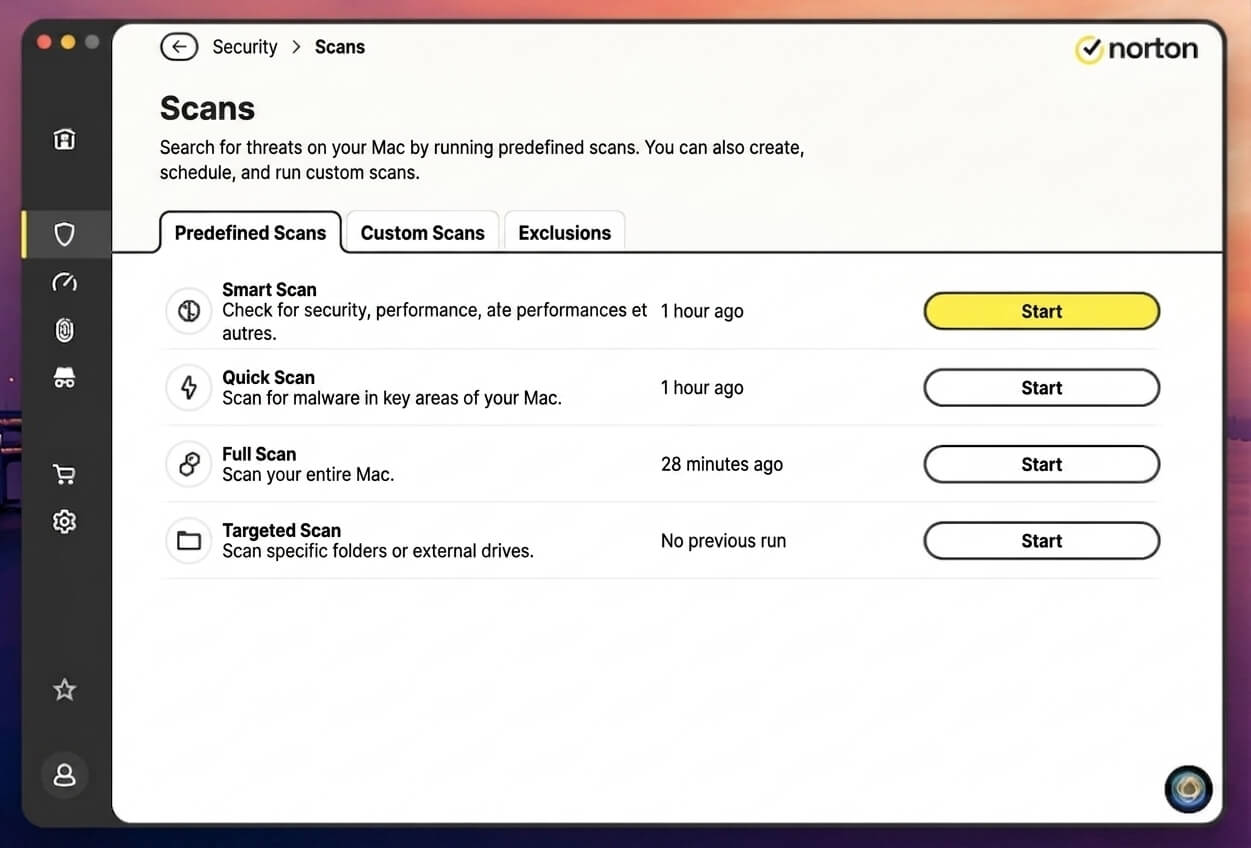
Norton is the pick when one subscription covers a Mac, an iPhone, and a Windows laptop. It blocked more phishing pages than anything else, scanned the fastest, and keeps a firewall where rivals don’t. It also uses the most of the machine.
Pros
- 95% phishing blocking, best measured
- Fastest full scan at 10:33
- Full firewall retained on macOS
- 6/6/6 at AV-TEST March 2026
- One license covers Mac, iPhone, PC
Cons
- 432 MB at idle, heaviest here
- 7% battery share, joint worst
- Deluxe renews at $124.99
Rating: 4.7/5 ⭐ Suits mixed households and heavy link-clickers.
What You Get With Norton on macOS
- macOS Version Support: High Sierra 10.13.x or later.
- Native Apple Silicon Build: Yes.
- Devices: 1 to 25 per plan.
- Features: Real-time protection, Safe Web, a full Smart Firewall, unlimited Secure VPN, dark web monitoring, password manager, and Norton Family. Cloud backup is Windows-only.
- Free Tier: No free tier.
- Trial and Price: 7 days, with a cross-platform license across Mac, iOS, Android, and Windows. From $29.99 for the first year, or $49.99 for 360 Deluxe across 5 devices.
Norton Detection Results on macOS
AV-TEST scored Norton 360 26.3 at 6/6/6 in its March 2026 macOS round. AV-Comparatives’ June 2026 Mac test lists Norton AntiVirus Plus at 99.9% on Mac malware and 95% on unwanted applications. On the Air, it caught 99.7% of my malware set with 2 false alarms, blocked 97% of adware, and stopped 95% of phishing pages with nothing flagged wrongly, the highest phishing result.
Norton and Avast One returned identical figures on all three measures, since both belong to Gen Digital and share a detection core.
Norton Speed and System Impact on Apple Silicon
It produced the fastest scans I measured: 48 seconds for quick, 10 minutes 33 seconds for full. It also drew the most while working, peaking at 60% CPU and 711 MB, and left the largest idle footprint at 432 MB and 1.8% CPU. Boot went from 15 seconds to 23, and it took 7% of battery over the week, joint-highest. The speed is genuine, and so is the price the Air pays.
What the Mac Version of Norton Leaves Out
Norton’s Mac build is the closest match to its Windows one. 3 things are missing: Cloud Backup, the PC Tune-up and Startup Manager utilities, and SafeCam. Cloud Backup is the one worth arguing about, since Norton 360 Deluxe advertises 50 GB of storage a Mac-only subscriber can’t use. The other two matter less on macOS.
The firewall survives intact, which matters because two other suites drop or simplify theirs. Norton also asks for more macOS permissions than anything else: full disk access, network content filtering, background items, and location. Location feeds the Wi-Fi safety checker, and no other product here requests it.
Should You Install Norton on Your Mac?
Buy it if the subscription has to stretch across platforms, or if scam links are the worry. The Mac app is included with a standard Norton 360 subscription, so PC customers should install it here instead of buying twice.
2. Bitdefender Antivirus for Mac: Best All-Round Security Suite for Mac
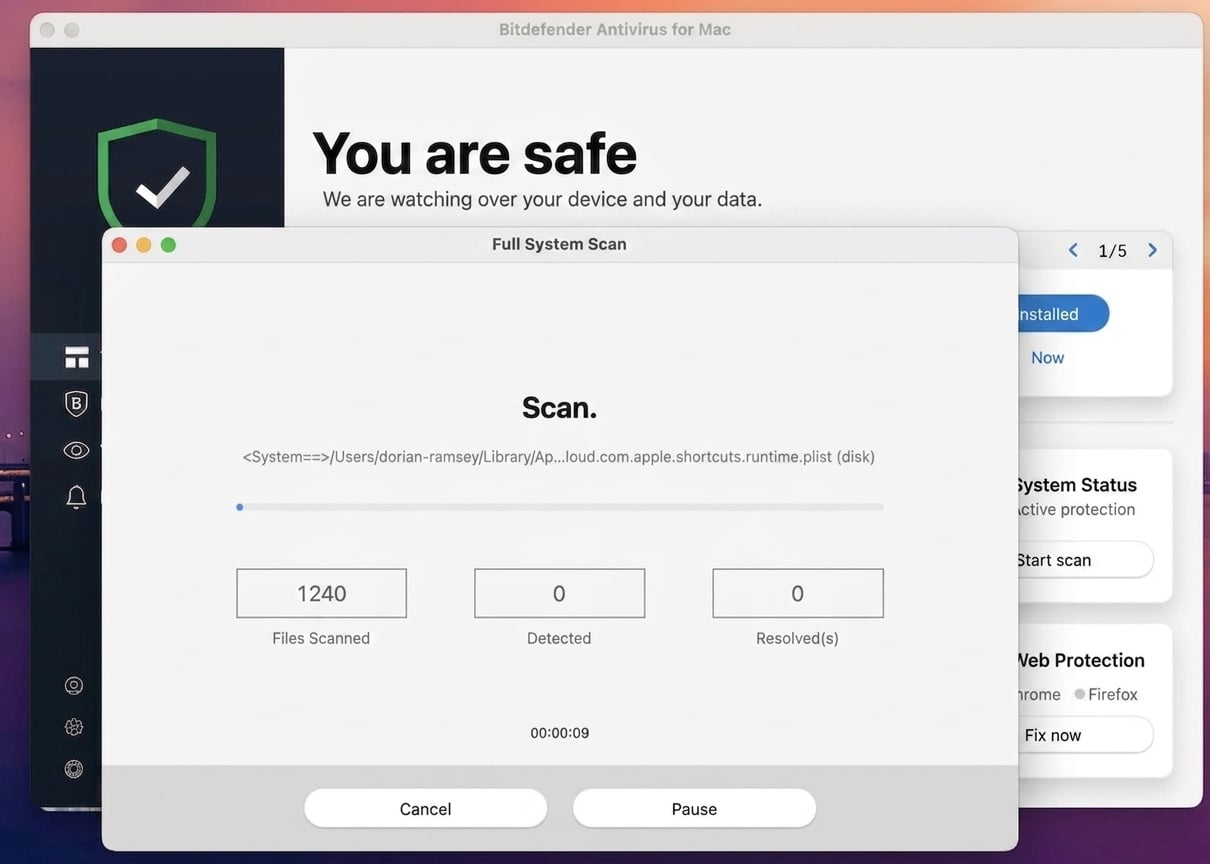
Bitdefender almost took the top slot on a narrow but consistent margin: most macOS malware caught, fewest false alarms, least added to startup time.
Pros
- 99.9% malware detection in testing
- Just 1 false alarm, best here
- Lightest boot cost of the suites
- Perfect 18/18 at AV-TEST
- Time Machine backup protection included
Cons
- 89% phishing, weakest measured
- No firewall in the Mac build
- VPN capped at 200 MB daily
Rating: 4.6/5 ⭐ Suits set-and-forget protection on an Apple Silicon Mac.
What You Get With Bitdefender on macOS
- macOS Version Support: Yosemite 10.10 or above.
- Native Apple Silicon Build: Yes.
- Devices: 1 to 25 per plan.
- Features: Real-time scanning, Safe Files, Time Machine backup protection, Web Protection, Anti-Tracker and adware removal.
- VPN: Capped at 200 MB per day per device on base plans, unlimited on Premium Security.
- Free Tier: No free tier on macOS.
- Trial and Price: 30 days. From $24.99 for the first year.
Bitdefender Detection Results on macOS
AV-TEST’s March 2026 macOS round scored Bitdefender Antivirus for Mac 10.3 a perfect 6/6/6. AV-Comparatives, in June 2026, recorded 99.0% against 1,500 Mac malware samples and 94% against unwanted applications. My results were: 99.9% of my macOS malware set blocked with 1 false alarm, the best figures on both counts. Adware was 95%, phishing 89% with no FP, the weakest phishing figure here.
Bitdefender Speed and System Impact on Apple Silicon
On an M1 Air with 8 GB, Bitdefender moved boot from 15 seconds to 20 and idled at 1.2% CPU and 328 MB. A quick scan finished in 57 seconds, a full scan in 12 minutes 45 seconds, peaking at 55% CPU and 689 MB. Across a week, it took 4% of battery consumption, joint-lowest among the scanners.
What the Mac Version of Bitdefender Leaves Out
The Mac build drops the two-way firewall and network threat prevention, which costs little, since macOS handles app-level network permissions itself. Safepay is the meaningful absence: Windows gets an isolated banking desktop; Mac gets the TrafficLight extension, which filters pages without isolating the session.
The Windows optimization set goes too: no vulnerability scanner, file shredder, Wi-Fi advisor, or cleanup tools. Against Windows’ ransomware rollback, macOS gets Safe Files plus Time Machine backup protection, arguably the better fit. The price is identical either way.
Should You Install Bitdefender on Your Mac?
Buy it if you want protection you configure once and forget. It caught the most, cried wolf the least, and cost the Air least in startup time and battery. Phishing is the soft spot, and it’s the only reason to consider alternatives below.
3. Avast One for Mac: Best Free Mac Antivirus
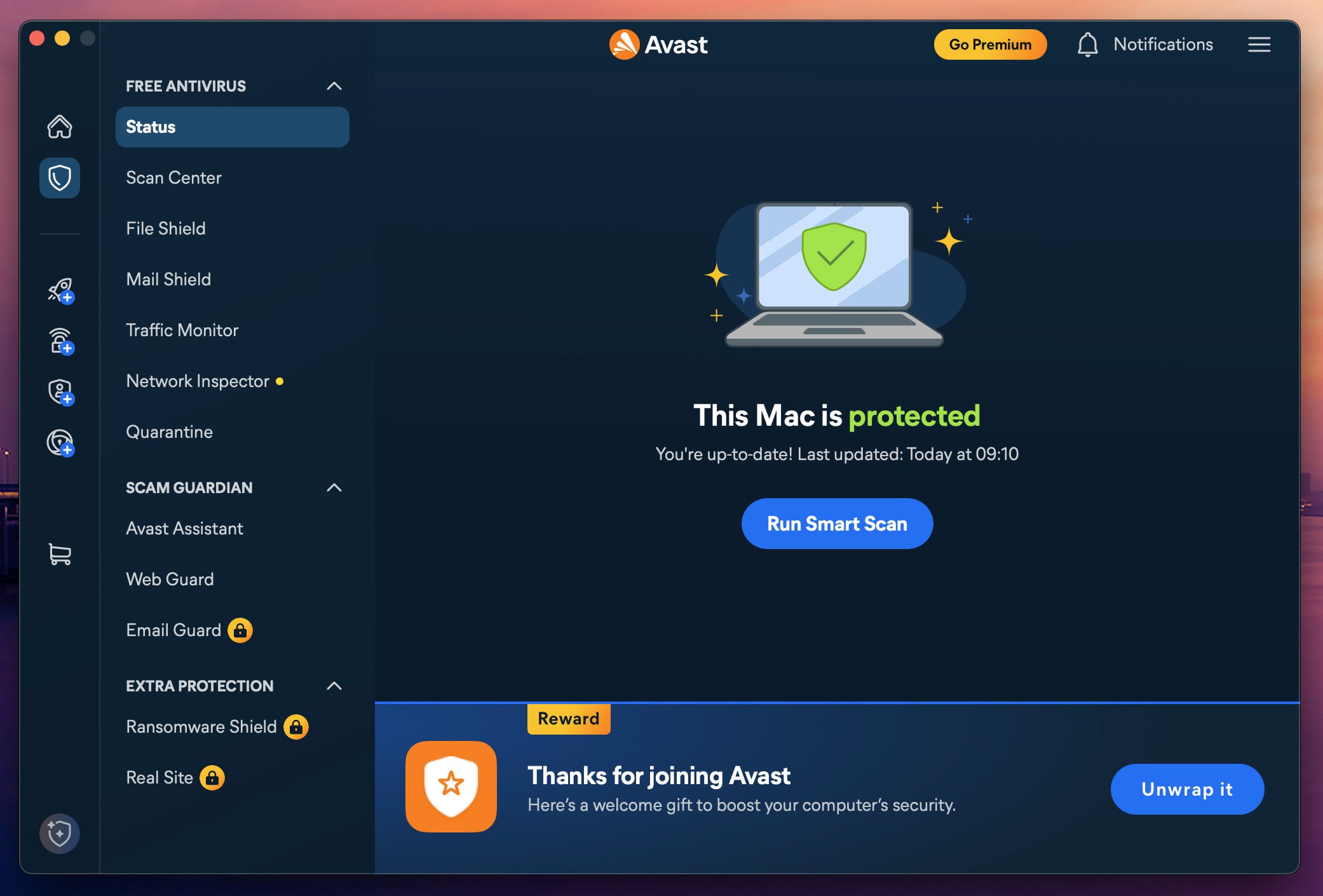
Avast One gives away what rivals charge for: real-time protection with no time limit and no card. It matched Norton exactly on detection and blocked more adware than any paid product below it. The catch is specific to macOS.
Pros
- 97% adware blocking, joint best
- Free tier includes real-time protection
- Perfect 6/6/6 at AV-TEST
- Only 2 false alarms recorded
- No device cap on free installs
Cons
- Ransomware Shield is paid on macOS
- 2024 FTC settlement over data selling
- Constant upgrade prompts after scans
Rating: 4.4/5 ⭐ Free cover for people who read the fine print.
What You Get With Avast One on macOS
- macOS Version Support: Mojave 10.14 or later.
- Native Apple Silicon Build: Yes.
- Devices: 1 device; paid covers 1 PC plus 1 mobile, or 10
- Features: File Shield, Mail Shield, Traffic Monitor, Network Inspector, Quarantine, Avast Assistant, and Web Guard.
- Premium Unlocks: Email Guard, Ransomware Shield, and Real Site. Cleanup, SecureLine VPN, BreachGuard, and Secure Browser cost extra.
- Price: Premium Security $49.99 for the first year, renewing at $77.99, with a 30-day money-back guarantee.
Avast One Detection Results on macOS
AV-Comparatives tested Avast One Free in June 2026 at 99.9% against Mac malware and 95% against unwanted applications. AV-TEST’s March 2026 macOS round covers a sibling build, Avast Security 16.3, at a perfect 6/6/6. My figures matched Norton’s to the decimal: 99.7% malware detection, 2 false alarms, 97% adware blocking. Phishing came at 93% with no FP.
Avast One Speed and System Impact on Apple Silicon
Boot went from 15 to 24 seconds, and idle held 301 MB and 1.4% CPU. A quick scan took 1 minute 3 seconds across 19,958 files; a full scan took 12 minutes 58 seconds, peaking at 51% CPU and 705 MB. Battery share was 6%.
What the Mac Version of Avast One Leaves Out
Most absences are defensible. Behavior Shield, CyberCapture, AutoSandbox, the advanced firewall, and the Inspector tools are all missing, and those are deep Windows-process monitors macOS restricts anyway. One difference is not defensible, and it matters because this is the free pick. Avast’s extra ransomware layer is free on Windows. On macOS, Ransomware Shield appears behind a padlock and needs a paid subscription, as do Real Site and Email Guard.
So the free Mac tier is thinner than the free Windows tier, and Avast’s comparison page won’t tell you, because it’s written around a Windows PC. Avast is also the most persistent about selling on this list. A Smart Scan that finds no malware ends on a “Core issues: Issues found” screen routing into the Cleanup Premium purchase, surrounded by a Go Premium button.
Should You Install Avast One on Your Mac?
Install the free tier for real-time protection. The ransomware layer costs extra. It’s the strongest free option by some margin. Pay only if Ransomware Shield and Real Site matter, since better-equipped suites compete at that price.
4. NordVPN Threat Protection Pro: Best for Web, Phishing and Download Protection
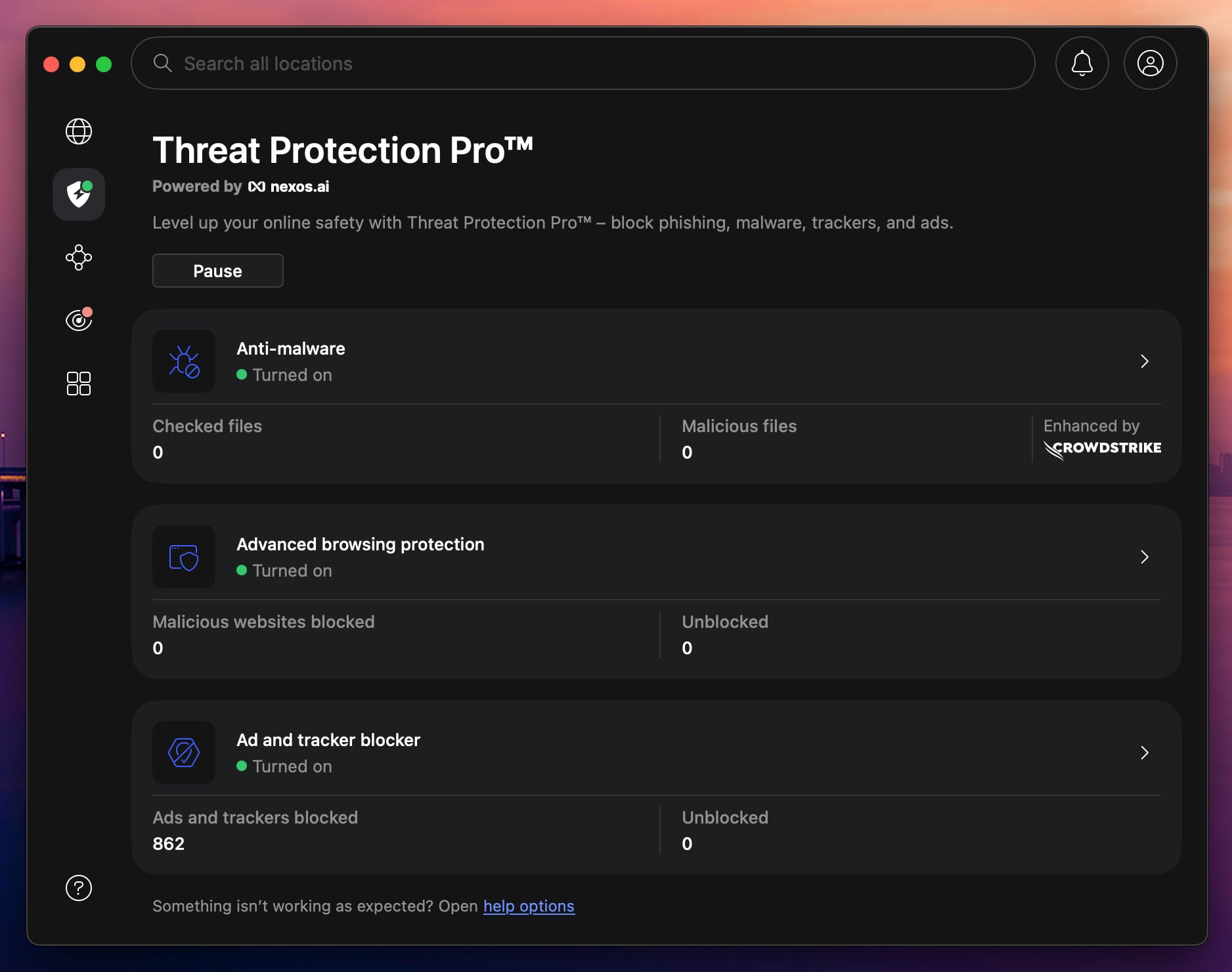
Threat Protection Pro is malicious-site, download, and tracker blocking inside a VPN. It’s not an antivirus program Mac owners can scan a disk with, and with no resident file scanner, it replaces nothing above. That matters less on a Mac, where most infections arrive through fake download pages and cracked-app sites, which is what this blocks.
Pros
- 95% phishing blocking, joint best
- 212 MB at idle, lightest here
- 3% battery share, lowest measured
- 14 web and scam tools included
Cons
- 93% malware detection, lowest here
- No on-demand system scan
- Needs the Complete plan
- No independent macOS lab results
Rating: 4.2/5 ⭐ A second layer for VPN subscribers, not a primary scanner.
What You Get With NordVPN on macOS
- macOS Version Support: macOS 12 (Monterey) or later.
- Native Apple Silicon Build: Yes.
- Devices: 10 devices.
- Features: The macOS feature set matches Windows exactly. Download-time malware scanner, vulnerability scanner, malicious website blocker, and DNS filtering. Scam and fraud alerts, email URL protection, search-result safety indicators, and crypto wallet address checking. Hijacked-session alerts, ad and tracker blocking, URL cleaning, and cookie banner hiding.
- Free Tier: No free tier.
- Trial: 3 days by signing up via Google Play.
- Price: Requires the Complete plan at $4.49 a month.
NordVPN Detection Results on macOS
Neither lab includes NordVPN in its macOS rounds, so the figures below are all mine. Against downloaded macOS malware, it blocked 93% with 4 false positives. That follows from the design: files are inspected as they download, so anything already on disk goes unexamined. Unwanted applications were also blocked at 93%.
Phishing earns it the slot, with 95% of my scam pages flagged and zero FP, matching Norton. Warnings appear as full-page interstitials.
NordVPN Speed and System Impact on Apple Silicon
Idle usage was 0.9% CPU and 212 MB, the lowest measured. Boot went from 15 to 18 seconds, and over a week it accounted for 3% of battery consumption. There are no scan durations, because there is no scan.
What the Mac Version of NordVPN Leaves Out
Nothing, which makes it the only product here with no Windows-versus-Mac gap. I checked the macOS build against the Windows one, and the feature set is identical. Threat Protection Pro isn’t in the entry-level Basic plan, which is VPN-only (read my NordVPN review for that one). It needs Complete at $4.49/mo, billed $121.23 for 27 months and renewing at $219.48 a year.
Should You Install NordVPN on Your Mac?
Take it if you were buying a VPN anyway. On its own, it doesn’t compete, since it can’t scan a disk or clean an infection. Alongside a resident scanner, it’s excellent, and it costs the Air almost nothing.
5. McAfee Total Protection for Mac: Best for Multi-Device Apple Households
McAfee’s argument is arithmetic. Most plans cover unlimited devices, so a household with three Macs, four iPhones, and an iPad pays once. Protection is solid, phishing blocking is good, and what it costs the machine is another matter.
Pros
- Unlimited devices on most plans
- 94% phishing blocking, third best
- Firewall included in the Mac build
- Web filtering across 3 browsers
Cons
- 7 false alarms, second worst
- 26-second boot, slowest here
- 14:55 full scan, slowest measured
- No independent macOS lab results
Rating: 3.9/5 ⭐ Built for families counting devices, not for a single older MacBook.
What You Get With McAfee on macOS
- macOS Version Support: macOS 13 (Ventura) or later.
- Native Apple Silicon Build: Yes.
- Devices: Unlimited devices on Premium and above.
- Features: Real-time and on-demand scanning, a macOS firewall, and Safe Browsing with WebAdvisor across Safari, Chrome, and Firefox. Scam Detector for texts and links, identity monitoring, unlimited VPN, and Personal Data Cleanup.
- Free Tier: No free tier.
- Trial and Price: 30 days. Premium: $49.99 for the first year, renewing at $149.99.
McAfee Detection Results on macOS
McAfee appears in neither macOS lab round, so the figures below are mine. It blocked 99.2% of my macOS malware set and 94% of unwanted apps. Phishing reached 94%, third-best here, but with 5 false positives, and malware testing produced 7 false alarms. That’s the second-highest count, and it repeats what McAfee scored on Windows, so it reads as a property of the malware detection engine.
McAfee Speed and System Impact on Apple Silicon
Boot went from 15 seconds to 26, the largest increase recorded, and idle usage was 2.4% CPU and 411 MB. A quick scan took 1 minute 14 seconds and a full scan 14 minutes 55 seconds, the slowest of the five scanners, peaking at 62% CPU and 734 MB. It took 7% of the battery over the week.
What the Mac Version of McAfee Leaves Out
Real-time and on-demand scanning are present on both platforms, the firewall exists on macOS in simplified form alongside macOS’s own network controls, and web filtering covers Safari, Chrome and Firefox, so there’s no browser penalty. The genuine gap is the depth, actually.
Windows gets an advanced two-way firewall with per-program traffic rules, while the Mac equivalent has far less to configure. Since the plans are unlimited-device by default, a Mac owner pays no Mac-specific premium, the fairest pricing story.
Should You Install McAfee on Your Mac?
Buy it if you’re covering a house full of Apple devices and the per-device math wins. Skip it on an 8 GB Air, where McAfee costs more startup time, memory, and battery, and the false-alarm count means checking quarantine more often.
6. Malwarebytes for Mac: Best On-Demand Cleaner for an Existing Infection
The Mac antivirus Malwarebytes sells is the name most Mac users know, and it earns that for one job: removing something already installed. I tested paid and free tiers, which is what most people install. It scans and removes on demand, keeps a scheduled monthly scan, and drops real-time protection after the 14-day trial. Paid adds that layer back, plus a firewall, a VPN, and identity monitoring.
Pros
- Best anti malware for Mac cleanup
- 388 MB scan peak, lightest measured
- Free scanning with no expiry
- Browser Guard extension costs nothing
- Monthly scheduled scan on the free tier
Cons
- 92% adware blocking, weakest here
- 8 false alarms, most recorded
- Real-time protection ends day 15
- No independent macOS lab results
Rating: 3.7/5 ⭐ A free second opinion, and a fuller suite if you pay.
What You Get With Malwarebytes on macOS
- macOS Version Support: macOS 11 (Big Sur) or later.
- Native Apple Silicon Build: Yes.
- Devices: 1 or 3 devices, depending on the plan.
- Free Features: On-demand scanning and removal with no expiry, plus a scheduled monthly scan. Browser Guard, the web protection extension, is also free. Installing grants a 14-day Premium trial, after which real-time protection stops.
- Scan Types: Quick Scan for common threat locations, Threat Scan for a full system pass and now the default, and Custom Scan for chosen folders or an external drive. Scheduled scans are available on both tiers.
- Paid Features: Real-time protection, a macOS firewall, a VPN, and Identity Theft Protection with dark web and social media alerts.
- Trial and Price: 14 days. Standard: $44.99 a year for 1 device, $59.99 for 3.
Malwarebytes Detection Results on macOS
Malwarebytes is absent from both macOS lab rounds, so there’s no third-party score to reference. It blocked 99.4% of the macOS malware I threw at it, but produced 8 false alarms, the highest count here. Unwanted app blocking came to 92%, the lowest, and phishing pages were caught at 89% with 5 FPs.
That 92% needs context, since potentially unwanted app removal is what Malwarebytes is known for. The measure tests real-time blocking, which isn’t this tool’s job. As an on-demand remover, it performed well in every removal test I ran. As a shield stopping adware, it’s the weakest here.
Malwarebytes Speed and System Impact on Apple Silicon
It was the second-fastest scanner and the most economical while working. A quick scan finished in 53 seconds, and a custom scan across the entire drive took 10 minutes 44 seconds, peaking at just 47% CPU and 388 MB, half what the heavier suites demanded. Idle usage was 1.3% CPU and 199 MB, the lowest of any scanner. Boot moved from 15 to 19 seconds, and it drew 4% of battery across the week.
What the Mac Version of Malwarebytes Leaves Out
Exploit Protection is Windows-only, with no equivalent on macOS, where the app folds malware, web, and adware protection into one layer. Apple’s own mitigations cover much of that ground through System Integrity Protection, hardened runtime, and app sandboxing, so the omission reflects the platform more than the product. The Mac build has narrowed the distance recently.
Malwarebytes launched a firewall for macOS, built on top of Apple’s own instead of replacing it, which simplifies managing incoming connections. A VPN and Identity Theft Protection with dark web and social media alerts are both available on paid plans. The scan engine was rebuilt for macOS as well, aimed at infostealers, persistent threats, and zero-day malware, the right target list for this platform.
Web protection comes through the Browser Guard extension, and that extension is free. Premium Security adds device-level web protection covering domain- and IP-based threats, which the extension alone doesn’t reach. The focus still differs sensibly: Windows chases trojans and ransomware at volume, while the Mac build targets infostealers, adware and unwanted apps.
Should You Install Malwarebytes on Your Mac?
Keep the free version installed as a second opinion. Searches for the best antivirus malware for Mac mean this. It coexists with any product above and gives you something to reach for when a Mac behaves oddly, and the free tier includes a monthly scheduled scan and the Browser Guard extension at no cost. Paid brings back real-time protection and adds a firewall, a VPN, and identity monitoring.
Mac Antivirus Compared: Detection, System Impact and Price
| Best for | AV-TEST macOS | Phishing (tested) | Impact on M1 | Free tier | Devices | From | Rating | |
|---|---|---|---|---|---|---|---|---|
| Norton 360 for Mac | All-round suite | 6/6/6 | 95% | +8s boot, 432 MB idle | No | 1 to 10 | $29.99/yr | 4.7⭐ |
| Bitdefender Antivirus for Mac | Overall | 6/6/6 | 89% | +5s boot, 328 MB idle | No | 1 to 25 | $24.99/yr | 4.6⭐ |
| Avast One for Mac | Free protection | 6/6/6* | 93% | +9s boot, 301 MB idle | Yes | 1 to 10 | Free | 4.4⭐ |
| NordVPN Threat Protection Pro | Web and phishing | Not tested | 95% | +3s boot, 212 MB idle | No | 10 | $4.49/mo | 4.2⭐ |
| McAfee Total Protection for Mac | Many devices | Not tested | 94% | +11s boot, 411 MB idle | No | Unlimited | $49.99/yr | 3.9⭐ |
| Malwarebytes for Mac | Existing infection | Not tested | 89% | +4s boot, 199 MB idle | Yes | 1 to 3 | Free | 3.7⭐ |
*AV-TEST’s March 2026 macOS round covers Avast Security 16.3. AV-Comparatives tested Avast One Free in June 2026 at 99.9% Mac malware protection.
The best antivirus software Mac buyers can get is Bitdefender, and the best AV for Mac by the same measure. The lightest Mac AV scanner to pair with something else is Malwarebytes Free. On any best Mac AV software comparison, read the renewal column twice, because first-year prices hide most of the cost.
How to Check for Malware on Mac and Remove It
Most people who want to check Mac for malware arrive here because something feels wrong. None of the steps below need a purchase. They’re written for macOS Sonoma 14.5, which is what I tested on. Item names shifted in later releases, and the Login Items pane was renamed, so expect small wording differences on a newer Mac.
Signs a Mac Is Infected
Every symptom here has innocent explanations too, so work through the list before you scan for viruses on Mac:
- Fans stay loud, or a fanless Air stays hot doing nothing
- Everything slows down for no obvious reason
- Your browser homepage or search engine changed by itself
- Pop-ups appear outside the browser, on the desktop
- Login items you don’t recognize
- Safari or Chrome extensions you never installed
- Network activity when nothing is open
- Warnings about certificates or configuration profiles
A slow Mac is usually a full disk or an aging battery. Two or three of these together is a different matter, and that’s the point to scan Mac for viruses.
Checking Activity Monitor and Login Items
Open Activity Monitor from Applications, Utilities. Sort by CPU and read the top of the list. Anything drawing steady CPU under a name you don’t know is worth investigating, though most odd-looking names are legitimate macOS processes. Search the exact process name before acting on it.
Next, open System Settings, General, Login Items. Sonoma splits this into “Open at Login” and “Allow in the Background”. The second list is where unwanted software hides, because most people never scroll to it. Anything from a developer you don’t recognize can be switched off safely, and switching it off deletes nothing. Do this before running any Mac virus scan.
It takes two minutes, needs no MacBook virus scan, and costs nothing to try before you reach for a virus scanner Mac vendors charge for.
Auditing Browser Extensions and Configuration Profiles
Mac adware persists in one of two places. A malicious browser extension survives most cleanups, which is why no malware scanner for Mac catches everything alone. Extensions come first.
In Safari, open Safari, Settings, Extensions. In Chrome, type chrome://extensions, and in Firefox, use about:addons. Remove anything you didn’t install, particularly anything calling itself a search enhancer, coupon finder, or download helper. Configuration profiles come second and matter more. A profile can force your search engine, homepage, and DNS settings, and it survives most cleanups.
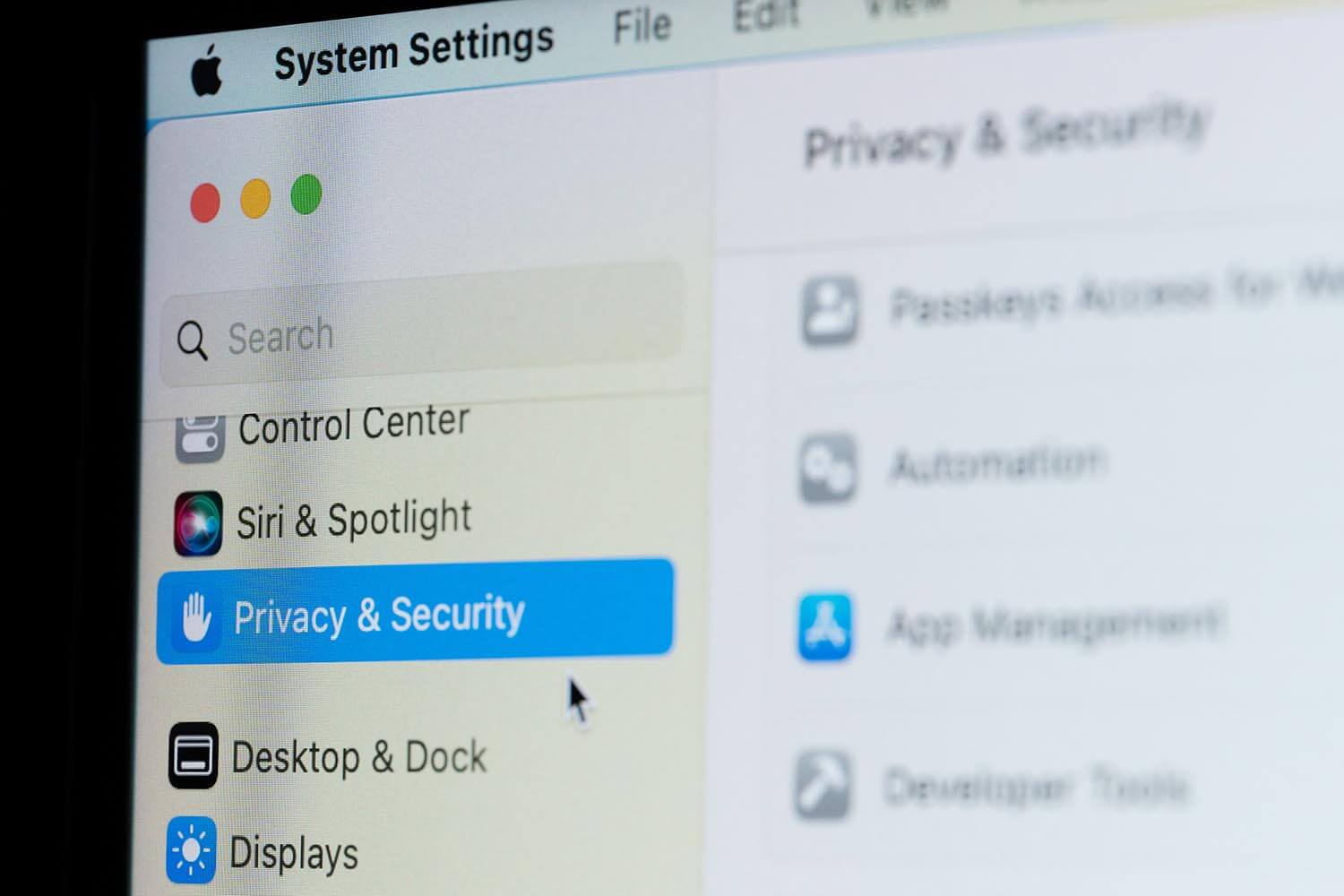
Open System Settings, Privacy & Security, and scroll to Profiles. No Profiles entry means none are installed. If it’s there, remove any profile you didn’t add yourself or receive from an employer.
Running a Malware Scan on a Mac
XProtect Remediator already scans on a schedule and removes what it recognizes, so a Mac with no third-party software is not unscanned. It just never says when it works, which is why so many people go looking for the best virus scanner for Mac. For a manual check, any tool above will do.
A quick virus scan for Mac takes under a minute and covers the locations malware normally occupies, and a deeper virus scan on Mac covers the rest. A full scan across the whole drive took between 10 and 15 minutes on my test machine. Malwarebytes Free is the easiest one-off virus scan Mac owners can run, since it costs nothing and needs no subscription.
Understand what a clean result proves. No known threat was found in the locations scanned. Any Mac malware scanner works from signatures and behavior patterns, as does every Mac virus scanner sold standalone, so a brand-new infostealer variant can pass. If symptoms continue, keep going.
Removing Mac Malware and Adware Step by Step
This is how to get rid of virus on Mac without specialist tools. Work in this order, and stop at any point if you’re unsure:
- Force Quit the suspicious process in Activity Monitor
- Disable its entry in Login Items and Background Items
- Drag the application to the Trash, then empty it
- Check ~/Library/LaunchAgents, /Library/LaunchAgents, and /Library/LaunchDaemons for launch agent and launch daemon .plist files matching the app’s name, and move those to the Trash
- Remove any configuration profile the software installed
- Reset the browser: clear extensions, restore the homepage and search engine, clear the cache
- Empty the antivirus quarantine once nothing legitimate is in it
- Restart and re-check Activity Monitor
One warning about step 4. Those folders hold legitimate entries for software you use. Only remove files whose names clearly match what you’re deleting, and never touch anything in /System.
When a Clean Install Is the Right Call
Reinstalling macOS is the answer in three situations.
- Symptoms return after removal.
- Files you can’t account for reappear after a restart.
- The Mac was compromised while holding data you can’t risk.
Back up documents and photos individually. A full system image brings the problem back with it. Reinstall macOS, restore your files, then reinstall all applications from their original sources.
What to Do After the Mac Is Clean
Removal is only half of it, because an infostealer’s purpose was to take credentials before you noticed. Scan Mac for malware again in a week, once things have settled. Change passwords for email, banking, and anything holding payment details, from a different device if you have one. Revoke app-specific passwords and active sessions in your Apple Account, and check appleid.apple.com for logins you don’t recognize.
Review your subscriptions, since scareware often leaves one behind. Then switch on FileVault in System Settings, Privacy & Security.
Free Antivirus Options for Mac
What Free Mac Antivirus Actually Includes
Free anti virus for Mac is not the compromise it once was. The detection engine in a free antivirus app Mac owners install is identical to the paid one. What gets removed is the layer around it: the ransomware shield, web/DNS protection, email scanning, VPN, support, and multi-device coverage.
On macOS, some of these differ from the Windows equivalents of the same product, so a feature that’s free on a PC can cost money on a Mac. Detection quality is rarely what you’re paying for.
Best Free Mac Antivirus Right Now
Avast One for Mac is the pick. Its free tier includes real-time file scanning, mail shielding, network inspection, and web filtering, with no time limit and no card. My testing tied it with a paid Norton subscription on malware and adware detection, because both use the same engine. The zero-install option deserves naming too: XProtect plus Gatekeeper, already on the machine.
Malwarebytes Free fills a different role among free antivirus Mac downloads. Real-time protection ends after 14 days, but on-demand scanning and removal continue with no expiry; a monthly scheduled scan stays active, and the Browser Guard extension is free to keep. Running Avast One resident and keeping Malwarebytes for second opinions works well.
Fake and Shady Mac Cleaner Apps to Avoid
Mac owners get targeted by scareware cleaners, and the pattern is consistent. It opens with an unsolicited scan, launched by a web page or a pop-up. The result is alarming and vague: hundreds of “problems”, “junk files,” or “privacy issues”, none of them explained. Then comes pressure to pay immediately, with a countdown, and a subscription that auto-renews at a higher price and resists cancellation.
Before installing any Mac security software, check this out. Is there a real company behind it with a physical address? Has AV-TEST or AV-Comparatives tested the product? Is the renewal price stated before checkout? Did you go looking for it, or did it find you? A tool that arrives by pop-up has already told you what it is.
Antivirus for MacBook Air, MacBook Pro and Apple Silicon
A full scan on a desktop costs time. On a MacBook Air it costs battery, and on the fanless models it costs thermal headroom. The questions do I need antivirus for MacBook Air, and do MacBooks need antivirus software share a threat answer with every other Mac, and a different cost answer. My battery figures come from a week of ordinary use on an M1 Air with 91% battery health across 648 cycles.
Measured as a share of total consumption: NordVPN 3%, Bitdefender and Malwarebytes 4% each, Avast One 6%, Norton and McAfee 7% each. Small in absolute terms, but consistent, and over a working day the gap between lightest and heaviest shows on an older battery. Thermals matter on the Air because there’s no fan to move heat. The chassis warmed in every full scan, but nothing throttled.
Memory was the bigger question on an 8 GB machine, and it resolved well. Scan peaks were 734 MB, and macOS never swapped to disk. That answers the most common worry about MacBook antivirus protection on a base-configuration Air. All have native builds covering M1 through M4. Scheduling still helps: set full scans for a time the laptop is plugged in, and let quick scans handle the day-to-day.
For MacBook virus protection, Norton is the #1. It was a bit resource-heavy at some points, but it’s the fastest scanner and very efficient overall. That combination is what best Mac virus protection means on a laptop.
Beyond Malware: What Mac Security Software Also Covers
Judging Mac antivirus by detection percentages alone misses where the money goes. The best virus protection for Mac is rarely the product with the highest number, because on macOS the layers below prevent more damage than the file scanner does.
- Phishing and scam-link blocking. The most common way a Mac user loses money involves no malware. A convincing fake login page collects the credentials. This is why the phishing spread matters more than the malware spread: 6 points separate 95% from 89%, a far larger practical gap than 99.9% against 99.2%.
- Adware and hijacker removal. The most common Mac infection. Slow browsing, redirected searches, and injected ads all come from this category, and Apple’s own tools address it least.
- Ransomware protection. Rarer on macOS than on Windows. The products here approach it through Time Machine snapshot protection and protected folders instead of file rollback.
- VPN on public Wi-Fi. Useful on a laptop that leaves the house. Bitdefender allows 200 MB a day on base plans, while Norton, McAfee, and NordVPN have no data cap, so they’re a lot more useful.
- Password managers and breach monitoring. Included with most suites here. Since infostealers target Keychain contents and browser-saved passwords, a manager behind a strong master password limits what an infection can take.
- FileVault. Free, built into macOS, and underused. It encrypts the whole drive so a stolen laptop yields nothing. No paid product replaces it.
How the Mac Antivirus Tools Were Tested
Test Machine and Baseline
A MacBook Air M1 from 2020: Apple M1 chip, 8 GB of memory, macOS Sonoma 14.5, battery health 91% across 648 cycles. Every product went onto the same machine and came off fully before the next. The clean baseline was 15 seconds to a usable desktop with nothing installed. Paid plans were used for every product with a paid tier, so free and premium builds are not mixed in the results.
How Detection Was Measured
Malware and adware samples came from live macOS campaigns and were handled in an isolated environment. Each product faced the same set, with detection recorded at download, on execution, and at the URL. Phishing pages were tested separately using a set of live scam URLs. False alarms were counted against known-good files and legitimate sites.
How Performance Was Measured
Boot time was measured to a usable desktop. Idle CPU, memory, and disk figures came from Activity Monitor after the system settled. Scan durations cover each product’s quick scan and its full-volume scan. Peak CPU and memory were recorded during full scans, with memory pressure watched for swap activity. Battery was measured as each app’s share of total consumption across a week of normal use.
The Mac Feature Audit and Lab Sources
Each macOS app was compared against its Windows equivalent using vendor documentation and the installed apps, with every claimed absence checked in the Mac interface. Where a feature was missing, I looked at whether macOS already covers that ground or whether the buyer gets less for the same price. The AV-TEST macOS round used here is March 2026. The AV-Comparatives Mac Security Test is June 2026.
Try Norton: Best Antivirus for Mac
Common Questions About Mac Antivirus
👾 Do Macs Need Antivirus Software?
No, not most of them. A Mac used for browsing, email, and App Store apps is covered by XProtect, Gatekeeper and System Integrity Protection. The answer flips for Macs that install software from outside the App Store, share files with Windows computers, hold client records, or pass between several people.
🦠 Can Mac Computers Get Viruses?
Yes, though the word misleads. People asking do Mac computers get viruses are seeing something else: infostealer malware harvesting passwords and crypto wallets, adware hijacking browser searches, and social-engineering scams. Self-replicating viruses barely exist on macOS.
✅ What Antivirus Does Apple Recommend?
Apple recommends none. It endorses no third-party security product, including its own protection in macOS instead: XProtect for signature scanning, XProtect Remediator for scheduled removal, Gatekeeper for verifying downloads. Apple's position is that this plus App Store distribution covers most users.
🔎 How to Check for Malware on Mac?
Three checks come before any scan. Activity Monitor reveals unfamiliar processes drawing CPU. System Settings, General, Login Items shows what launches at startup. System Settings, Privacy & Security, Profiles exposes configuration profiles, where adware commonly persists.
💻 What Is the Best Antivirus for a MacBook Air?
Norton 360 for Mac, also the best antivirus software for Mac overall. On an M1 Air, it added 8 seconds to startup, held 432 MB at idle, and took 7% of the battery over a week, one of the best results in testing.
🆓 Is Free Mac Antivirus Good Enough?
Stay free if the Mac handles browsing, email, and App Store software and its owner checks things manually. Pay if the machine holds client data, gets shared, receives files from Windows computers, or belongs to a fast clicker.
✨ Is Malwarebytes Good for Mac?
Yes, for cleaning up an existing infection, less so as permanent protection. Malwarebytes antivirus for Mac excels at finding and removing adware and infostealers already on a drive. As a resident shield, it was the weakest tested, blocking the least adware and flagging the most clean files. The free version drops real-time protection after 14 days, keeping on-demand scans, a monthly scheduled scan, and the free Browser Guard extension.
🐌 Does Mac Antivirus Slow Down Your Computer?
Measurably, but by less than most people expect. On an M1 Air, boot time rose by 3 to 11 seconds depending on the product, and idle memory ranged from 199 MB to 432 MB. Bitdefender was the lightest suite, McAfee the heaviest. No product forced macOS to swap memory to disk.
🛡️ What Is XProtect and Is It Enough?
XProtect is Apple's built-in malware scanner, checking files against Apple's signature list whenever an application launches or changes. XProtect Remediator extends it by removing known infections on a schedule. It's enough for App Store-only usage. It falls short on adware, phishing pages, Windows malware, and anything newer than Apple's latest signature update.
🔰 How Do You Get Rid of a Virus on a Mac Without Reinstalling macOS?
Most Mac infections come off without touching the operating system. The sequence is browser extensions first, then configuration profiles in Privacy & Security, then Login Items, then the app itself and any matching launch agents.
🆚 Is the Mac Version of an Antivirus the Same as the Windows Version?
Usually no, and the gap is rarely advertised. Bitdefender's Mac build has no firewall and no Safepay. Norton's omits Cloud Backup, tune-up tools, and SafeCam. Avast One puts its ransomware layer behind a paywall on macOS while giving it away free on Windows. Malwarebytes drops Exploit Protection and Deep Scan.
🎁 Is Mac Antivirus Included With a Windows Subscription?
Usually yes, and people pay twice constantly. A Norton 360 subscription covers Mac, iOS, and Android alongside Windows within its device limit, and Bitdefender, Avast One, and McAfee licenses work the same way. Check the device count on an existing subscription first. There is often an unused slot already paid for.