A VPS gives you a slice of a physical server with CPU, RAM and storage reserved for you, which makes it faster and more flexible than shared hosting and much cheaper than a dedicated machine. Recommended VPS hosting comes in two kinds: self-managed plans, where you run the server yourself, and managed plans, where the host takes care of updates, security and troubleshooting.
We compared five hosts on price, renewal cost, RAM, root access and support, and we looked at both kinds of plan. The shortlist comes first, and the tables and reviews that follow show how much you pay now and after the first term.
5 Best VPS Hosting in 2026 Ranked
- Hostinger: Best VPS Hosting Overall
- InMotion Hosting: Best for Customer Support
- Hosting.com: Best Scalable VPS
- DreamHost: Best VPS for WordPress
- HostGator: Best for AI and Developer Tools
VPS Hosting Compared
The table compares a self-managed plan with 8 GB of RAM at each host, along with the price you pay after the first term. The promo terms differ, so read the price as a guide to the best VPS host for your budget rather than an exact match.
| Host | Plan | vCPU | RAM | NVMe storage | Price per month | Renews at | Promo term |
|---|---|---|---|---|---|---|---|
| Hostinger | KVM 2 | 2 | 8 GB | 100 GB | $8.99 | $14.99 | Billed upfront |
| InMotion Hosting | VPS 4 vCPU | 4 | 8 GB | 160 GB | $13.99 | $26.99 | 24 months |
| Hosting.com | Self Managed Linux 8GB | 4 | 8 GB | 160 GB | $9.99 | $29 | 3 years |
| DreamHost | Stack 8 | 2 | 8 GB | 150 GB | $9.49 | $14.99 | 2 years |
| HostGator | Snappy 4000 NVMe 8 | 4 | 8 GB | 200 GB | $8.36 | $18.70 | Promo price as shown |
HostGator and InMotion give you four vCPUs at this size, while Hostinger and DreamHost give you two. HostGator has the lowest promo price, and Hostinger and DreamHost have the smallest renewal increases.
What Is VPS Hosting?
A virtual private server, or VPS, is a virtual machine that runs on a physical server shared with other customers. Your plan has its own vCPUs, RAM and storage, so a neighbor’s traffic doesn’t slow your site down the way it can on shared hosting.
A VPS sits between shared hosting and a dedicated server. It costs more than shared hosting, gives you far more control, and costs a fraction of a dedicated machine, which is why it suits growing sites, online stores, developer projects and self-hosted apps.
Most VPS plans use KVM virtualization, which gives each server its own kernel and guaranteed resources. You can install the software you need, run several apps side by side and resize the plan as your project grows. The trade-off is that someone has to look after the server, which is why the managed and self-managed split matters so much.
Best VPS Hosting Reviewed for 2026
Here is what each host offers, what it costs and where it falls short.
1. Hostinger: Best VPS Hosting Overall
Pros
- AMD EPYC processors and NVMe storage on every plan
- Free weekly backups
- Web terminal with AI
- One-click apps, including n8n, OpenClaw and WordPress
- Free domain for the first year
- 30-day money-back guarantee
Cons
- Bandwidth is capped from 4 TB to 32 TB
- Renewals cost 1.7 to 2.2 times the promo price
- Weekly backups only
- No phone support
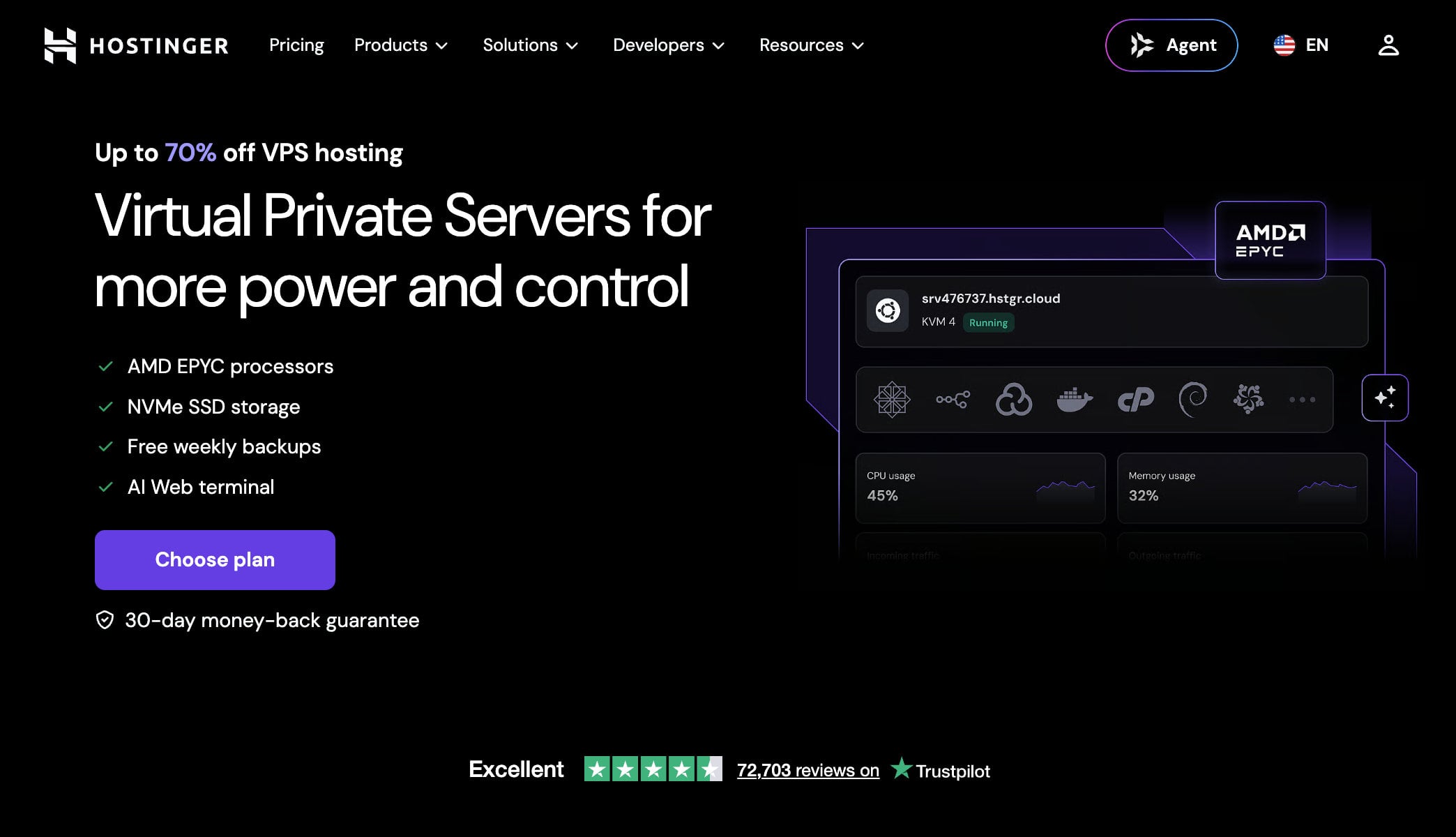
Hostinger gives you the best balance of price and tools among the VPS plans we compared in 2026. Every plan runs on AMD EPYC processors with NVMe SSD storage, and the range starts at $6.49 a month for 1 vCPU and 4 GB of RAM. Our Hostinger review covers the company in more detail.
Plans and Pricing
Hostinger has four KVM plans, and code GIZMODO takes another 10% off at checkout. The prices below are the promotional rates, and each plan is billed upfront for the term you choose.
| Plan | vCPU | RAM | NVMe storage | Bandwidth | Price per month | With code GIZMODO | Renews at |
|---|---|---|---|---|---|---|---|
| KVM 1 | 1 | 4 GB | 50 GB | 4 TB | $6.49 | $5.84 | $11.99/mo |
| KVM 2 (Most Popular) | 2 | 8 GB | 100 GB | 8 TB | $8.99 | $8.09 | $14.99/mo |
| KVM 4 | 4 | 16 GB | 200 GB | 16 TB | $12.99 | $11.69 | $28.99/mo |
| KVM 8 | 8 | 32 GB | 400 GB | 32 TB | $25.99 | $23.39 | $49.99/mo |
KVM 2 is the plan most people should pick: two vCPUs, 8 GB of RAM, 100 GB of NVMe storage and 8 TB of bandwidth for $8.99 a month ($8.09 with the code). KVM 1 works for a small site or a light app, while KVM 4 and KVM 8 suit busy sites and several apps on one server. The monthly rate on the page is the total price divided by the number of months, and the renewal price appears under each plan, so check both before you pay.
The bandwidth caps deserve a note. DreamHost and HostGator advertise unlimited bandwidth, while Hostinger limits each plan to between 4 TB and 32 TB. That is plenty for most sites and apps, but it matters if you stream video or move very large files.
Features and Performance
All plans include free weekly backups, firewall management, a 1 Gbps network, a public API and a free domain for the first year. Hostinger also states a 99.9% uptime guarantee, and the data centers span the world, so you can place the server close to your visitors.
The web terminal with AI is the feature that sets the plans apart for beginners. You can type what you want in plain language, and the assistant helps with server tasks such as configuring the firewall or installing software. Hostinger also presents the same plans as AI-managed VPS hosting, so this is the same product with a different pitch rather than a separate plan.
The one-click app library lists more than 1,000 applications, grouped under Popular, E-commerce and Automation. The popular tab includes n8n, which automates tasks across more than 400 apps without code, and OpenClaw, an AI personal assistant with multi-channel messaging. It also lists Hermes Agent, a self-improving AI agent, Paperclip, an AI orchestration platform, WordPress and Immich, a photo and video manager. If you want to run n8n, see our guide to the best n8n hosting.
Support and Guarantee
Hostinger backs every plan with a 30-day money-back guarantee, which gives you a month to check the performance with your own site or app. The plans are self-managed, so you handle the operating system and software yourself, with the AI terminal, the knowledge base and 24/7 live chat as help. Hostinger shows an Excellent Trustpilot rating based on 72,703 reviews.
2. InMotion Hosting: Best VPS for Customer Support
Pros
- Full root and SSH access on managed and self-managed plans
- 90-day money-back guarantee
- 99.99% uptime commitment
- Launch Assist setup and free migration on managed plans
- Choice of AlmaLinux, Debian or Ubuntu
- Snapshots on demand
Cons
- Self-managed renewals cost 1.9 to 2.7 times the promo price
- Self-managed support covers hardware and network only
- Premier Care is an optional upgrade
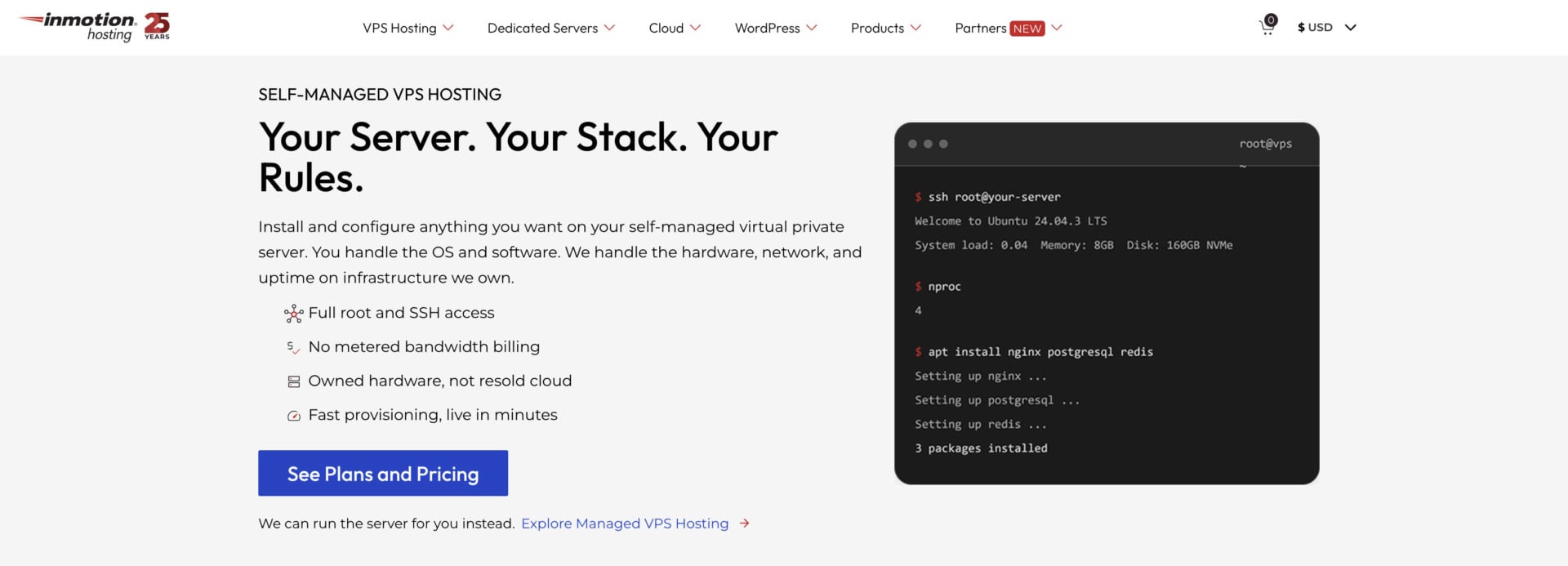
If you want a person to call when the server misbehaves, InMotion Hosting is the VPS host to look at. Its managed plans include Launch Assist, an onboarding service that sets up the server and migrates your site, and the page shows a 2025 customer service award from HostingAdvice.com. InMotion sells two VPS lines that run on the same hardware in the same data centers: a self-managed VPS, where you run the software, and a managed VPS, where InMotion runs the server for you.
Plans and Pricing
The self-managed line has four plans, and the prices below are for a 24-month term.
| Plan | vCPU | RAM | NVMe storage | Bandwidth | Price per month (24 months) | Renews at |
|---|---|---|---|---|---|---|
| VPS 4 vCPU | 4 | 8 GB | 160 GB | 5 TB | $13.99 | $26.99/mo |
| VPS 8 vCPU (Most Popular) | 8 | 16 GB | 260 GB | Unlimited | $21.99 | $56.99/mo |
| VPS 12 vCPU | 12 | 24 GB | 360 GB | Unlimited | $32.99 | $86.99/mo |
| VPS 16 vCPU | 16 | 32 GB | 460 GB | Unlimited | $44.99 | $121.99/mo |
The managed line uses the same four hardware sizes and adds cPanel and WHM, security patching, daily backups and human support.
| Plan | vCPU | RAM | NVMe storage | Bandwidth | Price per month (24 months) | Renews at |
|---|---|---|---|---|---|---|
| Managed VPS 4 vCPU | 4 | 8 GB | 160 GB | 5 TB | $43.49 | $56.49/mo |
| Managed VPS 8 vCPU (Most Popular) | 8 | 16 GB | 260 GB | Unlimited | $51.49 | $86.49/mo |
| Managed VPS 12 vCPU | 12 | 24 GB | 360 GB | Unlimited | $62.49 | $116.49/mo |
| Managed VPS 16 vCPU | 16 | 32 GB | 460 GB | Unlimited | $74.49 | $151.49/mo |
The VPS 8 vCPU plan, with 16 GB of RAM and unlimited bandwidth, is the one InMotion labels most popular, and it costs $21.99 a month self-managed or $51.49 managed. The renewal increases are steep on the self-managed plans, from 1.9 times on the 4 vCPU plan to 2.7 times on the 16 vCPU plan, and smaller on the managed plans, from 1.3 to 2.0 times.
Features and Performance
Every plan includes full root and SSH access, a 1 Gbps network, always-on DDoS protection and snapshots on demand, and InMotion promises 99.99% uptime. On the self-managed plans you can pick AlmaLinux, Debian or Ubuntu, or load your own operating system, and the servers are Docker-ready. You can add cPanel or CWP at any time if you want a control panel. InMotion says it owns its hardware rather than reselling cloud servers, and its data centers are spread around the world.
Support and Guarantee
The support difference between the two lines matters. On a managed VPS, InMotion’s human support team is available 24/7 for the server, the operating system, security patches and troubleshooting as well as the hardware and network. On a self-managed VPS, support covers only the hardware, the network and the data center, so you handle everything above that.
Premier Care is an optional upgrade for managed plans. It adds Advanced Product Support, Monarx malware protection and 300 GB of backup storage, and InMotion doesn’t show its price on the page. Both lines carry a 90-day money-back guarantee, and you can request a callback by phone.
Talk to InMotion About Managed VPS
3. Hosting.com: Best Scalable VPS
Pros
- Four sizes from 4 GB to 32 GB of RAM
- Turbo (NVMe and LiteSpeed) on all plans
- Managed and unmanaged options
- Free migration and free SSL
- 24/7/365 support
Cons
- Unmanaged renewals cost 2.7 to 2.9 times the promo price
- The best prices need a three-year term
- Managed plans renew at 2.5 times the promo price
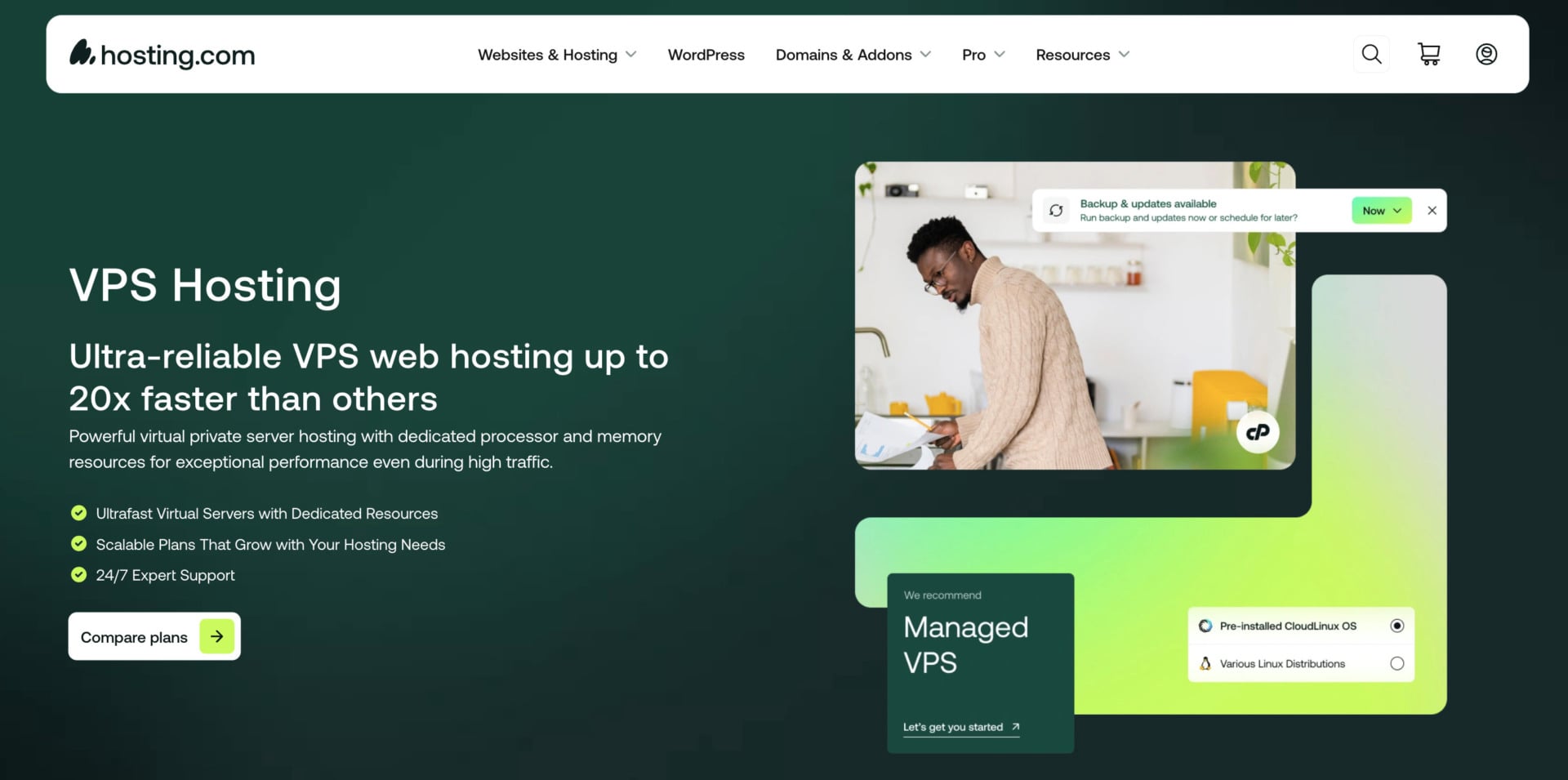
Hosting.com, the company that used to be A2 Hosting, is built for growth: you start with 4 GB of RAM and move up to 32 GB without changing hosts. Every plan includes Turbo, which combines NVMe storage with LiteSpeed, and your resources are isolated, so other customers don’t slow you down.
Plans and Pricing
The unmanaged plans are priced on a three-year term, and cPanel is optional.
| Plan | CPU cores | RAM | NVMe storage | Price per month (3 years) | Renews at |
|---|---|---|---|---|---|
| Self Managed Linux 4GB | 2 | 4 GB | 80 GB | $6.49 | $19/mo |
| Self Managed Linux 8GB (Most Popular) | 4 | 8 GB | 160 GB | $9.99 | $29/mo |
| Self Managed Linux 16GB | 8 | 16 GB | 320 GB | $17.99 | $49/mo |
| Self Managed Linux 32GB | 16 | 32 GB | 640 GB | $36.99 | $99/mo |
The 8 GB plan is the one Hosting.com labels most popular, and at $9.99 a month it gives you four cores and 160 GB of NVMe storage. The catch is the renewal price, because the plans renew at $19, $29, $49 and $99 a month, which is about 2.7 to 2.9 times the promo price.
The managed plans cost more, and their prices below are for a one-year term. Each one includes a managed server, one dedicated IP, SSL and cPanel Solo, and they renew at 2.5 times the promo price.
| Plan | CPU cores | RAM | NVMe storage | Price per month (1 year) | Renews at |
|---|---|---|---|---|---|
| Managed cPanel 4GB | 2 | 4 GB | 100 GB | $23.20 | $58/mo |
| Managed Server 8GB | 4 | 8 GB | 150 GB | $36 | $90/mo |
| Managed Server 16GB (Most Popular) | 8 | 16 GB | 300 GB | $56 | $140/mo |
| Managed Server 32GB | 16 | 32 GB | 400 GB | $92 | $230/mo |
Features and Performance
Hosting.com’s VPS plans are aimed at developers and site owners who want speed. Turbo pairs NVMe storage with LiteSpeed, and the plans support PHP, Node.js and other popular software, with deployment through Git, SSH or FTPS. The company states a 99.9% uptime commitment and offers free Let’s Encrypt SSL certificates.
The managed plan includes cPanel, which gives non-technical users an interface for managing the server, and the unmanaged plan gives developers the command line and complete control over operating system updates and patches. On the unmanaged plans you also choose from several Linux distributions.
Support and Guarantee
Support runs 24/7/365, and Hosting.com moves your site for free. It also offers a zero-downtime migration plan on request, which helps when you move a live site. Hosting.com suits people who want a scalable VPS and are ready to plan for the renewal price.
4. DreamHost: Best VPS for WordPress
Pros
- Managed VPS with unlimited websites, daily backups and free SSL
- Unlimited email and a free domain for the first year on managed plans
- Stack plans with full root access, Docker and KVM
- Unmetered bandwidth on every plan
- Auto-Boost RAM protection on managed plans
- Trustpilot rating of 4.6 out of 5
Cons
- The managed VPS has no root or sudo access
- Managed renewals cost 1.9 to 2.5 times the promo price
- The monthly promo lasts only three months
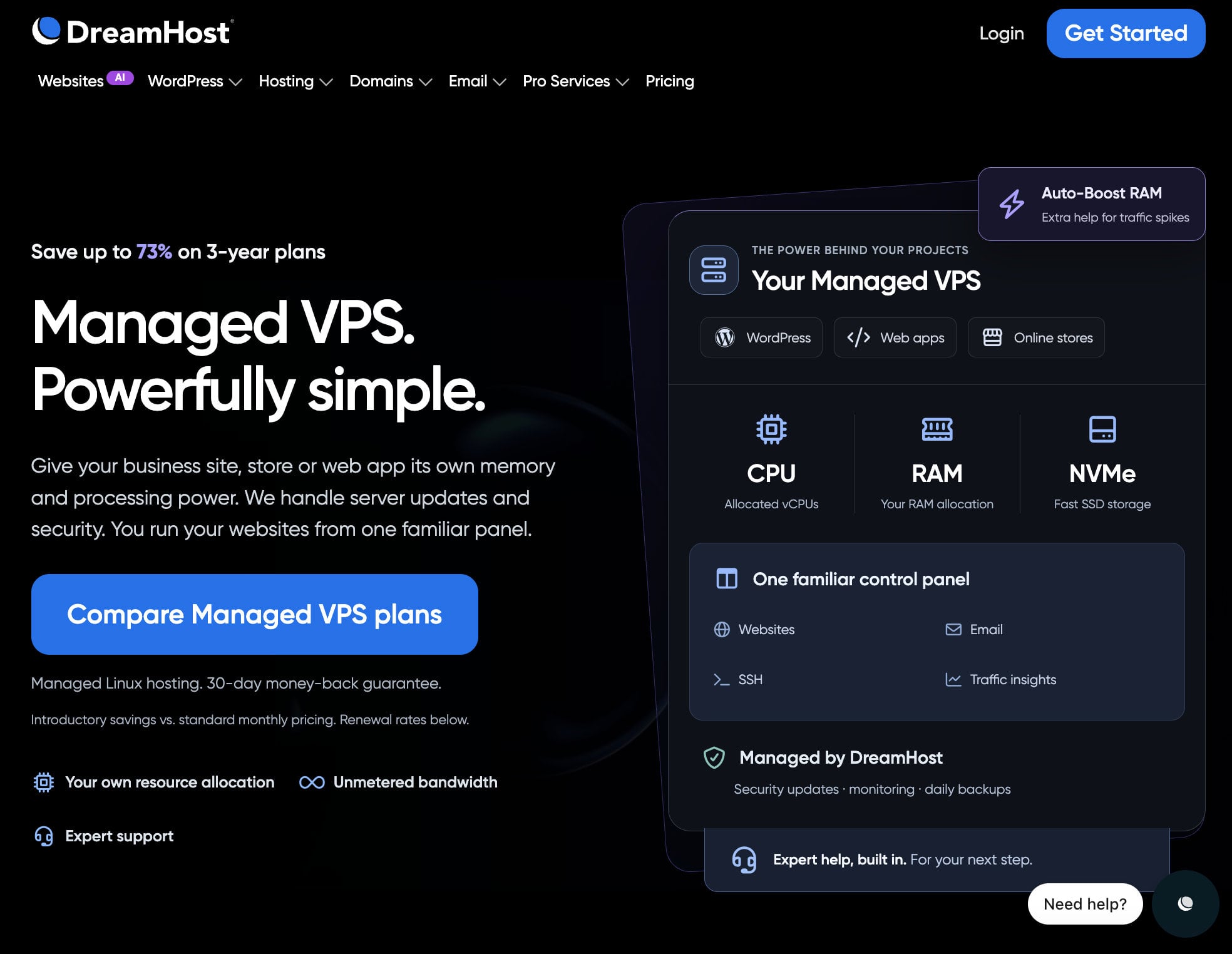
DreamHost sells two VPS products that look alike and behave very differently. Managed VPS looks after the server software for you and gives you SSH access without root or sudo, while the Stack plans are self-managed with full root access, Docker and KVM, and a one-click app library.
Plans and Pricing
The managed VPS is the WordPress-friendly option. DreamHost maintains the server software and security, so you manage your content, applications and site settings. The prices below are for a three-year term.
| Plan | Cores | RAM | NVMe storage | Price per month (3 years) | Renews at |
|---|---|---|---|---|---|
| Managed VPS Business | 2 | 2 GB | 60 GB | $10 | $24.99/mo |
| Managed VPS Professional (Most Popular) | 2 | 4 GB | 120 GB | $20 | $46.99/mo |
| Managed VPS Enterprise | 4 | 8 GB | 240 GB | $40 | $92.99/mo |
| Managed VPS Premier | 6 | 12 GB | 360 GB | $60 | $114.99/mo |
The Professional plan, with 4 GB of RAM, is the one DreamHost labels most popular. Every plan includes unlimited websites, unmetered bandwidth, daily backups, automated performance scans, free SSL and unlimited email on your domain, and the domain is free for the first year on the three-year term. DreamHost also offers monthly billing at $15, $30, $60 and $90 for the first month, which renews at $37.99, $69.99, $137.99 and $169.99.
The Stack plans are the self-managed option, and they give you AMD EPYC processors, full root access, a choice of Linux distributions and a one-click app library.
| Plan | vCPU | RAM | NVMe storage | Price per month (2 years) | Renews at | First 3 months on monthly billing |
|---|---|---|---|---|---|---|
| Stack 4 | 2 | 4 GB | 75 GB | $5.99 | $10.99/mo | $8.99 |
| Stack 8 | 2 | 8 GB | 150 GB | $9.49 | $14.99/mo | $13.99 |
| Stack 16 (Most Popular) | 4 | 16 GB | 250 GB | $15.49 | $23.49/mo | $22.99 |
| Stack 32 | 8 | 32 GB | 450 GB | $30.99 | $39.99/mo | $45.99 |
See DreamHost Managed VPS plans
Features and Performance
Auto-Boost RAM protection adds memory temporarily during spikes on the managed plans, and DreamHost shows resource graphs and alerts. It is a safety net rather than a replacement for a bigger plan, because persistent high usage still means you need to optimize or upgrade. The bandwidth is unmetered, with no per-GB fees, but fair-use and resource policies still apply, and your site stays within the CPU, memory and storage limits of the plan.
Managed VPS runs Ubuntu, and Windows isn’t available. If you need root access to control the operating system or install software that requires it, choose a Stack plan instead.
Support and Guarantee
DreamHost provides 24/7 support and a 30-day money-back guarantee on the managed VPS, and it shows a Trustpilot rating of 4.6 out of 5 from 8,222 reviews. DreamHost is a comfortable choice for WordPress owners who want the server handled for them, and the Stack plans give developers a cheaper route with more control.
5. HostGator: Best for AI and Developer Tools
Pros
- Claude Code preinstalled on every self-managed plan
- One-click apps such as n8n, OpenClaw, Ollama and Open WebUI
- Low entry prices with DDR5 RAM and AMD EPYC processors
- Unlimited bandwidth and full root SSH access
- Managed plans with 10 Gbps connectivity and a Tier 3 data center
- 30-day money-back guarantee
Cons
- Self-managed renewals cost about 2.2 times the promo price
- cPanel and priority support aren’t included on self-managed plans
- Managed plans start at $49.99 a month
HostGator has rebuilt its self-managed VPS around AI and developer tools. Claude Code, an agentic coding tool, comes preinstalled on every plan and is ready when you connect over SSH, and the one-click library covers n8n, OpenClaw, Hermes Agent, Ollama, Open WebUI and more.
Plans and Pricing
HostGator’s self-managed VPS has four plans, and the prices below are the promotional rates shown on the page.
| Plan | vCPU | RAM | NVMe storage | Promo price per month | Renews at |
|---|---|---|---|---|---|
| Snappy 1000 NVMe 2 | 1 | 2 GB DDR5 | 50 GB | $2.64 | $4.95/mo |
| Snappy 2000 NVMe 4 | 2 | 4 GB DDR5 | 100 GB | $4.18 | $9.35/mo |
| Snappy 4000 NVMe 8 (Recommended) | 4 | 8 GB DDR5 | 200 GB | $8.36 | $18.70/mo |
| Snappy 8000 NVMe 16 | 8 | 16 GB DDR5 | 450 GB | $17.67 | $39.53/mo |
Snappy 4000, with 4 vCPUs, 8 GB of DDR5 RAM and 200 GB of NVMe storage, is the plan HostGator recommends, and at $8.36 a month it has the lowest 8 GB promo price in this guide. Every plan includes bandwidth without overage fees, one dedicated IP and free migration, but the plans renew at about 2.2 times the promo price.
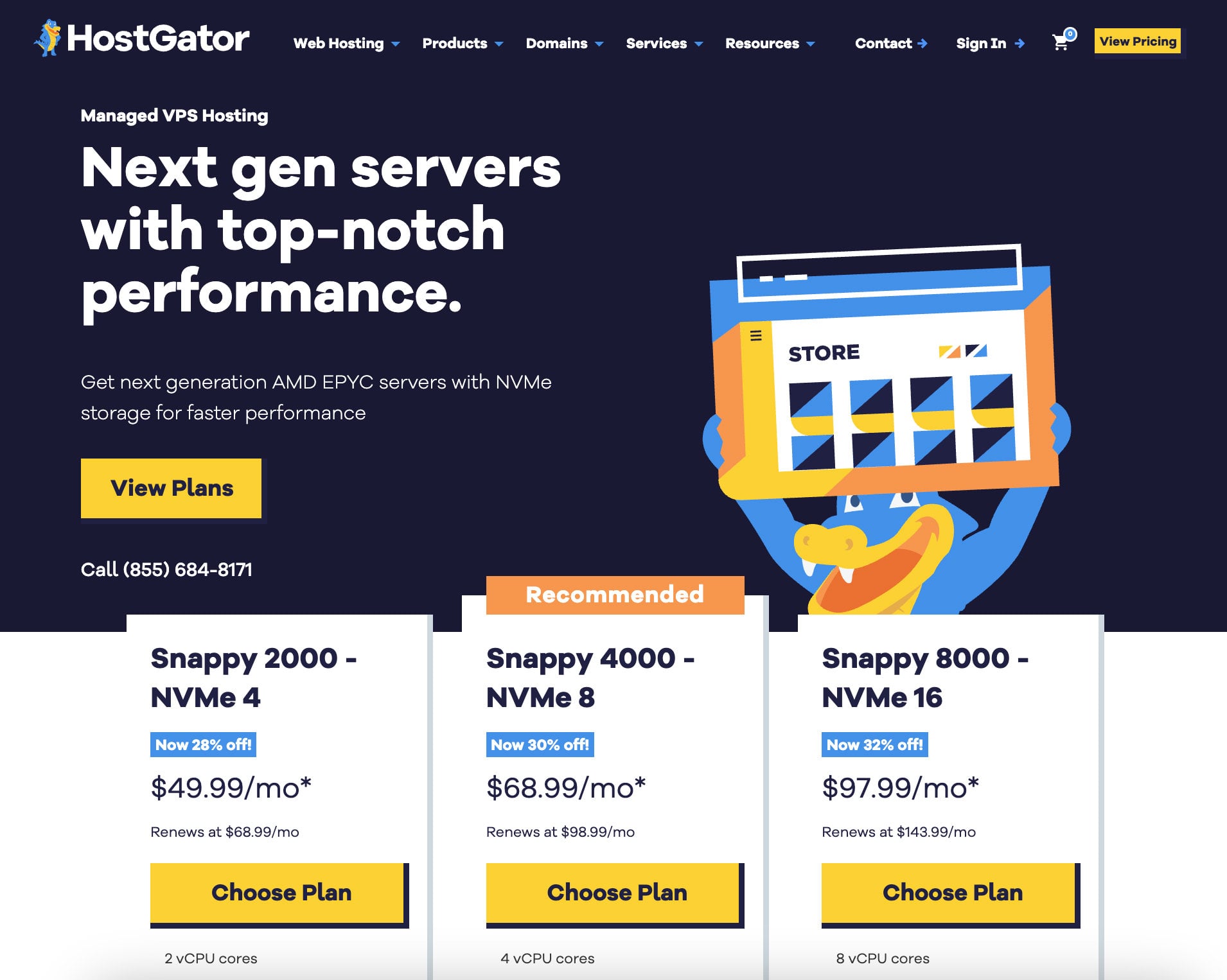
The managed VPS costs far more for the same hardware, and its prices below are the promotional rates shown.
| Plan | vCPU | RAM | NVMe storage | Promo price per month | Renews at |
|---|---|---|---|---|---|
| Snappy 2000 NVMe 4 | 2 | 4 GB DDR5 | 100 GB | $49.99 | $68.99/mo |
| Snappy 4000 NVMe 8 (Recommended) | 4 | 8 GB DDR5 | 200 GB | $68.99 | $98.99/mo |
| Snappy 8000 NVMe 16 | 8 | 16 GB DDR5 | 450 GB | $97.99 | $143.99/mo |
For example, the 4 GB self-managed plan costs $4.18 a month against $49.99 for the managed version. The difference pays for server updates, monitoring and guided setup, including cPanel and WordPress installation by the HostGator team.
See HostGator self-managed VPS
Features and Performance
Every VPS runs on AMD EPYC processors with NVMe storage and DDR5 RAM, and you can add CPU, RAM or disk space without rebuilding the server. You get full root SSH access, SFTP access, an API, DDoS protection and the freedom to install your own control panel. HostGator advertises 99.99% uptime on the self-managed page and 99.9% on the managed page.
The one-click deployment tool lists an application tab, an operating system with panel tab and a plain OS tab. Among the trending apps are Claude Code, Hermes Agent, n8n, OpenClaw and Open WebUI, and the list continues with Coolify, Dify, Ghost, Langflow, Magento, Moodle, Odoo, Ollama, Portainer, WordPress and WooCommerce. If you run n8n, see our guide to the best n8n hosting.
Support and Guarantee
The self-managed plans don’t include cPanel or priority 24/7 support. The managed plans add 24/7 chat and phone support, one-on-one help, server monitoring and hot kernel patching, and HostGator backs them with a 30-day money-back guarantee. Read the full HostGator review for more detail.
Cheap VPS Hosting
A 4 GB VPS is the sweet spot for a small site or a light app, and prices at this size are close. HostGator has the lowest promo price and also the lowest renewal price, DreamHost comes next, and Hostinger and Hosting.com share the same promo price with very different renewals.
| Host | Plan | vCPU | RAM | Price per month | Renews at |
|---|---|---|---|---|---|
| HostGator | Snappy 2000 NVMe 4 | 2 | 4 GB | $4.18 | $9.35 |
| DreamHost | Stack 4 | 2 | 4 GB | $5.99 | $10.99 |
| Hostinger | KVM 1 | 1 | 4 GB | $6.49 | $11.99 |
| Hosting.com | Self Managed Linux 4GB | 2 | 4 GB | $6.49 | $19 |
InMotion doesn’t sell a 4 GB plan, since its self-managed range starts at 4 vCPUs and 8 GB of RAM for $13.99 a month. Hosting.com’s price needs a three-year commitment and renews at $19, so it is the most expensive of the four after the first term.
How Much Does VPS Hosting Cost?
Self-managed VPS plans cost about $4 to $7 a month for 4 GB of RAM and about $8 to $14 for 8 GB on promotional terms. Managed plans cost several times more, from about $20 a month for 4 GB at DreamHost or Hosting.com to $70 a month for 8 GB at HostGator.
The renewal price is where the real cost sits. Renewals run from 1.3 times the promo price on InMotion’s managed plans to about 2.9 times on Hosting.com’s unmanaged plans, and Hostinger’s KVM 2 renews at 1.7 times the promo price. Compare the price after the first term as well as the intro price, and use the money-back window to test a plan before the discount matters.
Extras can add to the bill. HostGator’s self-managed plans don’t include cPanel, InMotion lets you add cPanel or CWP at any time, and InMotion’s Premier Care is an optional upgrade for managed plans. A control panel license, extra backup storage or priority support can raise the monthly cost, so add them to your budget before you compare plans.
Managed vs. Self-managed VPS Hosting
With an unmanaged, or self-managed, VPS, you install and maintain the operating system and the software, and the host looks after the hardware and network. With a managed VPS, the host also handles updates, security patches and troubleshooting, and it usually adds a control panel such as cPanel.
For most websites, the best VPS for web hosting is a managed plan if you don’t want to run a server, and a self-managed plan if you do. The managed plans below cost far more than the self-managed plans with the same RAM.
| Host | Plan | RAM | Price per month | Renews at | Promo term | Root access |
|---|---|---|---|---|---|---|
| InMotion Hosting | Managed VPS 4 vCPU | 8 GB | $43.49 | $56.49 | 24 months | Yes |
| Hosting.com | Managed Server 8GB | 8 GB | $36 | $90 | 1 year | Not stated |
| DreamHost | Managed VPS Enterprise | 8 GB | $40 | $92.99 | 3 years | No |
| HostGator | Managed Snappy 4000 | 8 GB | $68.99 | $98.99 | Promo price as shown | Not stated |
On a self-managed plan you handle the operating system updates, the firewall, the backups and the monitoring, and you fix problems yourself. Some hosts give you tools that help, such as Hostinger’s web terminal with AI and InMotion’s snapshots on demand, but the responsibility stays with you.
Root access is the other difference to watch. InMotion’s managed VPS keeps full root and SSH access, while DreamHost’s managed VPS gives you SSH but no root or sudo, so it suits people who don’t need to change the operating system. Choose a self-managed plan if you need root, and read what support covers, because InMotion’s self-managed support covers only the hardware and network.
The Bottom Line
For most people, Hostinger is the best VPS hosting option in 2026 with low prices, useful tools and a modest renewal increase, and code GIZMODO takes another 10% off. InMotion is the top VPS for people who want human support, and HostGator gives developers the lowest prices and AI tools. DreamHost is a good match for WordPress owners who want the server handled for them, and Hosting.com lets you scale from 4 GB to 32 GB.
If a VPS is more than you need, our list of the best shared hosting services has cheaper options.
FAQ
Which Company Offers the Best VPS Hosting?
Hostinger is the best VPS hosting for most people, thanks to low entry prices, AMD EPYC processors, NVMe storage, weekly backups and one-click apps. InMotion suits people who want hands-on support, and HostGator suits developers who want the lowest prices and AI tools.
When Should I Choose a VPS?
Choose a VPS when shared hosting no longer gives you enough CPU, RAM or control, for example when you need root access, run custom software or apps, or see slowdowns during traffic spikes. It also fits when you want dedicated resources but a dedicated server would cost too much.
How Much Does a VPS Cost?
Self-managed VPS plans with 4 GB of RAM start at about $4 to $7 a month on promotional terms, and 8 GB plans cost about $8 to $14. Managed plans cost several times more, from around $20 to $70 a month for similar resources, and renewals are usually 1.3 to 3 times higher.
What Is the Difference Between Managed and Unmanaged VPS?
With an unmanaged (self-managed) VPS you install and maintain the operating system and software, and the host looks after the hardware and network. With a managed VPS the host also handles updates, security patches and troubleshooting, usually with a control panel such as cPanel.
Can I Get a Windows VPS?
Not from the hosts in this guide. Their VPS plans run Linux, and DreamHost says its managed VPS doesn’t support Windows. If you need Windows Server, look for a host that lists it as an operating system option.
Is VPS Better Than Shared Hosting?
A VPS gives you dedicated CPU, RAM and storage, so other customers’ traffic doesn’t slow you down, and self-managed plans add root access. Shared hosting costs less and needs no server skills, so it is better for small sites that don’t need those resources.