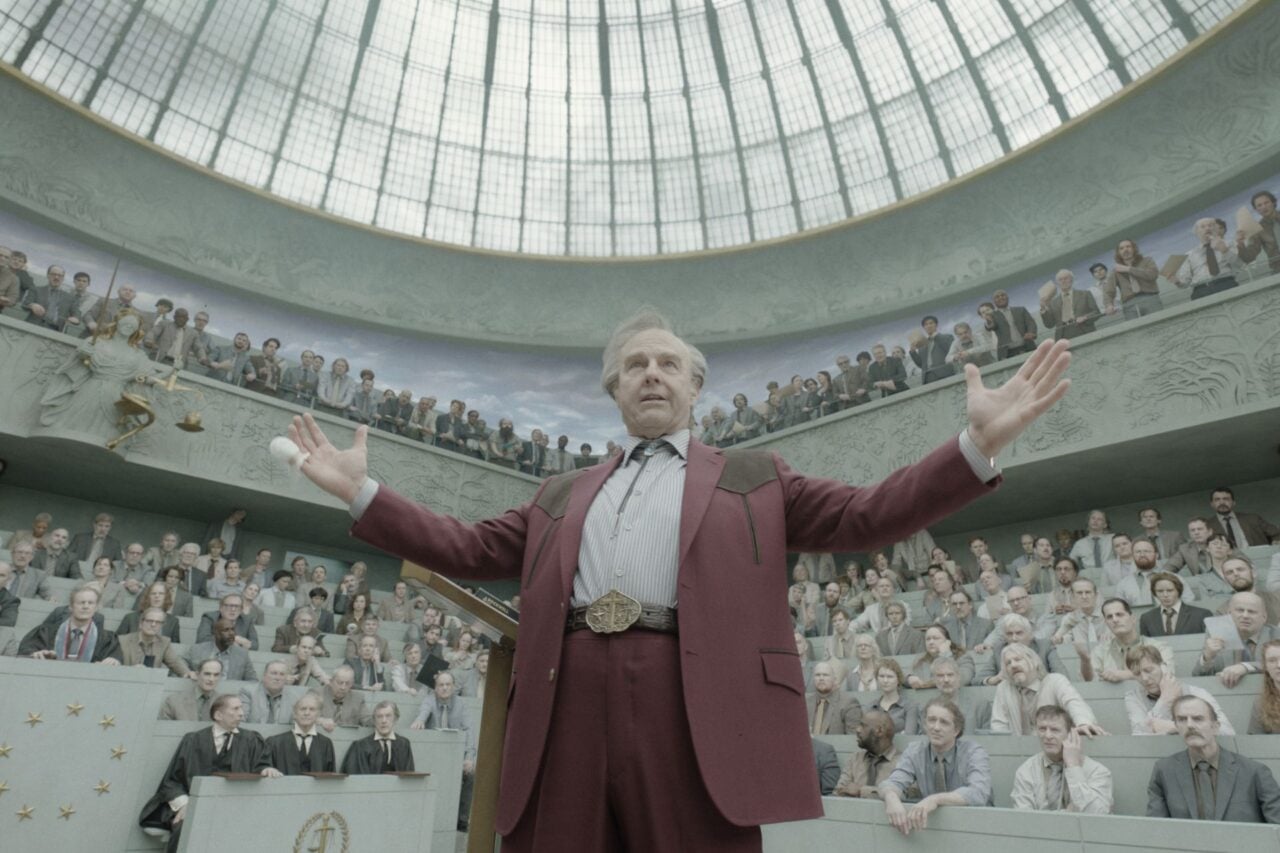
At first glance, it’s hard to see how Digger and The Social Reckoning could have much in common. One is a movie about an ambitious, egotistical man of wealth who delivers incalculable horrors that threaten to destroy humanity. And the other stars Tom Cruise.
But the one thing that really links these two movies is a question of stakes. At some point during each movie, I found myself asking, “Why do I care?” Watching Digger, I cared deeply by the end. So much so that I think it was my second-favorite movie of 2026 thus far. I’ve already seen it twice. During The Social Reckoning, the feeling of detached apathy never went away.
I should mention at this point that I’m going to reveal spoilers for both films, and if you haven’t seen Digger, I suggest you see the movie first. Digger is a lot more fun if you don’t know the twist.
Jeremy Strong gives a perfectly acceptable performance as Mark Zuckerberg. And it’s hard to fault the other actors in The Social Reckoning for a hokey script filled with laughable dialogue. But even if you can get over screenwriter Aaron Sorkin’s obnoxious lines, you’re still left with one big problem in The Social Reckoning: A movie set primarily in the late 2010s feels like ancient history when the technological threats to humanity are whether Meta’s Muse mistakenly empties my bank account and Anthropic’s Claude starts World War III. Or, at the very least, Claude is used to surveil Americans and power fully autonomous weapons.
Throughout The Social Reckoning, I kept asking myself, why should I care about this? The big scandal of the movie is that Facebook was messing around with its algorithm to create an environment where people are constantly angry about politics and kids are exposed to material that harms their mental health. And that’s undeniably true. But nothing about the movie made me feel like it was something I needed to care about in this moment. There has been no reckoning for Meta or Mark Zuckerberg, and at least when it comes to a reckoning for the events portrayed in the film, there never will be. You may as well have presented me with ancient Roman history.
Contrast that with Digger. The movie starts by presenting an over-the-top character played by Tom Cruise, until the audience is abruptly pulled out of that reality and it’s revealed we’ve all been watching a play. Admittedly, I found it really difficult to go back to suspending disbelief for maybe 10-15 minutes after that big reveal. We’re plunged back into the world of theater and are supposed to become fully immersed again as though we haven’t just been presented with another layer of reality. After a while, I was able to care again. But I understand why some people couldn’t do it. And I suspect that’s why the reviews have been so polarizing.
Once I was able to suspend disbelief again, I was fully invested in the characters. Because it all felt extremely relevant to our present moment. The reality of the movie is set well into the future, while the play is based on “historic” events that are still in 2026’s future. It couldn’t feel more up to the minute as it examines the issues of climate change, high-tech surveillance, and the role of satire in our lives. Does art still matter in a world that’s dying ecologically? Can satire change the world in any way? Those are the questions that Digger poses, and I would argue it doesn’t present a clear-cut answer. Failing to present a conclusion doesn’t always make a great work of art, but in Digger‘s case, the film is all the richer for it.
Our ability to immerse ourselves in any work of fiction relies on the suspension of disbelief. I never really saw any of the characters in The Social Reckoning as authentic enough to lose myself in the story. But that’s largely a product of hack writing rather than bad performances. At one point, our hero whistleblower (played by Mikey Madison) tells our hard-hitting journalist (played by Jeremy Allen White) that he shouldn’t mansplain. The hero journalist says that “mansplain” is just a word that women use when they’re losing an argument. Whatever is going on in that script, it’s clear Aaron Sorkin is working through some shit with women that should remain off-screen.
It also didn’t help that The Social Reckoning keeps throwing text on the screen to remind you of the year as it flips between the late 2010s and the early 2020s. There may be a case for doing that once, but doing it repeatedly throughout the movie just serves to tell audiences that this is all fakery. You’re watching a movie about things that have long since passed, and you can safely ignore it.

I’ll admit that I was a bit perplexed by some of the negative reviews of Digger. Take, for example, the New York Times review, which includes this line: “The relative restraint and expressive specificity of [Jesse] Plemons’s performance — his character holds his gaze on other people a touch too long, and his smile seems backlit by madness — is a relief, given the rest of the cast’s cartoony turns.”
Jesse Plemons plays the “real-life” nephew of Digger Rockwell, the oil man who has helped destroy the modern world by accelerating climate change. He’s financing a new production of the play Fossil Fuels, which is about his own family. If you’ve seen Digger, you know why Plemons gives a restrained performance while the other characters sometimes give “cartoony” performances. It’s because Plemons is the producer of the play in the film. He exists in “reality,” while many of the other actors’ screen time is spent portraying characters in the play that’s being rehearsed. They’re giving grandiose, cartoony performances in the play while giving understated and more “realistic” performances in the other reality the film presents to us. And that’s simply because theater demands a different style of acting. The players are performing “for the back row,” so to speak.
Tom Cruise’s character, snapping out of the play-reality, even complains to the director of the play that he’s doing a “cartoon version” of the real Digger Rockwell, and “it all just feels so fake.” An inability to understand that these cartoony performances were choices that make them even more realistic makes me wonder what the hell the New York Times is thinking.
If you want to talk about cartoony distractions, look no further than The Social Reckoning. Aaron Sorkin, who both wrote and directed the movie, apparently decided that the female lead, Mikey Madison, who plays whistleblower Frances Haugen, should be dressed in revealing outfits. It’s a choice that’s rationalized in the script as logical because she didn’t want anyone to catch on to the fact that she was leaving her apartment in order to talk to a reporter. We’re supposed to believe that she does this because it should look like she’s going on dates rather than leaking confidential information from Facebook. But it couldn’t be more obvious that this is just a stupid excuse to add some sex into a movie that’s fundamentally about boring concepts like algorithms. In other words, Sorkin is working from a ridiculously stereotypical male perspective on what makes a female character interesting, to tell us a dated story with no new insights.
We can see the reality of Digger around us in 2026. The natural world is rebelling, and I see it constantly here in California. This past weekend, there was the viral video of a wave crashing into the Pacific Surfliner train that runs between Los Angeles and San Diego, a reminder that the rising ocean levels will pose an enormous problem during this coming El Niño winter. This week, there’s the enormous crack threatening the Pacific Coast Highway between Laguna Beach and Newport Beach.
Why did I leave both screenings of Digger feeling as though I saw a preview of my own reality? Because that crack in the glacial ice belittled by Tom Cruise’s character may as well have been the crack now forming in Orange County. If you want to see a movie about the threat of tech, The Social Reckoning is old news. Maybe check out the new Musk documentary. Better yet, rent the 1970 film Colossus: The Forbin Project, in which two advanced computers develop complex math and decide they don’t need humanity anymore, so they threaten to nuke the entire world. That feels much more relevant than some old director finding excuses to put Mikey Madison in revealing outfits.