By the time a franchise reaches its sixth iteration, all bets are off. Whatever happened in the first few films can’t happen again. Audiences want something new. Something surprising. But usually, that doesn’t involve undercutting the title of the franchise itself.
This weekend, the sixth Hunger Games movie, The Hunger Games: Sunrise on the Reaping, is in theaters, and we liked it quite a bit. Our full review is here. But watching it, we were surprised at how that key element of the series, the Hunger Games themselves, takes an almost comedic backseat in this iteration. To explain further, we’ve got to dive into some spoilers.

So, to recap, the titular Hunger Games of the series is an annual event held by the government of Panem to remind and punish the country’s districts for rebelling against them many years ago. Each year, a boy and girl from each of the 12 districts is selected at random and forced to fight to the death in a giant arena with the whole world watching.
We’ve seen these in every Hunger Games movie, and Sunrise on the Reaping is no different. However, the Games themselves don’t have as big a role in this film as in the previous ones.
This, obviously, makes sense on a bunch of levels. It being the sixth film and wanting to provide a new spin on things is one. The fact that we know the main character of the film, Haymitch Abernathy, wins the Games is another. And the biggest thing is that the Games are merely a means to a greater end in Haymitch’s story. He, like many in the series, is fed up with the Games and wants nothing more than to fight back and have the Games end. So he doesn’t put much effort into engaging with the actual Games, and neither does the movie.
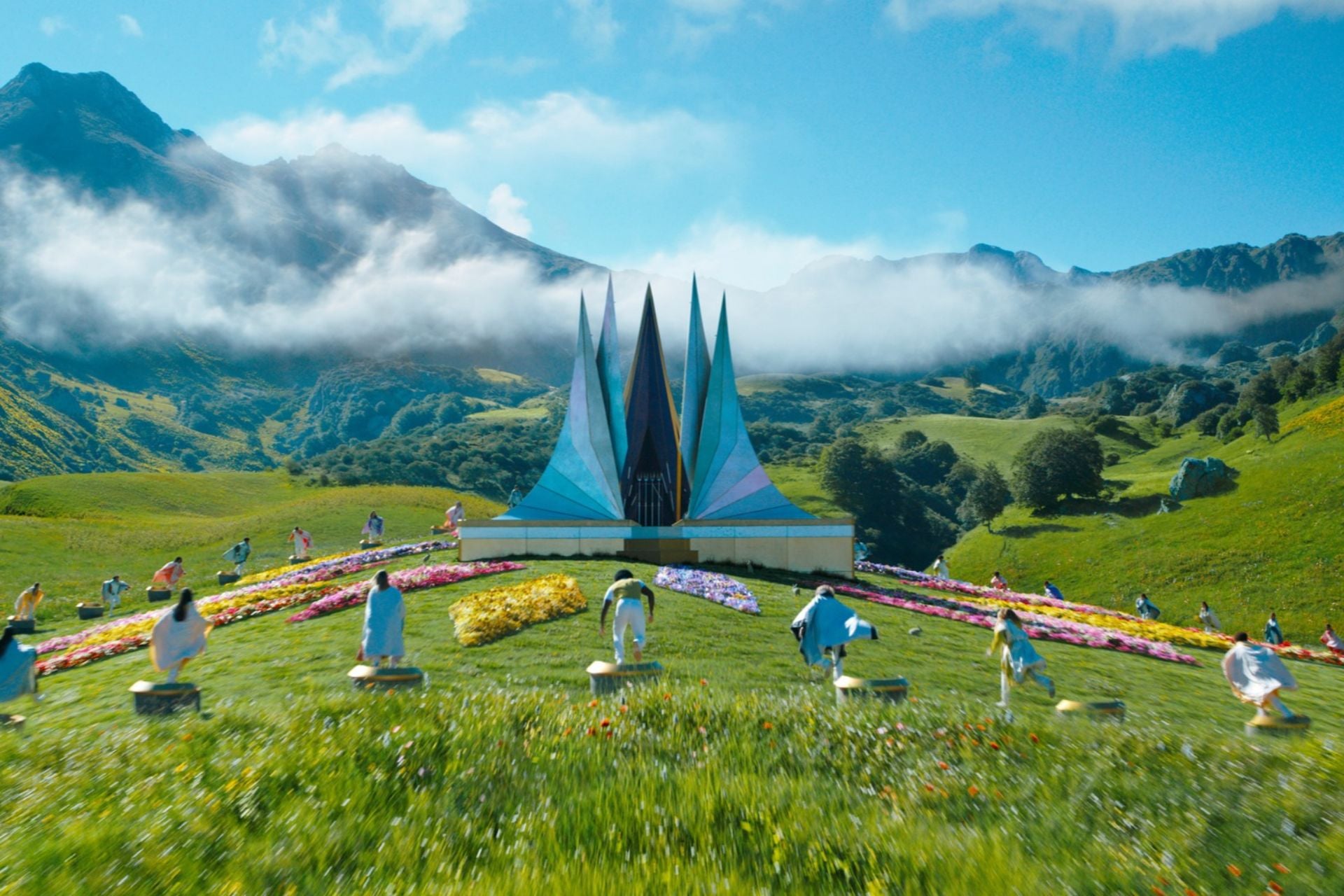
The main thing that muddies that all up a bit is that Sunrise on the Reaping also makes a big deal that the Games in the film are a very special 50th anniversary of the Hunger Games called the Second Quarter Quell. And, therefore, the number of tributes doubles from 24 to 48. More innocent children are led to the slaughter.

When the Games start in the film, it initially feels like we’re going to get that double dose of violence. Quickly, though, Haymitch runs off, begins his rebellious plan, and everything changes. Soon after, the Gamemakers set off a volcano in the center of the arena that wipes out almost all of the tributes off-screen. You read that right. A literal volcano is set off, killing almost everyone.
Which, to be fair, makes sense for this story. Of the 48 tributes who enter the arena, only a handful have speaking parts, let alone a crucial part to play. So finding a way to wipe the slate clean in a single action is kind of genius. But it also makes this version of The Hunger Games more like “The Quick Snack Games.” We don’t feel their loss nearly as much as we have in other movies because there are too many people, and we don’t know most of them.
The volcano eruption has other advantages, too, though. It focuses the story on the characters at hand. It also shows just how far the Gamemakers will go to combat Haymitch’s actions. And, in tandem, those things allow Sunrise on the Reaping to get to the core of its true intentions, which is showing us the power of propaganda alongside the importance of a single person’s actions. So, in the end, the volcano works. Tempering the Hunger Games in The Hunger Games was the right move. But that doesn’t make it any less amusing.
The Hunger Games: Sunrise on the Reaping is now in theaters.
Want more io9 news? Check out the best movies and TV shows to stream this month and all the upcoming sci-fi, fantasy, and horror books that should be on your radar.