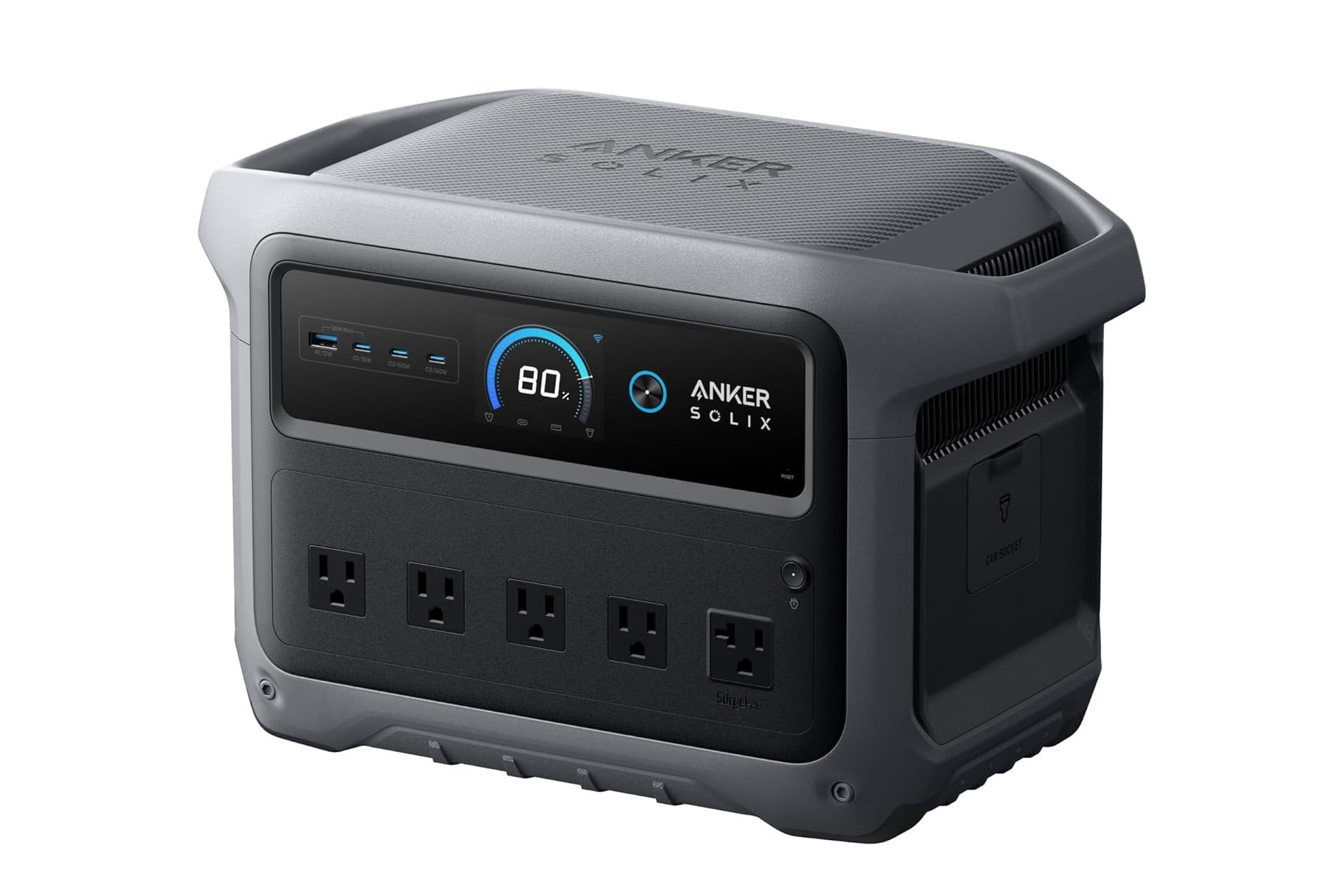
Losing power halfway through a video call is annoying, but losing it at 3 a.m. with a CPAP machine running is a different story. That second scenario is where Anker’s SOLIX C1000 Gen 2 earns its place in a house, and for Black Friday, Amazon has knocked 41% off the 2,000W power station, which drops from $799 to $469. I’d call it one of the more useful things you can buy during the sale, even if it ends up sitting quietly in a corner most of the year.
Portable power stations used to be camping gear first and home backup second. The C1000 Gen 2 flips that order, since its 1,024Wh LiFePO4 battery is designed to stay plugged into the wall all year and take over the moment the grid goes down. Anker also says it’s smaller and lighter than comparable models, so moving it from the home office to the kitchen doesn’t take two people.
Under 10 Milliseconds to Take Over
The feature I’d put first is the UPS mode. Plug the power station into an outlet, connect your devices to it, and if the electricity cuts out, it switches to battery in less than 10 milliseconds. Your desktop computer keeps running without a hiccup, and so does a CPAP machine, so an outage at night doesn’t wake you up because the mask suddenly stopped blowing air.
Output reaches 2,000W continuously, with peaks of 3,000W, spread across 10 ports, so it can handle much more than a laptop. In a blackout, that’s enough to heat dinner in a 1,000W microwave while the router keeps the Wi-Fi alive for everyone else in the house. When the power comes back, the station quietly returns to standby.
Recharging is where the Gen 2 really pulls ahead. Turn on HyperFlash in the Anker app, and it pulls 1,600W from a regular wall outlet to go from empty to full in 49 minutes, roughly the time it takes to cook and eat that dinner. For longer outages or trips off the grid, it accepts up to 600W of solar input (60V max) and fills up in about 1.8 hours of good sunshine.
Longevity is the other strong point. Anker rates the LiFePO4 cells for 4,000 cycles before capacity falls under four-fifths of the original, which the company translates into about 10 years of regular use. The Anker app also includes a time-of-use mode for homes with peak electricity rates, letting the station charge when power is cheaper and take over some of the load when it costs more.