The Pyramids of Giza were built to last for eternity, securing a safe passage to the afterlife for the souls of the pharaohs. To ensure that their divine gateways could infinitely withstand the mortal realm, the ancient Egyptians built them with precise structural design and a profound understanding of their surroundings, a new study has found.
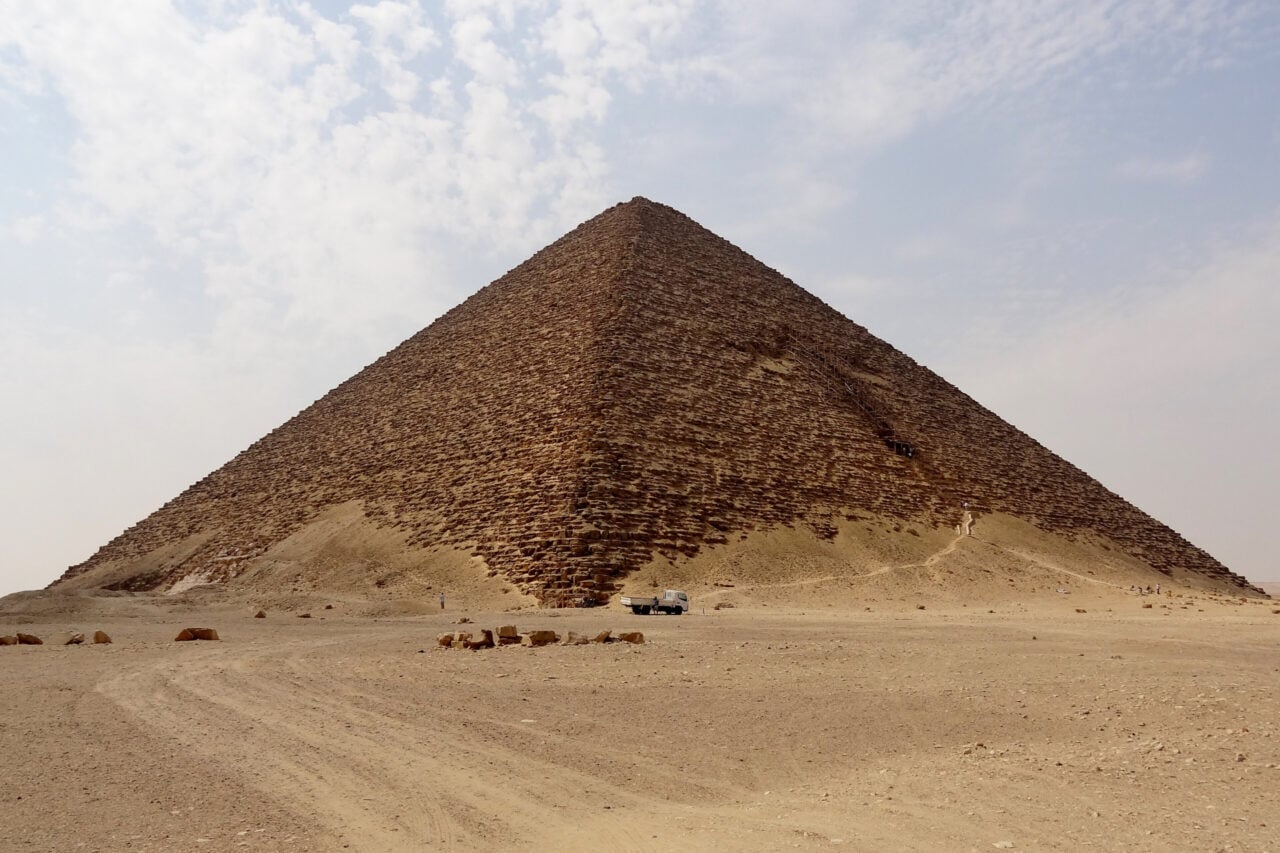
The Great Pyramid of Khufu was completed between approximately 4,600 and 4,450 years ago. Since then, the 450-foot-tall (138-meter) structure has endured numerous earthquakes without suffering any major damage. Until now, researchers had little evidence to explain the pyramid’s impressive resilience.
A team of researchers led by Asem Salama from the National Research Institute of Astronomy and Geophysics in Cairo, Egypt, set out to examine the secret behind the Khufu pyramid’s ability to withstand earthquakes. The findings, published today in Nature, provide new insight into the ancient Egyptians’ optimization of structure design and site characterization to ensure stability against seismic hazards.
Land of eternity
King Khufu, the second pharaoh of the fourth dynasty, was the first to commission a pyramid in Giza as his royal burial chamber. Khufu’s pyramid is the largest in the Giza complex, consisting of an estimated 2.3 million stone blocks arranged in increasingly small layers.
The engineering feat behind the construction of the Great Pyramid is still not well understood. Archaeologists still argue about some of the finer details behind the construction of ancient Egyptian pyramids, but researchers are also continuing to investigate how the pyramids have sustained so little damage despite enduring several seismic events over the years.
The pyramid complex in Giza has been affected by a number of earthquakes that came within a 50-mile radius (80-km). The largest reported earthquake took place on August 7, 1847, with an estimated magnitude of 6.8. On October 12, 1992, another earthquake struck Giza at a magnitude of 5.8. During this event, a batch of casing stones fell from the top parts of the pyramids and rolled to the ground. Apart from that, the pyramid was left largely intact.
Seismic vibrations
To help understand how the Great Pyramid has remained (mostly) unscathed over thousands of years, the team behind the new study recorded ambient vibrations—low-level ground and structural motions caused by everyday human activity, oceanic waves, and climatic changes—at 37 locations around the pyramid. The analysis allowed the researchers to measure how vibrations travel through the pyramid’s internal chambers, construction blocks, and surrounding soil, helping them learn how the structure responds to earthquakes.
The results showed most of the vibrations resonated throughout the structure at frequencies between 2 and 2.6 hertz, indicating that the vibrations were distributed relatively evenly across the different locations. Outside the pyramid, the vibrations had a frequency of approximately 0.6 hertz.
The difference in vibration frequencies may have also helped the Great Pyramid stay intact, as it may reduce resonance effects during an earthquake by limiting interactions between the structure and surrounding soil, according to the study.
The researchers also found that the Subterranean Chamber, which is carved directly into the bedrock beneath the pyramid’s base, does not have any boosted frequencies. The relieving chambers, located directly above the King’s Chamber, may have helped prevent destructive frequencies from reaching the room where Khufu was laid to rest. The authors believe the relieving chambers provided structural protection to the King’s Chamber.
While the study highlights that there’s no direct way of knowing whether these structural features were intentionally designed to protect the pyramid from earthquakes, they do suggest that ancient Egyptian builders developed a profound understanding of structural design and geotechnical engineering.