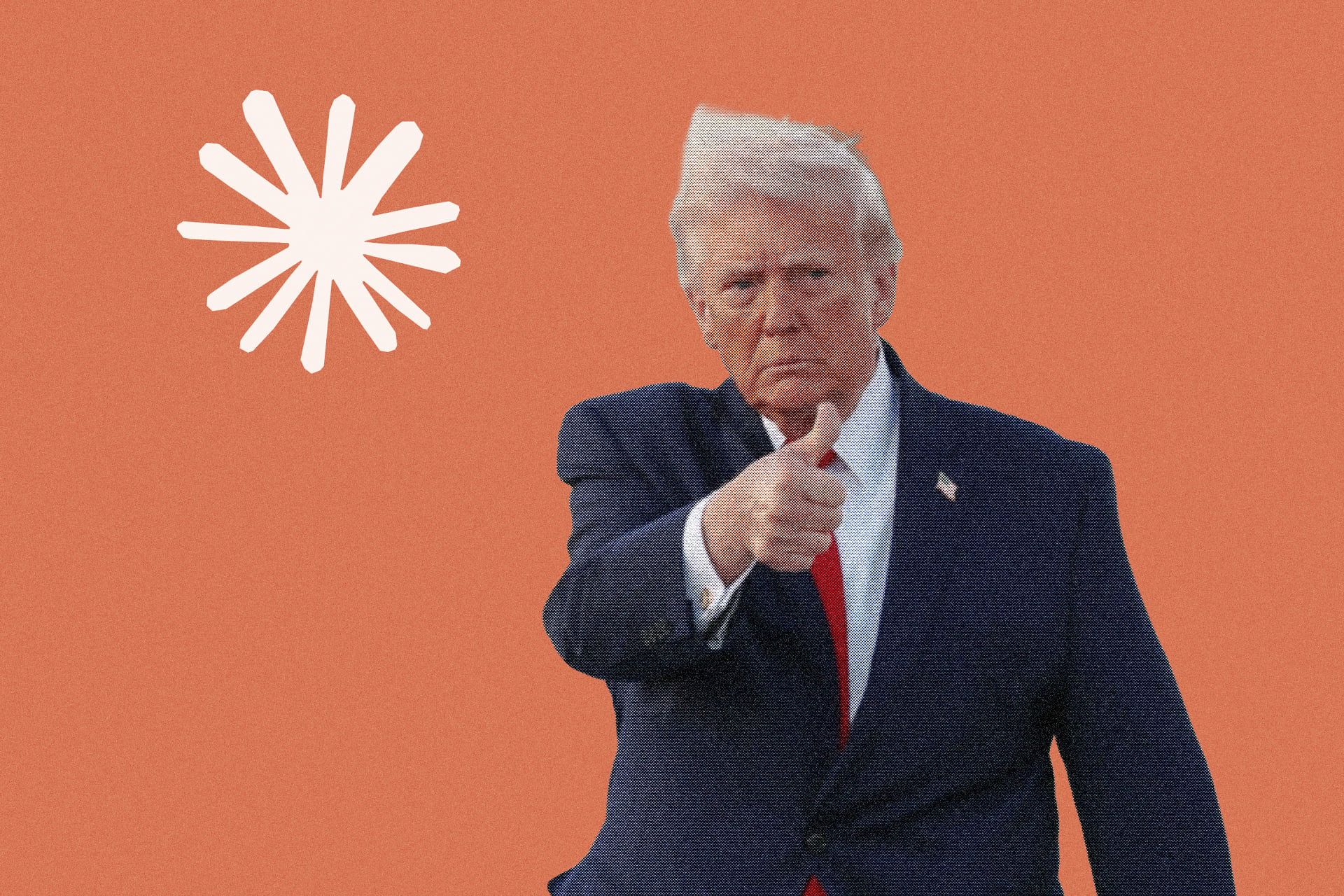
Donald Trump arrived in office for his second term on the back of hundreds of millions of dollars of Silicon Valley money and a simple dictate from his backers: Leave us alone. That worked for a little while, but now Trump’s approval rating is so far underwater that it’s discovering previously unknown shipwrecks. That has him looking for a new way to align himself with the public, and the AI industry looks mighty ripe for some administrative meddling.
That is setting up the ultimate showdown of an unstoppable force in the form of the endlessly upward trajectory of AI lab valuations, versus the immovable object that is the unexplainable and intangible but very real Trump curse that seems to come out any time he sticks his nose where it doesn’t belong.
At this point, the Trump Curse is pretty well established. After getting elected to office for a second time and operating under the assumption that he had not only a political mandate but a social one, Trump has sought to inject himself into just about every part of American life. He’s put his face on passports, his signature on money, and has started showing up at major public events that were not hand-selected to guarantee him a cheering crowd.
Those events have gone particularly poorly. It started when he predicted a Kansas City Chiefs win in the Super Bowl shortly after he returned to office, only to show up to the game and watch them get their doors blown off by the Philadelphia Eagles. Later that year, he showed up at the Ryder Cup in New York to rally the US golf team as it took on a European squad. The US lost, and the European team became the first to win the Ryder Cup on the road in more than a decade.
A couple of months later, in November 2025, Trump pulled up to a Washington Commanders game to root for D.C.’s local ball club, becoming the first sitting president since Jimmy Carter to attend a regular-season NFL game. The Commanders got trounced, 44-22, but they already stunk that season. The bad juju of Trump’s appearance stuck to the Lions for the rest of the year, as they lost 5 of their last 8 games and missed the playoffs entirely just one year removed from a franchise-best 15-2 season.
Those were all pretty safe bets for the crowd to be Trump-aligned, but he broke out of his bubble to show up in Madison Square Garden and watch the New York Knicks in the NBA Finals. It should have been a relatively safe bet: it was the Knicks’ first home game in the series, they had already won the first two games in San Antonio, and they were in the midst of a historically dominant playoff run with 13 consecutive wins. Trump got booed. The Knicks lost. Then they won every remaining game and lifted the trophy.
The latest example of the President’s bad touch played out Monday night. The United States was set to play Belgium in the World Cup knockout stage and was going to have to go without their best player, who received a suspension for a red card in the game prior. Trump and his team intervened and got the suspension overturned (FIFA claims Trump had no influence, but FIFA is deeply corrupt and has already shown fealty to Trump by giving him a made-up “Peace Award“). Trump’s intervention might have gotten America’s best player back on the pitch, but it also gave the whole team his stink, and they got wrecked, 4-1.
But the Trump Curse goes well beyond just sports. The guy has spent most of his second term looking for easy wins to curry public favor, only to blow it entirely. He spent a good chunk of his political capital on trying to impose sweeping tariffs on the entire rest of the globe, only for it to almost immediately tank the stock market—his personal favorite measure of economic prosperity—and eventually get his powers curbed by a Supreme Court that was supposed to be stacked in his favor.
He started a war with Iran on a false premise, claiming the pre-emptive attack was made to keep the country from getting nuclear weapons. The American people tend to rally around the flag, and the admin thought that the war would be quick and easy. Instead, Iran resisted and won concessions from the US to end the conflict. Meanwhile, the war was deeply unpopular among Americans and may have been the straw that broke the camel’s back in terms of public perception of Israel. Absolutely nothing was gained for Trump.
With Trump in need of a win worse than ever before, especially heading into a midterm election where he’s not on the ballot but is a weight around the neck of Republicans hoping to hold office, he’s turning his attention more and more towards AI—a topic he previously seemed to prefer not to touch. It’s not terribly hard to see why: Most Americans want the industry regulated and have a negative view of the Trump administration’s apparent desire to use AI for warfare and surveillance.
The AI industry has also been asking for guardrails—not necessarily out of civic virtue, but because even Big Tech would rather know the rules than operate in regulatory fog. So it seems like a no-brainer all around. Except…there’s that pesky Trump Curse.
The whole theory for Trump’s initial hands-off approach to regulating AI stemmed from the idea that the administration didn’t want to hamstring the AI labs because they were competing with China. Well, China managed to develop cheaper, lighter-weight models than the American labs produced, and now the nation is setting up its own firewall to limit American access. Then China went and built cheaper, lighter-weight models anyway—and is now reportedly moving to wall off its own best AI systems from American users. That move comes just at the moment when American companies are realizing that American AI is too expensive and rushing to incorporate Chinese models into their businesses.
The innovations from the US, meanwhile, are getting stuck in limbo as Trump tries to figure out whether he wants to regulate AI or not. Anthropic’s powerful Mythos model was restricted as the administration cited national security concerns, and now OpenAI’s planned new model, GPT-5.6 Sol, is reportedly tied up in a security review. And while you won’t find too many people upset at the idea of more scrutiny being placed on these companies, it’s a bit of an own goal for Trump, who has turned into the biggest obstacle for American AI development and whose obstinacy and animosity toward China have led that country’s tech industry to learn how to live without American products and create its own infrastructure.

At this point, if Trump moves forward with his plan to have the government take a stake in the big AI labs, we can probably expect that to be the moment the bubble pops and the stocks tank. That’s just the way the Trump Curse goes.
READ MORE: China Built Cheap AI. Now It’s Building a Great Wall Around It