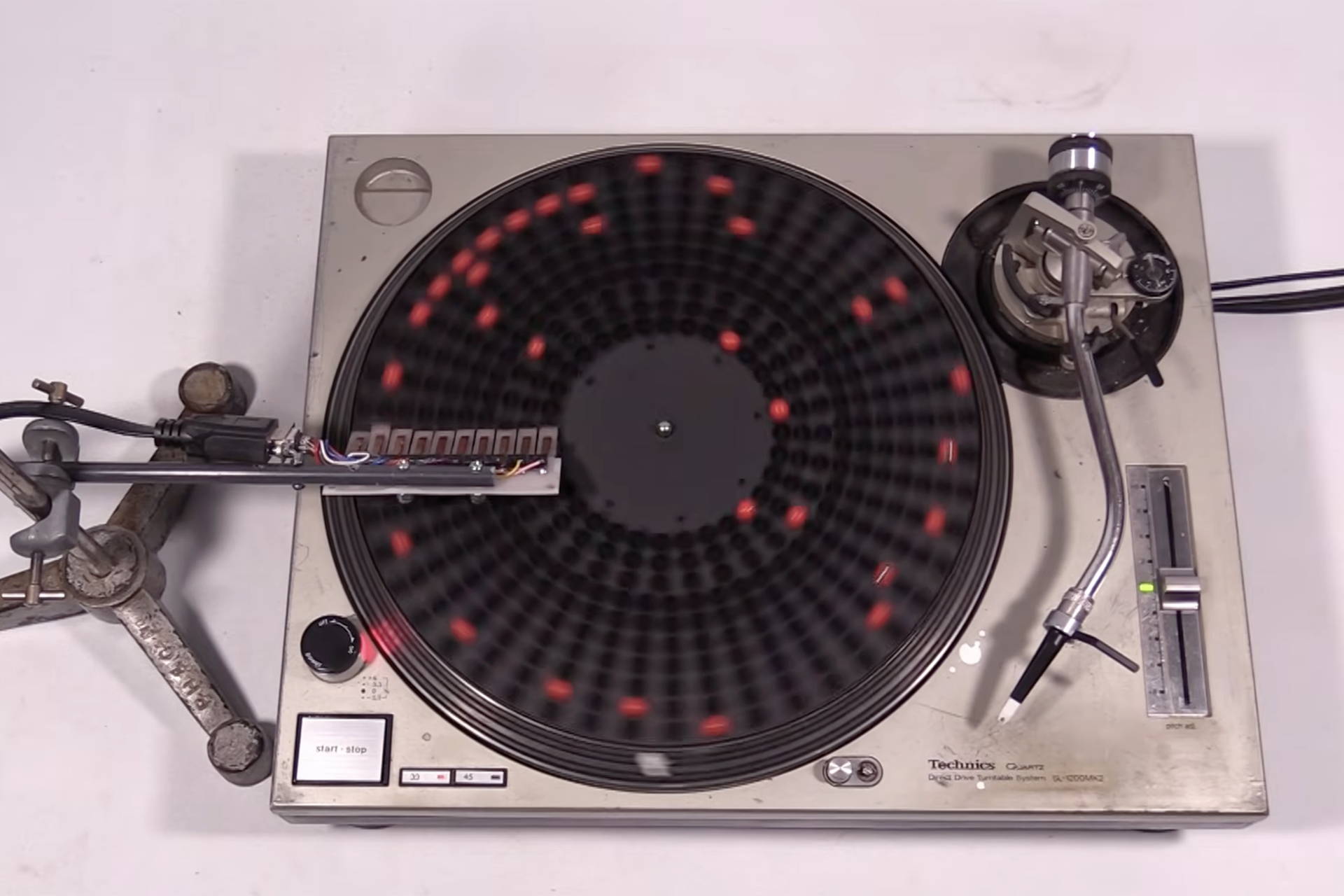
There are two types of people in this world: people for whom beatmatching just clicks immediately, and people for whom it … does not. For those in the former category—like my ex-roommate, who spent months in vain trying to teach me how to match the tempo between two records—the idea of a turntable rigged up to act as a drum sequencer probably seems like a great idea.
For the rest of us, though, it looks like a monument to 2000s-era PTSD. Yes, I can absolutely hear that the two beats are out of sync, and yes, OK, I think it’s the one on the right-hand deck that’s a bit slower, so maybe if I just… oh, the other song has finished. Dang. OK. Yes, let’s try one more time. *sighs deeply*
The sequencer/turntable is the creation of London-based polymath Graham Dunning, who describes himself as a “musician, maker and sound artist.” It apparently forms part of his PhD thesis at London South Bank University, which is entitled Mechanical Techno: Extended Turntable as Live Assemblage, and whose existence demonstrates the fact that serious techno people are very serious indeed these days.
The discussion on the device’s relationship to “assemblage theory” will have to be left to people better versed in the nuances of such discourse than your correspondent, but as far as its role as an actual piece of gear goes, it’s a clever piece of design. Like your average sequencer, it works by allowing you to place sounds on a quantized grid, with each horizontal line of the grid corresponding to a different sound, and each column corresponding to a set time interval.
In this case, however, the grid is projected onto the surface of the record. This places some limitations on the length of the pattern; most sequencers allow for a four-bar loop, but the turntable sequencer only allows for one bar. Dunning’s thesis explains: “Given the turntable is rotating at 33 1/3 RPM, a four-beat cycle will produce a tempo of 133.333 BPM.” Trying to cram two bars into the same space would result in a tempo of 266.666 BPM, which is well beyond even gabber territory.
This does mean, however, that there’s room for an impressive amount of complexity within that one bar: each beat is split into eighth notes, allowing for the construction of intricate, off-kilter rhythms. (Listen to the timing of the kick drum in the demo for an example: it fires on the first beat, but then at different offsets for every subsequent beat.)
Since this is in no way a conventional LP, the turntable’s needle stays safely latched away; instead, you set notes by placing a ball bearing into the corresponding grid slot. On the other side of the deck, a series of sensors that look like the spinning targets on a pinball machine are suspended above the disc. Each time a ball bearing passes under its corresponding flap, it triggers the corresponding sound on a connected drum machine.
While the device seems more like an academic exercise than an instrument intended for everyday use, you could actually use something like it in practice—perhaps to set up a basic and easily modifiable pattern that could serve as the underpinning for a DJ set, for example. And honestly, having something like this to provide a visual representation of the beat would make it just that little bit easier for those of us who are still struggling to match the one to the one, decades later.



