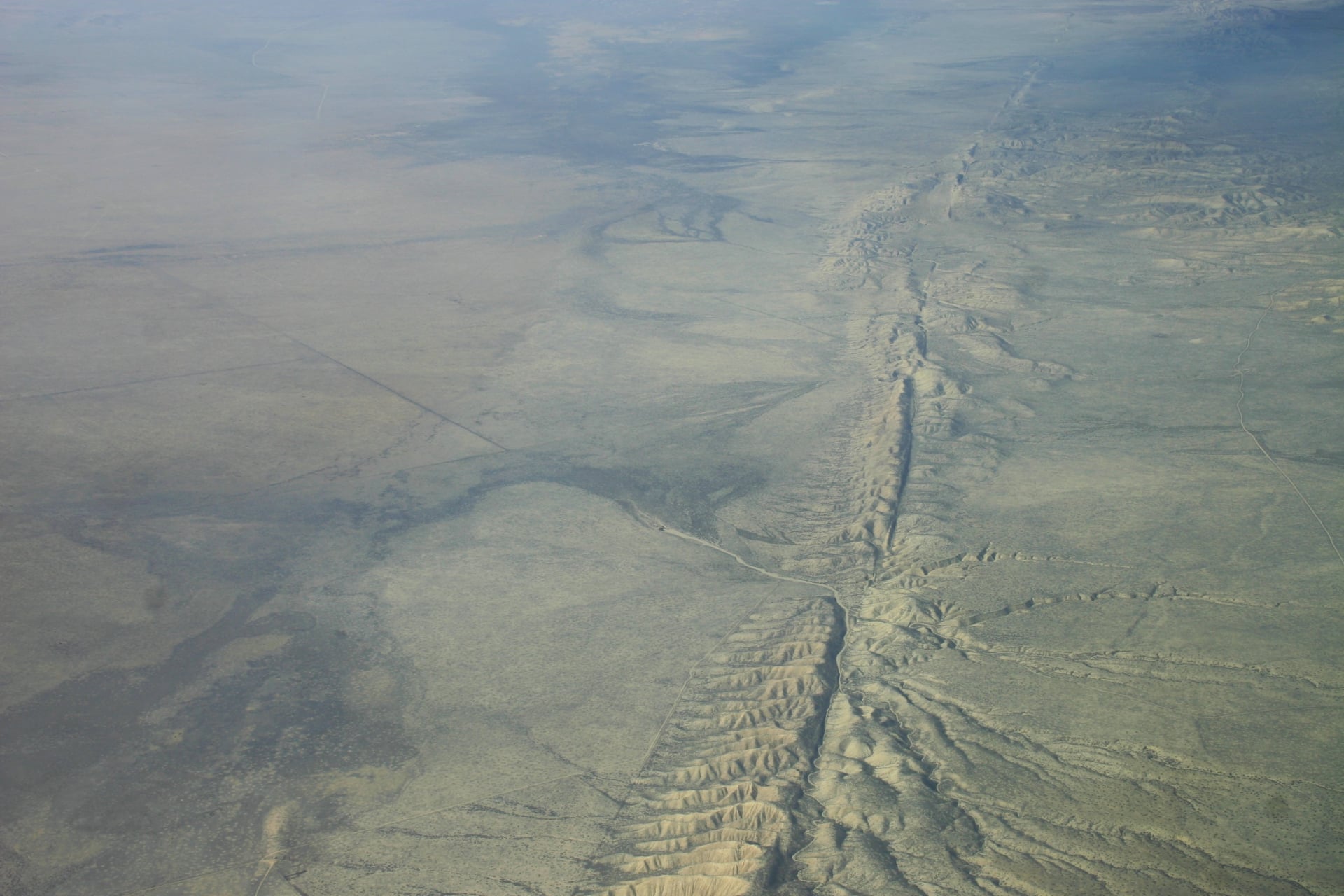
The British Geological Survey says scientists have seriously contemplated the role of solar and lunar activity on earthquakes for over 100 years. But they weren’t able to find a compelling explanation for how exactly that occurred—until now.
Turns out, scientists don’t need that complex of a design to see how tidal stresses—caused by the gravitational tug-of-war between the Moon and the Sun—affect Earth’s fault networks. In a study recently published in JGR Solid Earth, a team of geologists primarily based in PSL University in France digitally simulated a spring-block model, in which a block is pulled by a spring. The model was simple but replicated key details. When the researchers applied repeated waves of forces meant to resemble the gravitational pull of the Sun and Moon, they found that it took surprisingly little for a fault to shift significantly.
“Our results show that even small stress perturbations can trigger periodic as well as temporally complex slip events on stable sliding faults,” they wrote. “We find that when the period of tidal stress perturbations matches the natural response timescale of a fault, the fault becomes significantly more sensitive to triggering.”
The earthquake trigger
Observationally, the correlation between seismic activity and tidal stress is not news to scientists. In fact, one of the study’s co-authors, Satoshi Ide, a seismologist at the University of Tokyo in Japan, was involved in an investigation from 2016 that found a strong correlation between high tidal stresses and the occurrence of high-magnitude earthquakes. The study, which analyzed more than 10,000 earthquakes exceeding a magnitude 5.5, pointed out that earthquakes were more likely to grow up to magnitude 8 during times of high tidal stress.
Another takeaway from this work was that tidal stresses are likely one of many factors that trigger an earthquake. According to the latest study, these stresses are very small, “comparable to the pressure from a gentle hand press.” But these tiny forces are known to trigger slow earthquakes, or longer-scale rumblings of tectonic plates undetectable to us but have been observed to precede massive earthquakes.
Small vibrations, big results
That raises an “important question about the physical conditions under which faults become sensitive to such weak, periodic forces,” the team explained in the paper. From their simulations, the researchers realized that timing may be a key factor. Specifically, very weak tidal stresses can cause faults to “slip” through resonance, “much like pushing a swing at the right rhythm makes it move higher,” they wrote.
Of course, the model greatly simplifies reality. For one, other studies have shown that, although tidal stresses do matter, exactly how much influence they exert depends on geological conditions specific to the region. The model is also supposed to replicate a single, isolated fault, which is rarely how faults actually exist.
However, the model does offer an experimental framework to assess the fundamental forces at play underground. As slow earthquakes may precede larger, more dangerous earthquakes, frameworks like these may allow experts to “infer fault properties from observations of tidal-triggered slow earthquakes,” the team concluded.