Thermococcus gammatolerans
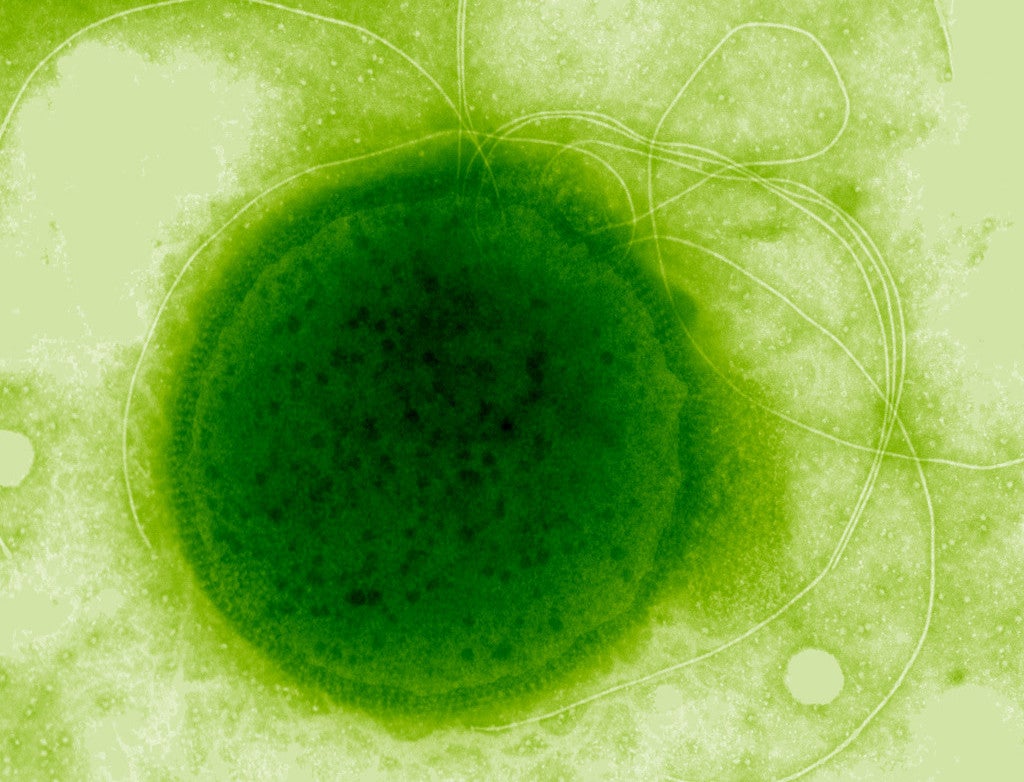
Alright, here we are. Lucky number seven. And we’ve saved the most radioresistant for last. As its name suggests, Thermococcus gammatolerans is good at handling gamma radiation, both in reducing the extent of DNA damage induced by radiation and in its ability to repair damaged chromosomes. (It’s fitting, perhaps, that it’s a select few single-celled organisms that would fare best in a nuclear apocalypse, rather than the sort of complex lifeforms that would invent such bombs in the first place.)
In 2016, researchers dosed the microbe with 5,000 Gray, and it shrugged. But that was just to get a better understanding of how the organism was able to resist the radiation on a genetic level. The extremophile’s real feat occurred in 2003, when it was first identified. Found among hydrothermal chimneys in the Gulf of California, T. gammatolerans grew even when subjected to a whopping 30,000 Grays of gamma radiation. (Again, the lethal dose for 50% of a human population in 30 days is 4.5 Grays. So, not even remotely close).
Even when nematodes, E. coli, and perhaps even tardigrades have gone the way of the dodo, it seems that bacteria like T. gammatolerans could still hold their own. But the evolutionary path is long and winding, and we haven’t blown the world to bits just yet. Perhaps we humans just prefer death by a thousand cuts.