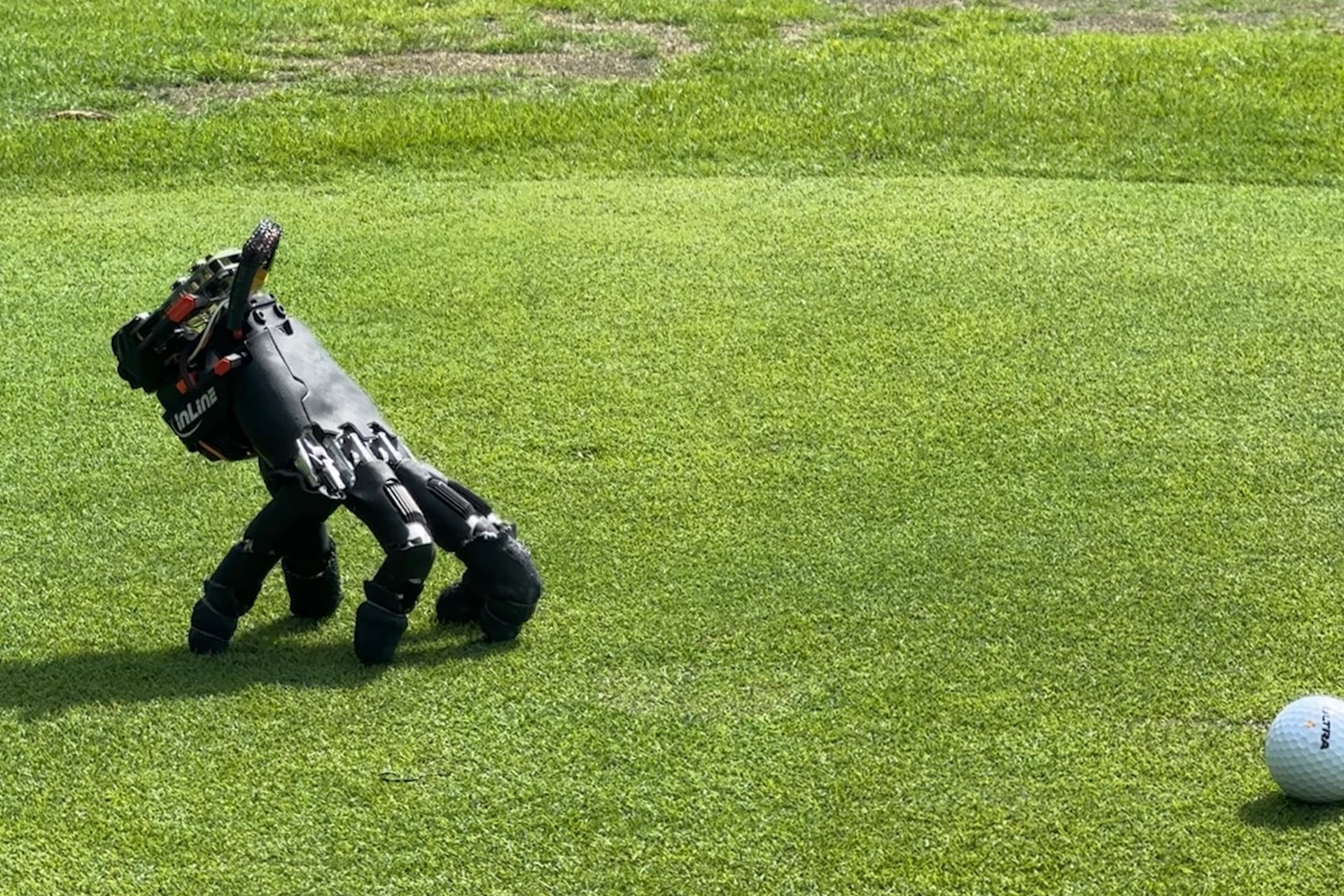
Snap, snap. There’s a new member of the Addams-inspired robotics family, and it’s got a very unusual way of getting around. Shaped like a disembodied hand and walking on its own fingers, this quirky robot brings Thing to life in a whole new way.
A team of researchers from Soft Robotics Lab, ETH Zurich, built an autonomous robotic hand that uses its fingers as legs. Inspired by Thing from The Addams Family, the robot learned how to navigate across different surfaces, press keys, push small objects, and recover from falls, all with the same set of fingers it walks on.
You can watch the little guy in action in the video above. And yes, we agree it’s pretty adorable.
Busy hands
The robot is based on a standard anthropomorphic right hand with five fingers and 20 actuator joints (four on each finger). The researchers installed a compact on-board module with a battery, sensors, and computing hardware onto the hand.
Weighing in at only 1.8 pounds (818 grams), the detached robotic hand can operate autonomously without the rest of its body. “A robotic hand with its own mobility could operate in confined workspaces without requiring the arm that normally carries it to follow,” the researchers explain in a paper available on the preprint server, arXiv. “For example, a larger robot could place the hand on a support surface near a restricted opening. The hand could then move toward a control or object, interact with it, and return for retrieval.”
The researchers trained the hand using reinforcement learning in a specialized simulator with different parallel environments. Teaching it how to walk and carry out different tasks using its fingers presented a challenge: as one finger lifts to step or press a key, the others need to keep the entire hand supported.
Unlike the legs of a standard robot, the fingers are not identical, and the palm rests at a tilt. To help overcome this challenge, the researchers assigned each fingertip its own target position built around the hand’s natural stance. Based on each task, the robot would decide on where and when each finger steps.
A hand with a plan
During a series of tests, the detached hand navigated through 14 different types of indoor and outdoor surfaces—including asphalt, metal, tile, grass, gravel, and damaged stone. It also learned to carry out different tasks, including pressing keyboard commands and pushing a small cube toward a target.
The robot hand even engaged in a game of Sokoban, completing a level of the puzzle-solving video game by pressing the arrow keys. Aside from being able to walk, crawl, and steer its way across different surfaces, the hand is also able to recover from a fall, propping itself back up on five fingers after taking a tumble.
The researchers hope their prototype can be integrated as part of a larger robot for specialized tasks. “We show that a commercial anthropomorphic hand can serve as a self-contained mobile manipulator,” the paper reads. “Giving robotic hands their own mobility could make future robots more versatile in the spaces and interfaces built for people.”