Lagrange points (L-points)

For some spacecraft, such as space-based telescopes, it’s not ideal for them to be so close to Earth. Our planet emits visible light and infrared radiation, which can interfere with observations of distant stars and galaxies.
In those cases, we can send spacecraft to one of two Lagrange points—locations in space where the gravitational fields of Earth and the Sun combine to keep an object stable and in a fixed position relative to Earth. Technically speaking, these are solar orbits, but Earth is directly involved in generating these gravitational sweet spots.
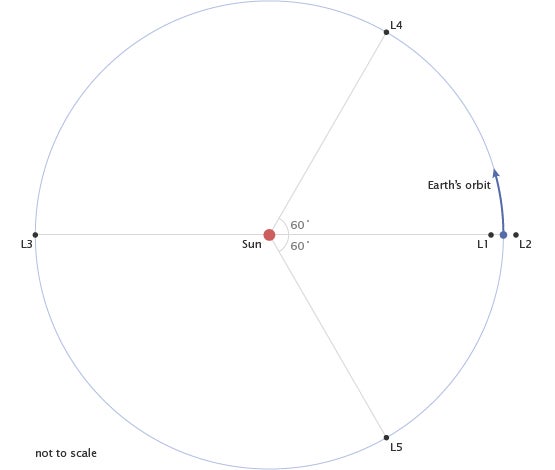
The first Lagrange point, L1, is located inside Earth’s orbit, while the second Lagrange point, L2, is behind Earth as viewed from the Sun. Both L1 and L2 are located 932,000 miles (1.5 million km) from Earth.
Spacecraft currently working in Sun-Earth L1 include NASA’s SOHO solar telescope and ESA’s gravitational wave detector, LISA Pathfinder. L2 is currently home to the Webb Space Telescope and ESA’s star-mapping GAIA observatory.