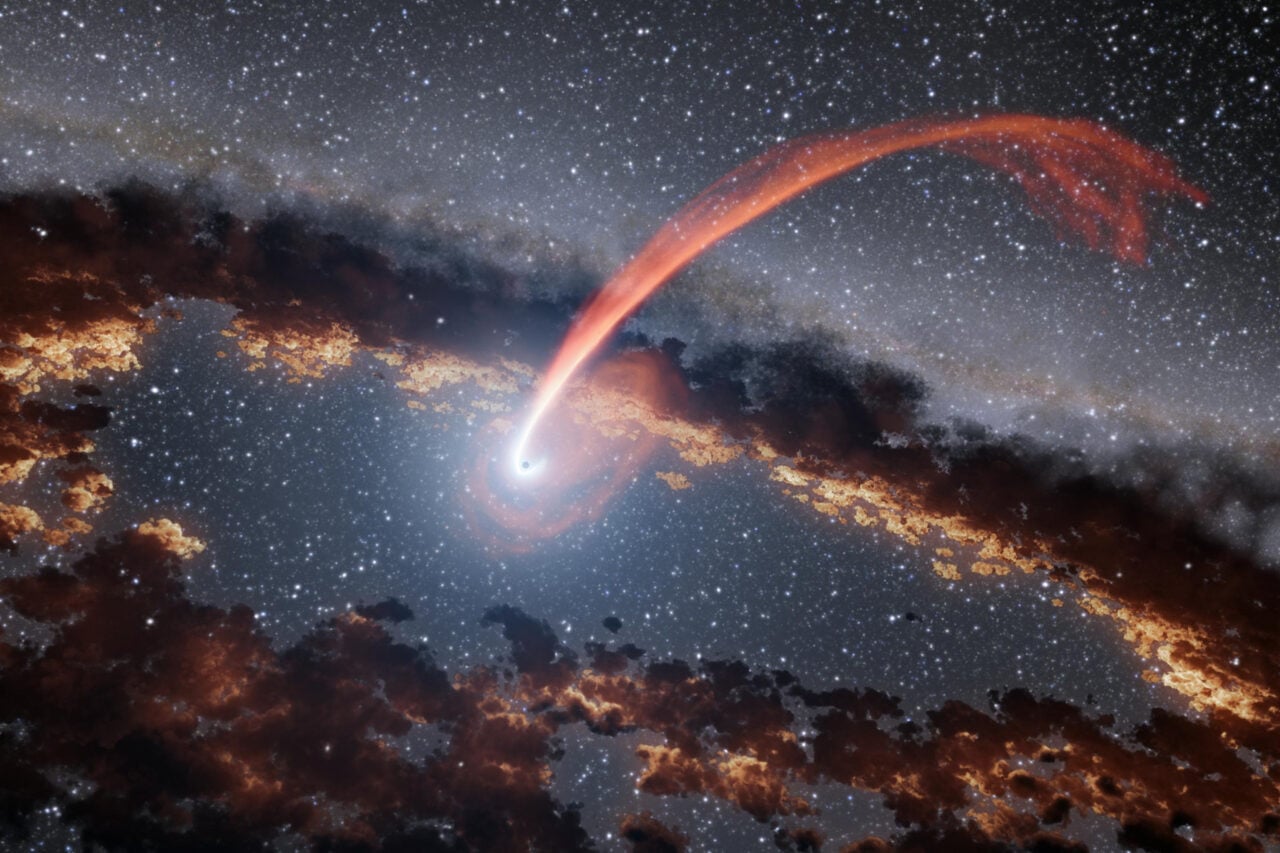
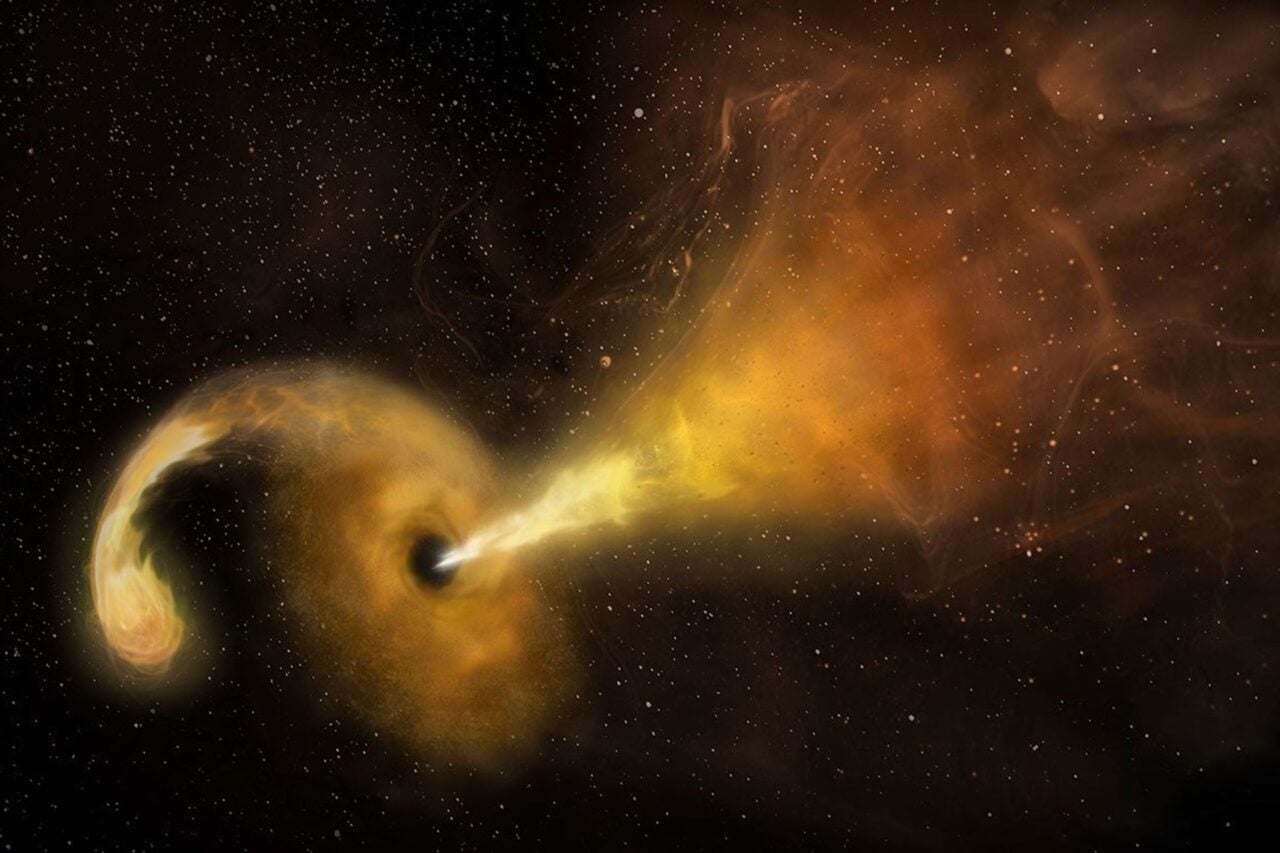
A star, no bigger than our own sun, orbits a black hole, and every once in a while they get so close, the black hole starts siphoning off pieces of the star — creating an explosive particle blast.
The above image is an artist’s representation of GX 339-4, a “low-mass X-ray binary located about 26,000 light-years away in the constellation Ara.” The sun is no bigger than ours, but it orbits a black hole “estimated at 10 solar masses,” every 1.7 days. And four times in the past seven years, the sun and its black hole partner have had an explosive meeting.
Binary systems where a normal star is paired with a black hole often produce large swings in X-ray emission and blast jets of gas at speeds exceeding one-third that of light. What fuels this activity is gas pulled from the normal star, which spirals toward the black hole and piles up in a dense accretion disk.
“When a lot of gas is flowing, the dense disk reaches nearly to the black hole,” said John Tomsick at the University of California, Berkeley. “But when the flow is reduced, theory predicts that gas close to the black hole heats up, resulting in evaporation of the innermost part of the disk.” Never before have astronomers shown an unambiguous signature of this transformation.
It’s a bumpy orbit, but the view is probably spectacular. [NASA]