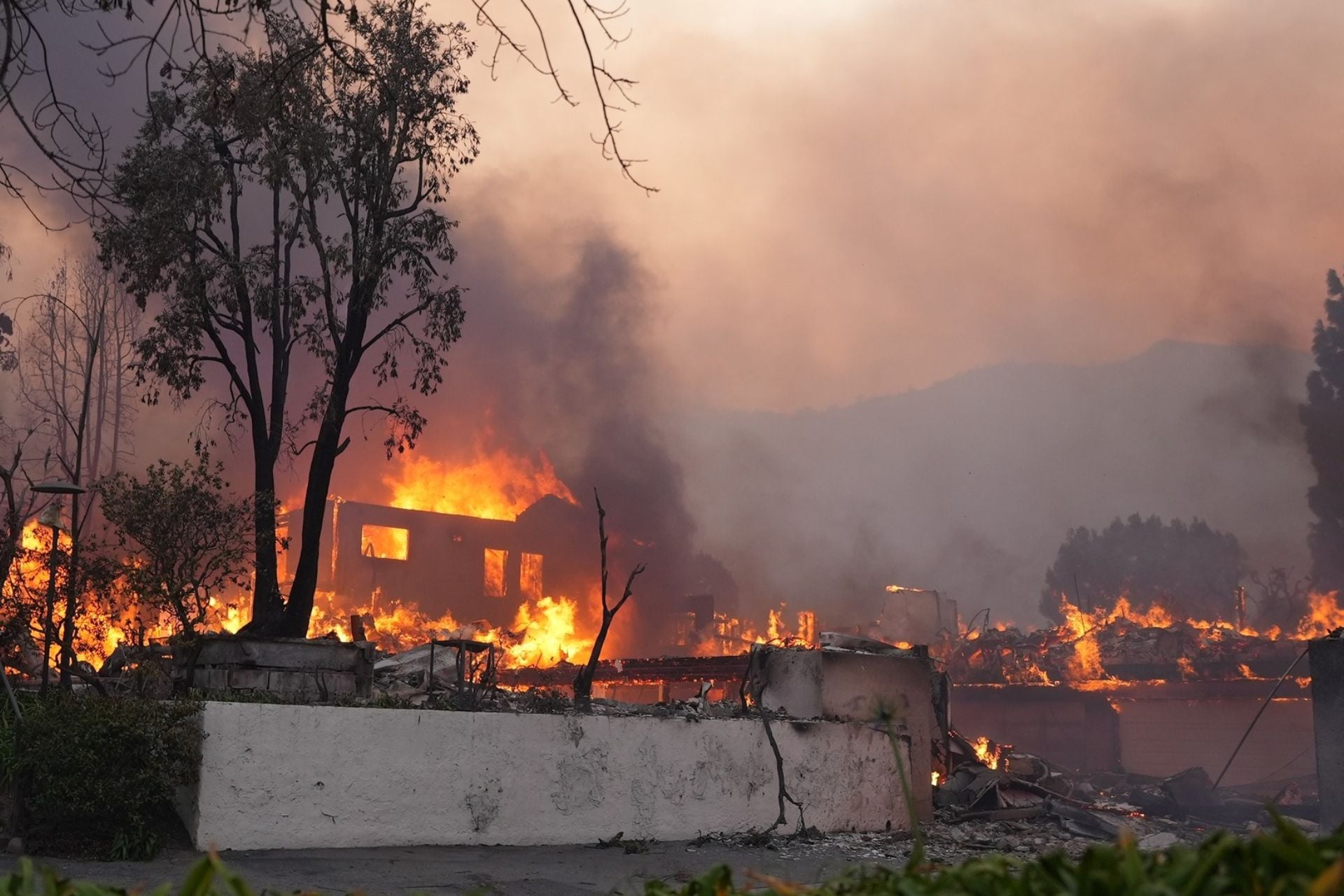
The Palisades and Eaton fires, which tore through Los Angeles County in January 2025, marked one of the most destructive wildfire disasters in U.S. history. Together, they destroyed about 16,000 buildings—roughly four times the typical annual number of structures lost to wildfires across the entire country.
This tragic event exemplifies a growing risk to homes, businesses, and infrastructure across the United States, particularly in the West. According to a study published today in Nature Communications, that risk is on track to triple by mid-century. The researchers found that some 300,000 buildings could be destroyed or damaged by wildfire by 2060 unless we take meaningful action to curb global warming and adapt to fire.
“The central message of our research is that the projected increase in wildfire losses is not inevitable,” lead author Virginia Iglesias, director of Earth Lab at the University of Colorado Boulder, told Gizmodo in an email. “Our estimates describe what could happen if current patterns of mitigation, development, and structural vulnerability persist without additional adaptation. The decisions we make today can substantially change that trajectory.”
Wildfire risk is growing nationwide
To project wildfire risk to U.S. buildings decades into the future, Iglesias and her colleagues first reconstructed that risk from 1945 to 2023 using historical data about burned area, development patterns, and fire impacts. They then fed this reconstruction into a model along with weather, climate, and housing-density data to calculate how many structures could burn between now and 2060.
The researchers found that, under business-as-usual conditions with no adaptation, between 133,200 and 449,100 buildings could burn by mid-century, with an average of 300,000. For 2051 to 2060, they project wildfire risk to U.S. structures to be up to 3.2 times greater than it was from 2011 to 2020.
The analysis also revealed important regional and socioeconomic disparities. While the West—particularly California—will remain the epicenter of fire risk, emerging hotspots across central and eastern states could threaten communities that have less experience with wildfire and are therefore less prepared. In the West, 30% of census tracts projected to face the highest fire risk overlap with socioeconomic hardship, meaning the most vulnerable communities could suffer the greatest structural losses.
Preventing the worst-case scenario
A 2022 study by Iglesias and colleagues showed that wildfires became bigger, more frequent, and more widespread across the U.S. in the 2000s, largely due to climate change. The nation is struggling to protect people and infrastructure from this rising threat. In recent years, annual firefighting expenditures have exceeded $3 billion, and yet the U.S. has seen some of its most destructive and lethal fires on record, with economic losses more than 130 times higher than suppression budgets.
Mitigating global warming is absolutely essential to reducing the risk of wildfire across the United States, but changing fire behavior alone cannot explain the sharp rise in structural losses observed in recent years, according to the new study. The authors believe this trend stems from a confluence of sprawling development into fire-prone terrain, heightened structural and social vulnerability, and widespread landscape modification—all compounded by a lengthening fire season.
“What we found is that development largely determines where risk is concentrated, while changes in fire activity drive how risk increases over time,” Iglesias said. She and her colleagues hope their study will help spur investment in fire adaptation and resilience at multiple scales.
“At the household level, measures such as using fire-resilient building materials, protecting homes from embers, and maintaining defensible space can largely improve the odds of a home’s survival,” Iglesias said. “But no single measure removes risk completely. Wildfire resilience requires a collective effort, with neighbors and local governments working together to reduce risk across entire communities and surrounding wildlands.”
Without concerted action, the U.S. will almost certainly face more devastating events like the Palisades and Eaton fires in the coming decades. The longer we wait, the harder it will be to reverse course toward a safer future.