Hot, dry, and gusty Santa Ana winds blasting across Southern California have ignited two rapidly spreading wildfires near Malibu and San Diego. Firefighters working to contain the blazes could face even more challenging conditions today as the winds reach their peak.
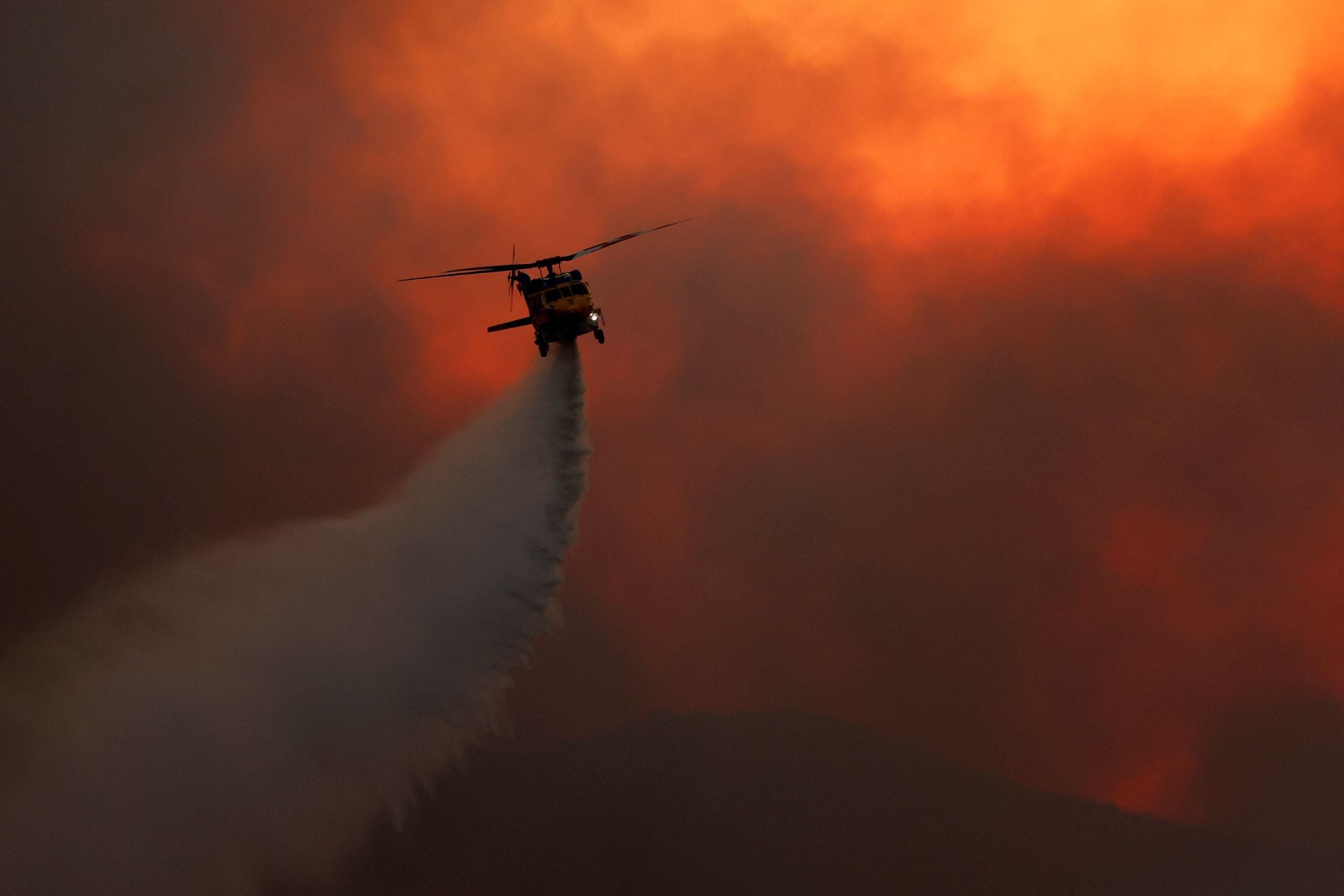
The Henderson fire ignited on Camp Pendleton, a Marine Corps base about 40 miles (64 kilometers) north of San Diego, at around 2:35 p.m. PT on Thursday, according to the California Department of Forestry & Fire Protection (CAL Fire). In just a few hours, the inferno exploded in size. Firefighters with the Camp Pendleton Fire Department and partnering agencies responded with ground crews and aircraft, but faced challenging fire weather conditions overnight. Per CAL Fire’s latest update, the fire has burned 2,080 acres and is 0% contained.
According to the disaster tracking platform Watch Duty, Santa Ana winds were pushing the Henderson fire westward at 12 p.m. PT on Friday. Around that time, the California Highway Patrol Oceanside Office stated that nearby Northbound Interstate-5 had been closed at Vandegrift Boulevard. Thursday evening, authorities briefly closed I-5 in both directions due to the encroaching blaze, snaring traffic.
At roughly 5:00 p.m. PT that same day, the Bryson fire broke out near Encinal Canyon Road in the dry, brush-covered mountains of Malibu, according to CAL FIRE. In less than two hours, it grew to 100 acres. Local news channel KTLA 5 reports that firefighters deploying helicopters, bulldozers, and hand crews to prevent them from spreading south of Encinal Canyon Road. They managed to achieve some suppression overnight, and by Friday morning the fire was 17% contained and had burned 147 acres.
🔥🚨NEW: Multiple wildfires have broken out around the greater Los Angeles, CA metro Thursday afternoon! The two largest are the Bryson Fire (Malibu) and the Henderson Fire (Northern San Diego County). A strong Santa Ana wind event is likely to fan these blazes further through… pic.twitter.com/fMakJ7DgjN
— WeatherNation (@WeatherNation) October 16, 2026
Santa Ana winds return with a vengeance
The Santa Ana typically strike between September and May, when air from a region of high pressure over the desert Southwest flows westward toward low pressure off the California coast This creates dry, fast-moving winds that flow eastward through the mountain passes of Southern California and drastically increase fire danger. This year, the winds arrived right on schedule but at more aggressive speeds than expected, according to the National Weather Service.
“We are on track for the longest and strongest period of Santa Ana winds today, especially at lower elevations (coastal valleys to coast) with [the] strongest corridor of winds sliding a bit north into a more traditional Santa Ana setup,” the agency’s Los Angeles office stated Friday morning.
Peak wind speeds could reach 50 to 70 miles per hour (80 to 113 kilometers per hour) across the counties of Ventura and Los Angeles today before gradually weakening. The NWS office in San Diego expects 50 to 65 mph (80 to 105 kph) wind gusts through Saturday. In addition to creating dangerous fire weather, lashing winds could damage structures, trees, and power lines.
In anticipation of the winds, Pacific Gas & Electric (PG&E) implemented widespread public safety power shutoffs. As of Friday afternoon, more than 86,000 PG&E customers remained without power.
During a press conference this morning, Kevin McGowan, director of the Los Angeles County Office of Emergency Management, said the most critical fire weather will occur through Friday afternoon, when the strongest and longest-lasting winds are expected.
“Strong winds and very dry conditions will continue to cause fire starts to spread rapidly,” McGowan said. “So we’re urging everyone to remain vigilant and ready to act.” Red flag conditions could persist through 8 p.m. PT on Saturday, officials said.
While it’s typical for Southern California to see an uptick in wildfire activity this time of year, rapidly growing blazes like the Henderson and Bryson fires are becoming more common as the climate warms. Over the past century, the region has seen increases in forest area burned, burn severity, fire spread potential, and fire season length. As Santa Ana winds return each fall, it will become increasingly difficult to extinguish the fires they ignite.