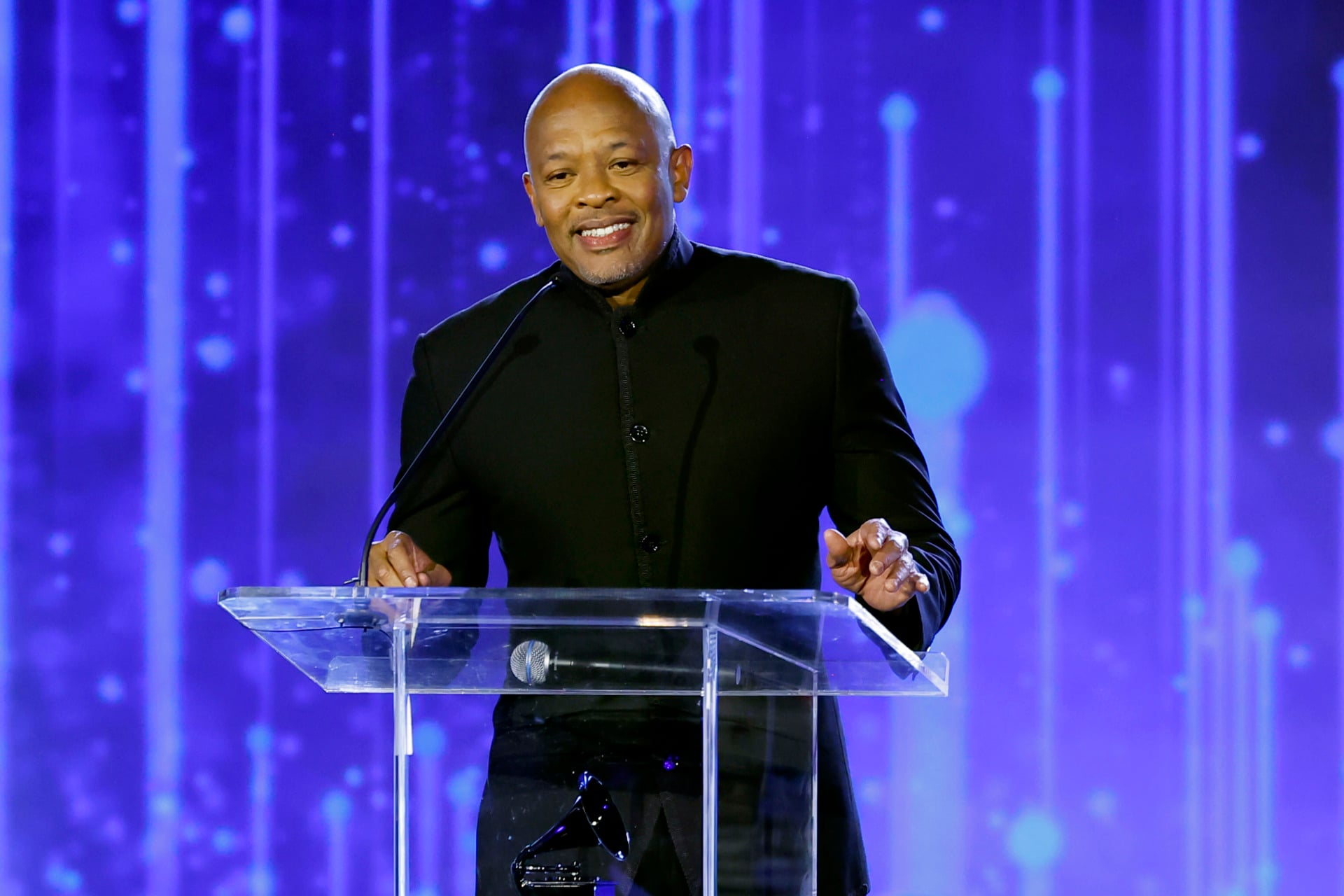
Dr. Dre, the pioneering rapper and seven-time Grammy-winning producer behind hit songs like Tupac’s “California Love” and Eminem’s “The Real Slim Shady,” is very much pro using artificial intelligence tools to make music.
In an interview with the New York Times, Dr. Dre and Interscope Records co-founder Jimmy Iovine spoke about artificial intelligence’s recent foray into music production, with the producer characterizing those who oppose AI song generation tools as “afraid of learning new things.”
“I don’t see it as a threat. I think the only people that see it as a threat are the people who have trouble creating,” Dr. Dre said. “I had a discussion with a few people a few days ago. They were against AI, and I’m like, ‘OK, you sound like the person that would have been against the drum machine when it came out.’ Or synthesizers, right?”
AI song generation tools have experienced a surge in popularity in the last year. In the coming weeks, both Spotify and Apple Music will begin labeling AI “artists” on their platforms as such, a move that simultaneously highlights the increasing criticism for AI-generated music that presents itself as authentic, and the growing acceptance of these tools as a legitimate way of creating songs. Spotify is even partnering with Universal Music Group to build a tool that will let users create AI-generated song covers, even going so far as to bank on Spotify users to pay to use the upcoming feature when it launches.
There are many, like Dr. Dre, who view these tools as just another piece of technology to aid the greater production process, cutting down barriers like time and cost by automating some of the work that the producer themselves or perhaps a collaborator in the form of a real, paid human would have otherwise done. Others are worried about wider implications of the wholesale adoption of this technology, including the automation of jobs, the murky (and some argue illegal) use of copyrighted material, and the end products that sound like soulless, repetitive AI slop.
Iovine, the music executive and Dr. Dre’s partner in Beats by Dre, for his part, says he doesn’t “see the downside at all.”
“There will be some crappy music. There’s crappy music now,” Iovine told the NYT. “In the studio, when gifted people have AI, they’re going to make better records.”
Dr. Dre said he uses AI in producing “as a tool to see what it would do with what I just did.”
The award-winning producer also said he is definitely not alone among his peers in his stance on AI either: many producers use AI but fear to admit it. Iovine calls them “closet AI producers,” and says Timbaland, the four-time Grammy-winning singer-producer behind a long list of hits like “Promiscuous” with Nelly Furtado, is also one.
AI’s role in the creative fields is a topic of controversy that extends far beyond just music. The generative AI boom is resulting in AI tools that also automate the work processes of writers and visual artists like videographers, photographers, models and actors. Those industries are also facing a similar split, with some creatives embracing the technology in moderation while others raise concerns about any form of acceptance.
In the film industry, for example, directors such as Martin Scorsese and Steven Soderbergh, and actors like Reese Witherspoon have all come out in support of adopting AI into the filmmaking process. Others have not been as keen. Director Guillermo Del Toro said earlier this year that he would rather die than use generative AI, and Seth Rogen said that if you use AI to write scripts, then maybe you just should not be a writer.
“The idea of a tool that makes me write less is not appealing to me, because I like writing,” Rogen told Brut in May. “And if your instinct is to use AI and not go through that process, you shouldn’t be a writer. Because you’re not writing. Go do something else.”