The brain is an intricate organ, one that we still barely understand. And sometimes, as a recent case study shows, we can change the brain in ways that no one would have expected.
Researchers at Dartmouth College and Brigham and Women’s Hospital have detailed a 28-year-old man with a peculiar condition that causes him to see his cat’s eyes on people and the other way around. The man, identified only as Karl, developed the condition after he underwent brain surgery. Though these sorts of cases are incredibly rare, they illustrate the unique neural circuitry that underlies our facial perception, the researchers said.
“Seeing a friend’s eyes in your cat’s face, or vice versa, is extraordinary, but it tells us something about how all of us process faces,” lead author Brad Duchaine, a professor and chair of psychological and brain sciences at Dartmouth, told Gizmodo.
The man who sees cat eyes where they aren’t
Duchaine is head of the Social Perception Lab at Dartmouth. He and his team have a particular focus on people with prosopometamorphopsia, a group of conditions that causes people to experience distortions in their facial processing.
Prosopometamorphopsia, or PMO for short (phew, thank goodness for the acronym), is rare in general, with only about 75 cases ever recorded in the medical literature. Duchaine’s team has personally documented about 250 people with PMO who have contacted the lab. But Karl’s version is even stranger than most.
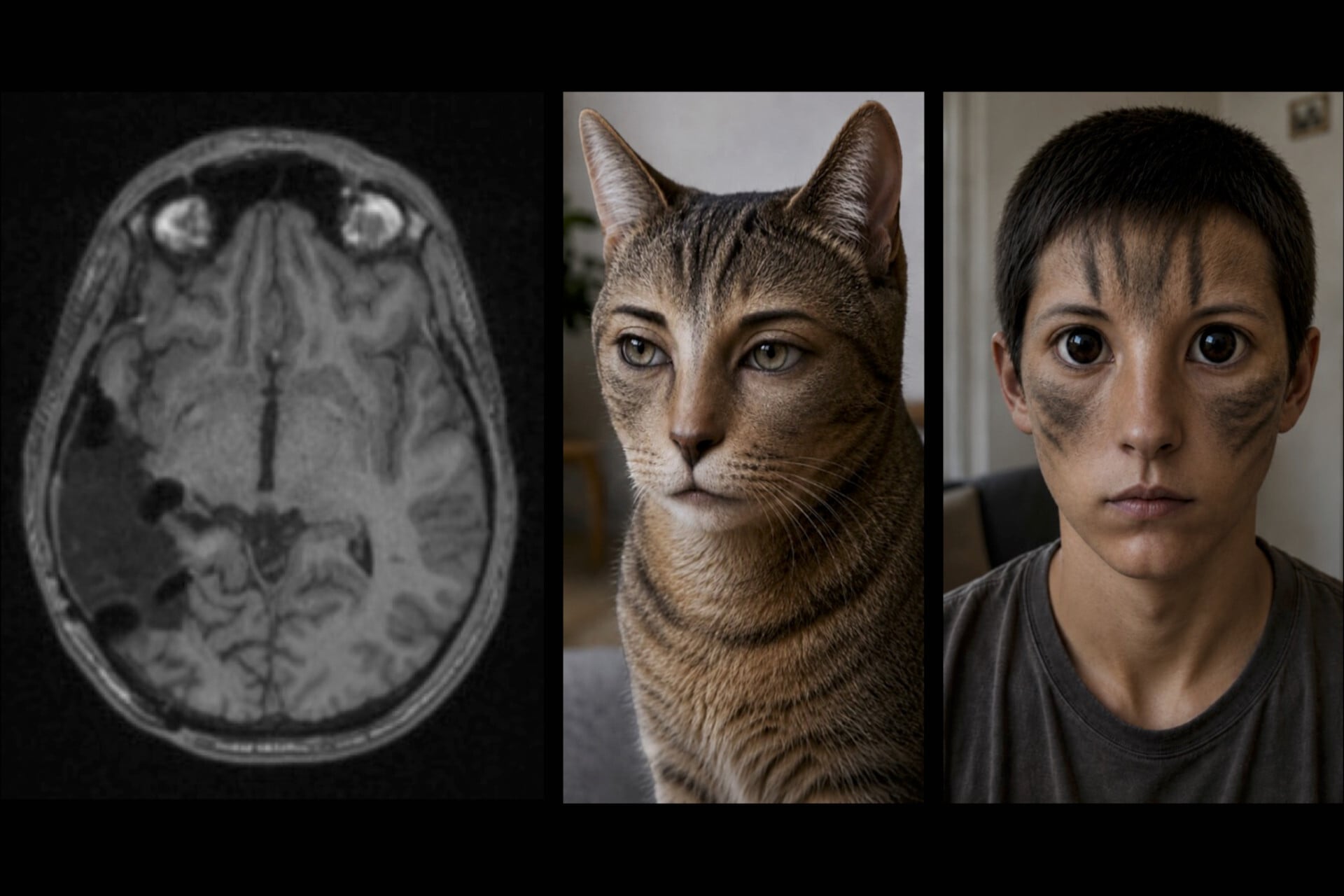
Two years ago, Karl needed surgery to treat a case of arteriovenous malformation, an abnormal tangle of veins and arteries that can raise the risk of a brain bleed; the surgery removed part of his right temporal lobe. Karl then developed palinopsia, a symptom that causes an earlier image, object, or light to linger or reappear in a person’s field of vision after it’s no longer there.
Karl’s palinopsia causes him to see features from a face he saw earlier, particularly the eyes, on other faces. This usually involves him seeing the eyes of his cat Luna on other people, since she’s often the first face he sees in the morning. However, his brain can also swap part of a human’s face onto his cat or simply swap parts of two people’s faces. These episodes typically occur for several hours but can sometimes last for the entire day.
The right temporal lobe plays a crucial role in our facial processing, and Karl’s face swapping represents a breakdown in how this normally happens, the researchers said.
“Our brains break faces into components and match them against features stored in memory. Karl’s percepts are what happens when that matching goes wrong and a stored feature gets stuck in the face perception system,” Duchaine explained.
Karl’s unusual PMO reminded Duchaine and his team of one other similar case involving a 58-year-old woman documented 40 years ago. The woman, identified as patient 2, reported that for 30 minutes, she saw the face of a poodle riding the bus in place of the other passengers’ faces. Her episode was likely caused by a stroke she experienced four months earlier, which led to other neurological symptoms.
The team published its study of Karl’s case last month in the journal Cortex—fittingly the exact same journal where the woman’s case of poodle palinopsia was reported.
A better illustration
The researchers say their work also shows off a valuable application of artificial intelligence.
Scientists studying PMO have long used sketch drawings, often based on patients’ accounts, to approximate what they see. This time, however, the team fed the drawings of Karl’s PMO into a generative AI model, specifically OpenAI’s Chat GPT 5.5, to create a more life-like rendering. They then worked with Karl to further mold the initial draft into the images included in the paper. The team also created an AI-generated image of the sketch included in the poodle palinopsia case.
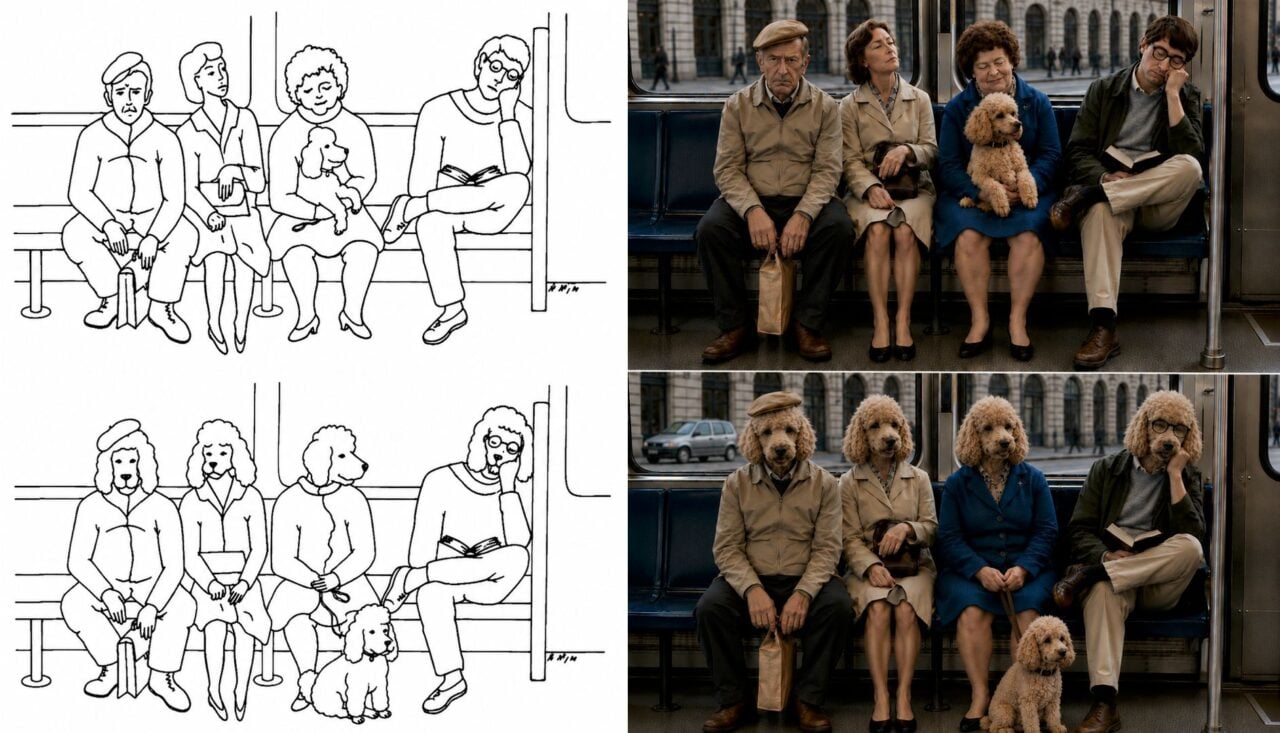
“Until recently, researchers studying visual disorders have relied on patients’ verbal descriptions or rough sketches. With Karl, we refined photorealistic images with him until he said they matched what he had seen,” Duchaine said. “These visualizations allow others to understand visual disorders much more accurately, and I expect this approach to become a standard tool for researchers and clinicians.”
AI-generated imagery might be getting harder to distinguish from the real thing, but somehow, I don’t think these images will ever be mistaken for something most people could see outside of an exceptionally rare brain condition.