When you put a giant legion of humanoid robots on the floor of an auto factory, do they actually increase efficiency and replace labor, or is that just a corporate fantasy? An auto workers union in South Korea, where Hyundai may one day deploy one such legion of robots, doesn’t seem to be asking that question. Instead, it’s essentially asking for reassurance that when—not if—the robots come to take people’s jobs, there will be a deal in place that cushions the blow.
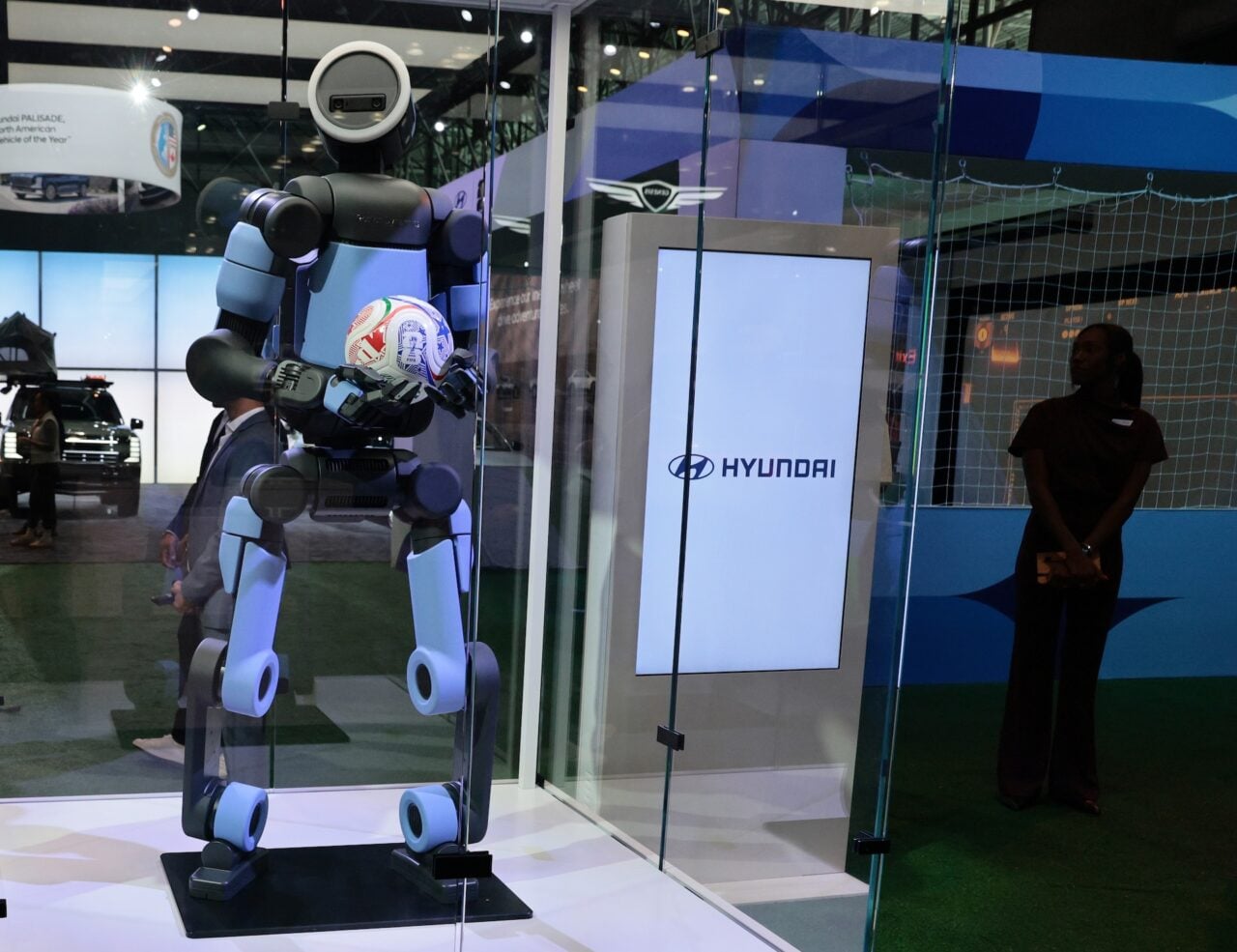
Hyundai, in case you haven’t been following this saga, has developed robot fever over the past couple years as its deepened its involvement with Boston Dynamics—buying most of the company in 2021, and initiated a deal to take over pretty much the rest of it earlier this year. During this transition, we’ve seen a lot of videos of the sleeker, new-ish Atlas prototype with its now famous uncanny double-jointedness and its ring light-shaped face.
But this year, Hyundai and Boston Dynamics have been signaling to investors that the Atlas robot is no longer a prototype with jutting hardware and exposed joints. It should now be thought of as a finished piece of hardware with real world applications that can be operated in the same room as workers and equipment. What’s more, Hyundai claims to be manufacturing tens of thousands of them, and rolling them out soon.
More specifically, according to CNBC, Hyundai plans to bring Atlas robots to its plant near Savannah, Georgia by 2028, and initially have them perform “sequencing,” or placing parts in the correct order for assembly. Apparently that will only involve small parts at the beginning, but if all goes according to plan, by 2030, Atlas robots will perform, again per CNBC, “tasks involving heavy loads, repetitive motions and complex operations across production sites.”
In some ways, the labor movement in South Korea has been ferocious this year. For instance, to avert an impending strike in May, Samsung made an astonishing deal with unionized workers at its memory plant that paid out to the tune of almost $400,000 per worker in bonuses, as estimated by Yonhap News Agency.
Perhaps with that in mind, Hyundai workers in Ulsan, South Korea launched a three-day partial strike earlier this week as part of its routine annual wage talks. The action, according to the Korea Herald, involved workers leaving two hours early across two shifts, resulting in four hours of lost productivity per day for Hyundai. According to Bloomberg, this is after last week’s talks failed to result in an agreement.
The Hyundai union seems to be capitalizing on these recent victories for labor. Per Bloomberg, big bonuses are a major sticking point:
Long dismissed as an opening bargaining chip, the demand has gained traction after tech giants Samsung Electronics Co. and SK Hynix Inc. recently gave chips workers massive bonuses to share in the windfall profits the companies are generating from the artificial intelligence boom.
But according to the Wall Street Journal, one of the main negotiators for the union, Byun Jun-hwan, said another sticking point in negotiations was the Boston Dynamics robot plan. “We have to prepare to ensure there are safeguards in place,” Byun told the Journal. At the start of negotiations back in May, the Journal reports that workers had shouted “Demands for job security against future industrial shifts!” the shout-ability of which must have gotten lost in translation.
The Journal characterizes this as “the car industry’s first factory stoppage addressing humanoid robots,” which it is, but in a way it also represents the union negotiating terms of surrender before a battle has started. The Journal’s reporters say there are signs in Ulsan demanding “pre-emptive action” over robots, which are not yet scheduled to be deployed in South Korea.
What the union seems to be demanding isn’t that humanoid robots never be used in factories, but simply a more favorable deal with eventual robot use in mind: a change from hourly wages to salary—“to guard against a potential reduction in work hours brought on by automation,” the Journal says—along with a somewhat counterintuitive demand that the retirement age be moved from 60 to 65.
This retirement age point could be read as the saddest concession of all. It seems to assume that automation is really going to make reducing headcount into an imminent corporate priority, and—perhaps wisely—guesses that Hyundai won’t use mass layoffs to make it happen. Maybe they’ll use retirement to shrink the workforce through attrition. Retirement at 65 would be a backdoor way of locking in a larger payroll under the assumption that there will be competition from robots.
Perhaps this is smart strategy, and the union has the right approach for its workers. Perhaps Hyundai’s Georgia rollout of Atlas robots will be a rip-roaring success, and will herald the final downfall of human factory labor. Perhaps a deal that earns workers a few concessions on their way out the door is the smart move.
On the other hand, as Hyundai, along with other automakers like Tesla, attempt to integrate humanoid robots into manufacturing over the next few years, it also seems possible that a wait-and-see approach will look even more forward-thinking. The performance of humanoid robots in factories could, after all, turn out to be an eloquent negotiator on behalf of human workers, and the moment when that’s revealed may turn out to be the right time to demand those colossal bonuses.