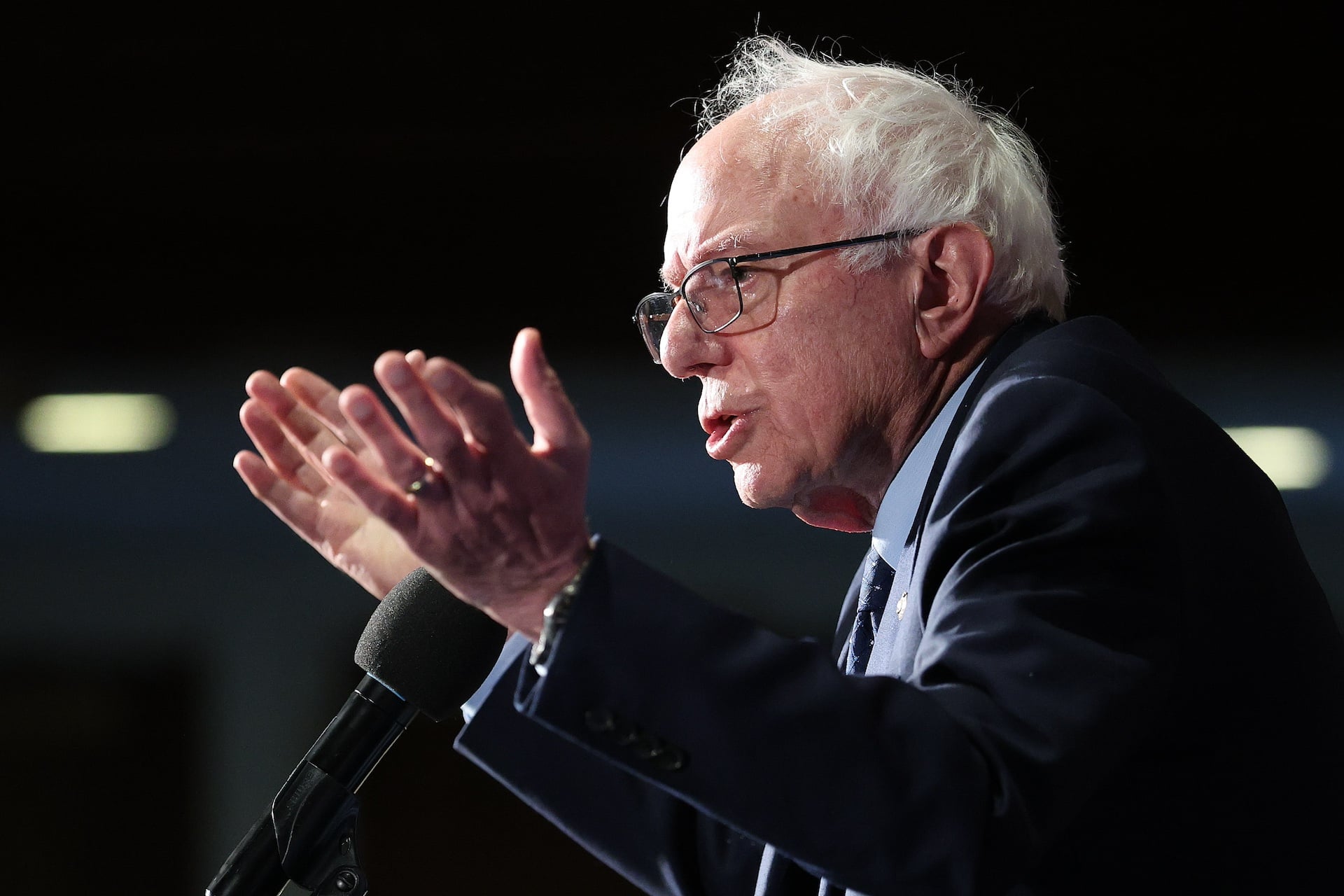
Bernie Sanders is making the case in Washington that since modern AI systems were built using the intellectual and creative outputs of all of humanity, the revenues they generate should go directly to the people—not just to a small cohort of tech moguls.
On Thursday, Senator Sanders—an Independent from Vermont—introduced a bill which, if passed, would create a sovereign wealth fund for the United States’ AI industry. The fund would be valued at roughly $7 trillion, a number derived from the current valuation of the country’s top AI labs, and would give the American public a 50% public stake in those companies.
As a result, taxpayers would receive an annual payment of $1,000 through the fund. That amount “will probably go up as AI becomes more prosperous,” Senator Sanders told reporters in a press briefing on Thursday. The fund could also eventually funnel “significant amounts of money … into social programs, making sure that all Americans have healthcare, education, decent housing, and other basic necessities of life.”
AI as a public resource
Proposed as an amendment to the 1986 Internal Revenue Code, Sanders’ bill argues that AI is ultimately a public resource, like precious minerals or oil extracted from publicly owned land, but a tiny number of companies are profiting from this resource as if it were a proprietary, privately owned product.
AI “derives its economic value from humanity’s collective intelligence, including our books, songs, artwork, journalism, computer code, scientific research, videos, conversations, images, and ideas spanning generations,” the bill reads. “A small number of oligarchs have essentially stolen the creative work of hundreds of millions of people … without permission, acknowledgment, or compensation in order to control the majority of economic value created by artificial intelligence.”
More than 100 sovereign wealth funds currently operate in 67 countries, including the United States. One example is the Texas Permanent School Fund, established in 1854, which helps fund the state’s public school system with revenue from the extraction of natural resources such as oil and gas.
Growing bipartisan support
Sanders isn’t the first person to suggest that giving Americans a direct ownership stake in the wealthiest AI companies might be an effective way to offset the technology’s more destabilizing economic impacts. California Governor Gavin Newsom has directed state officials to start researching the practicality of the model, which is known as universal basic capital, or UBC (not to be confused with universal basic income, or UBI).
It’s even received some support within the AI sector itself. OpenAI and Anthropic have both suggested that some version of this system may be necessary to share the AI industry’s gains with the broader public and cushion workers against job losses caused by the technology’s adoption. The companies—which are both expected to finalize their IPOs later this year—have also recently called for the formation of an international organization to oversee, and if necessary slow down, the development and deployment of powerful new AI models.
Elon Musk—as of this week, the world’s first trillionaire—has suggested that the federal government may need to issue checks to Americans to compensate for AI-driven disruptions to the labor market. Even Donald Trump, who’s become known for giving the American AI industry a decidedly generous amount of leeway, is now reportedly weighing the possibility of providing direct payments to Americans through an equity stakes agreement with AI labs like OpenAI. But Sanders’ new bill marks the first time this idea has been put forward as potential federal legislation.