
NordVPN was the only VPN to unblock TVING from a Seoul server, at 137.40 Mbps. ExpressVPN and Proton VPN met an endless loading screen. Netflix Korea, Wavve, and Coupang Play opened on every app we tested. Korea is a long way from Europe. Every Seoul connection we measured cost at least a quarter of our download speed.
Korean IP Address in 4 Steps (October 2026)
- Sign up for NordVPN and install the app on your device.
- Search for South Korea and connect to the Seoul entry.
- Check the country on an IP lookup page such as whatismyipaddress.com.
- Sign in to the Korean service and start playback as usual.
Connecting to a Seoul Server
A VPN sends your traffic through a server of your choosing. Your IP address becomes that server’s. Pick Seoul, and Korean sites treat the connection as domestic. Type Korea into the app’s search box and pick the Seoul result. The whole process takes about a minute. Verify the result before signing in anywhere.
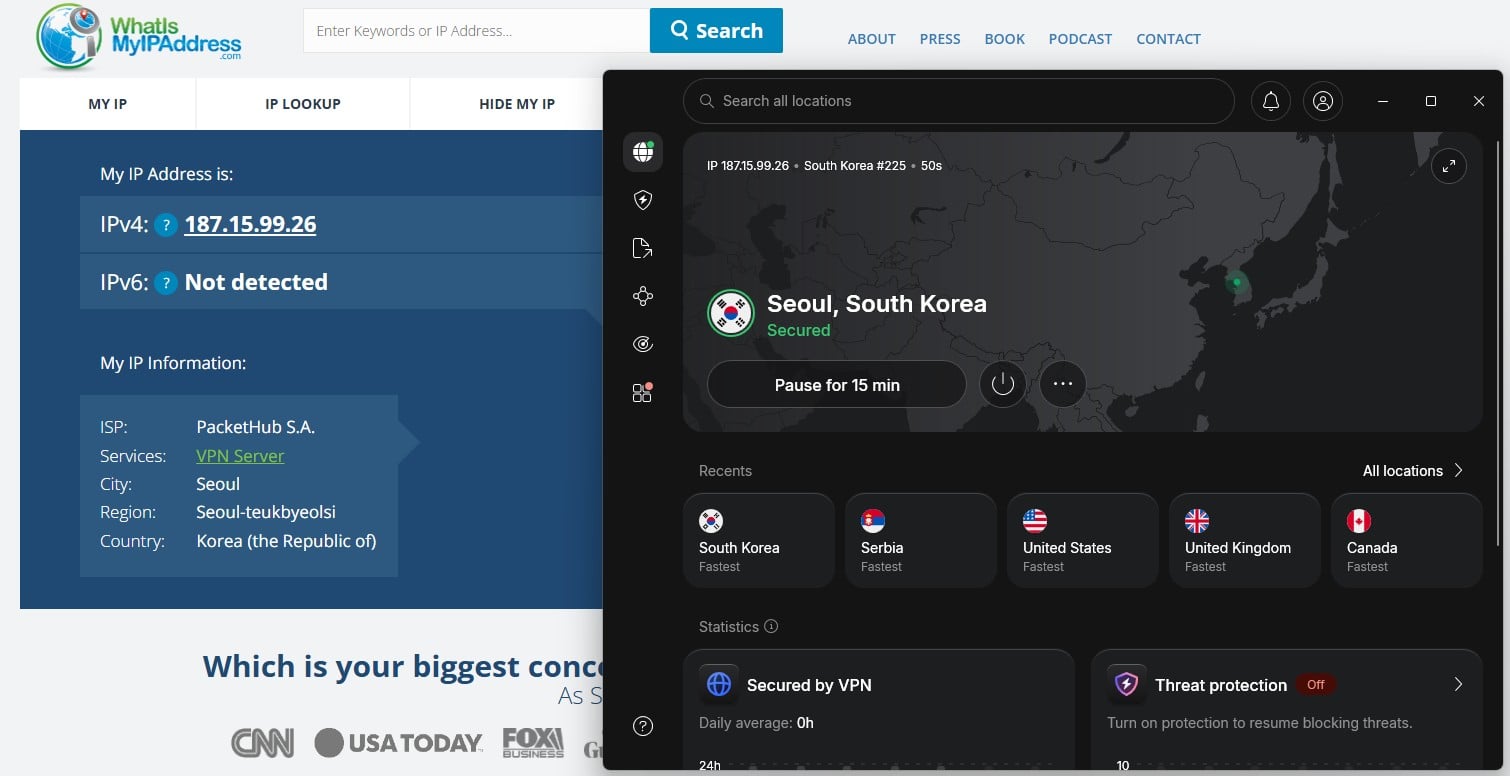
An IP lookup page should name Seoul, and it did for NordVPN, Proton VPN, and ExpressVPN alike. Plan for the distance. Ping from Europe measured between 265 and 282 ms, so video takes longer to start and live chat lags. Download speeds were sufficient for HD on every connection.
Korean Services That Check Your Location
Korean streaming is licensed for Korea. TVING, Wavve, and Coupang Play read the IP address before the player loads. A foreign connection receives a regional error. Netflix Korea works differently. The catalog follows the country of the IP, so a Seoul server switches to the local library. The list of Korean platforms is shorter than it was. Kakao TV closed on June 30, 2026, and Naver TV closes on September 30, 2026.
What remains splits between the subscription drama services TVING, Wavve, and Coupang Play, and the live streaming sites Chzzk and SOOP. Our guide to VPNs for South Korea covers the rest of the field. Banking accounts for the rest of the demand. Korean banks and government services treat foreign connections as a fraud signal. Unblocking a site that expects a domestic connection starts with the IP address.
Three VPNs in Seoul, Compared
We tested from a Windows 11 PC in Europe in October, with a 190.36 Mbps baseline before any VPN was connected. Each app went to its Seoul location; we checked the IP address, then opened Netflix Korea, TVING, Wavve, and Coupang Play.
| VPN | Korean servers | Download | Ping | Netflix Korea | TVING | Price |
|---|---|---|---|---|---|---|
| NordVPN | 10+ in Seoul | 137.40 Mbps | 276 ms | Unblocked | Unblocked | $3.49/mo |
| ExpressVPN | Count undisclosed | 118.70 Mbps | 265 ms | Unblocked, 1 detection | Stuck loading | $2.99/mo |
| Proton VPN | 66 in Seoul | 93.09 Mbps | 282 ms | Unblocked in HD | Stuck loading | $2.99/mo |
Best VPNs With Servers in Seoul
1. NordVPN: The Only One That Opened TVING
Pros
- TVING and Wavve unblocked
- Quickest Seoul download
- Netflix Korea in 4K
- Smart DNS for PlayStation
Cons
- Costly at renewal
- Windows conflicts with rivals
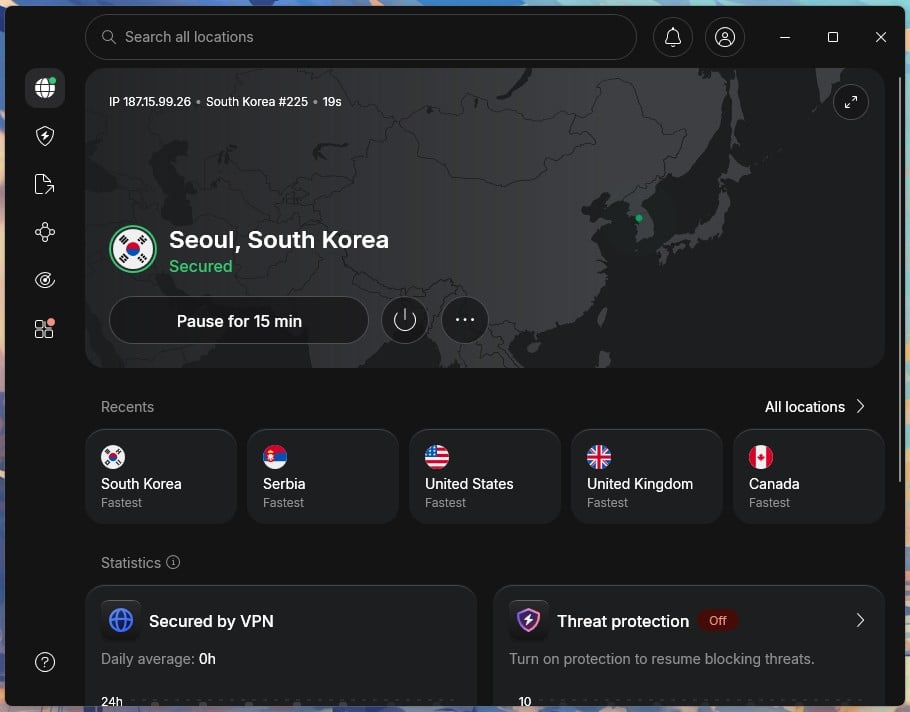
NordVPN unblocked every Korean service we tried, TVING included. Speeds on its Seoul server came to 137.40 Mbps down and 14.89 Mbps up at 276 ms, a 27.8% loss and the quickest Korean download we recorded. Netflix Korea played in 4K with no quality drop. The app lists 10+ servers in Seoul, and Smart DNS extends the Korean IP address to a console or a television without VPN support.
Two faults stand out. Renewal costs $139.08 a year against $3.49 a month on the 27-month plan. The Windows app also won’t connect now and then while a second VPN is installed, which never happened on Android or iOS.
2. Proton VPN: Deepest Seoul Coverage
Pros
- Dozens of Seoul servers
- Netflix Korea unblocked
- Secure Core routing
- Open-source, audited apps
Cons
- Slowest Seoul connection
- TVING stuck loading
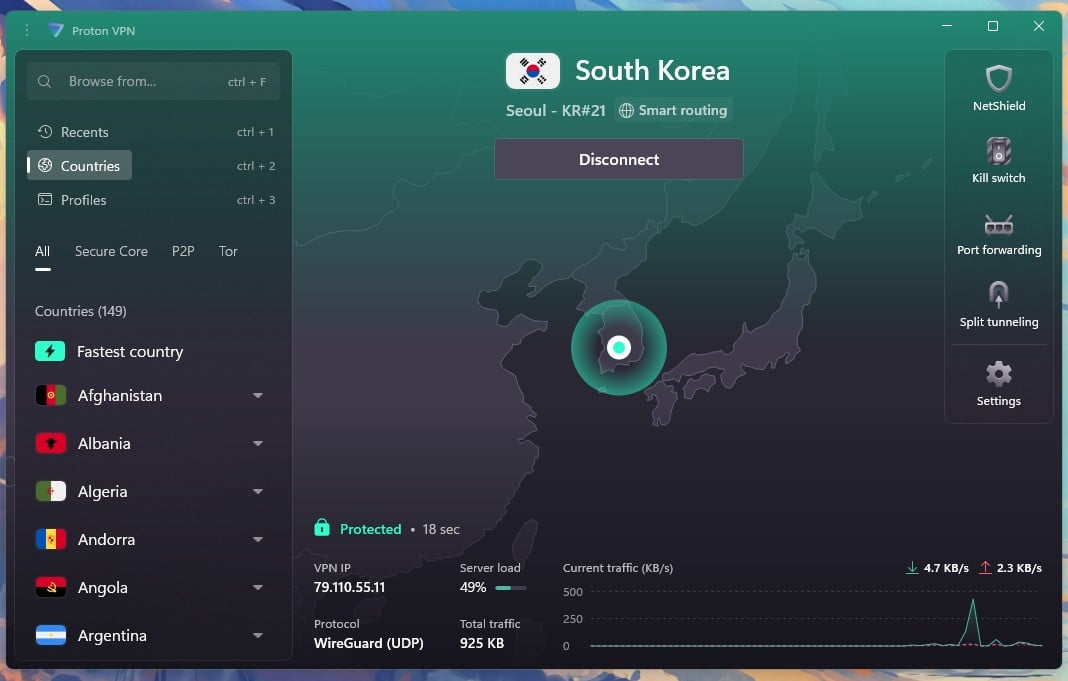
Proton VPN operates 66 servers in Seoul, so swapping away from a busy one is easy. Netflix Korea opened on it, though playback buffered often enough that we moved the quality setting down to HD and left it there. Speed explains that. Its Seoul server measured 93.09 Mbps at 282 ms, a 51.1% loss, the steepest drop we recorded to Seoul.
TVING never finished loading here either. Proton VPN skips Smart DNS altogether, which leaves a router install or the Android TV app for the living room. A year of VPN Plus costs $47.88, with 10 devices on the plan.
3. ExpressVPN: Lowest Ping to Seoul
Pros
- Lowest Korean ping measured
- Coupang Play unblocked
- MediaStreamer for televisions
- Obfuscation without a toggle
Cons
- Netflix detected it once
- Few settings to adjust
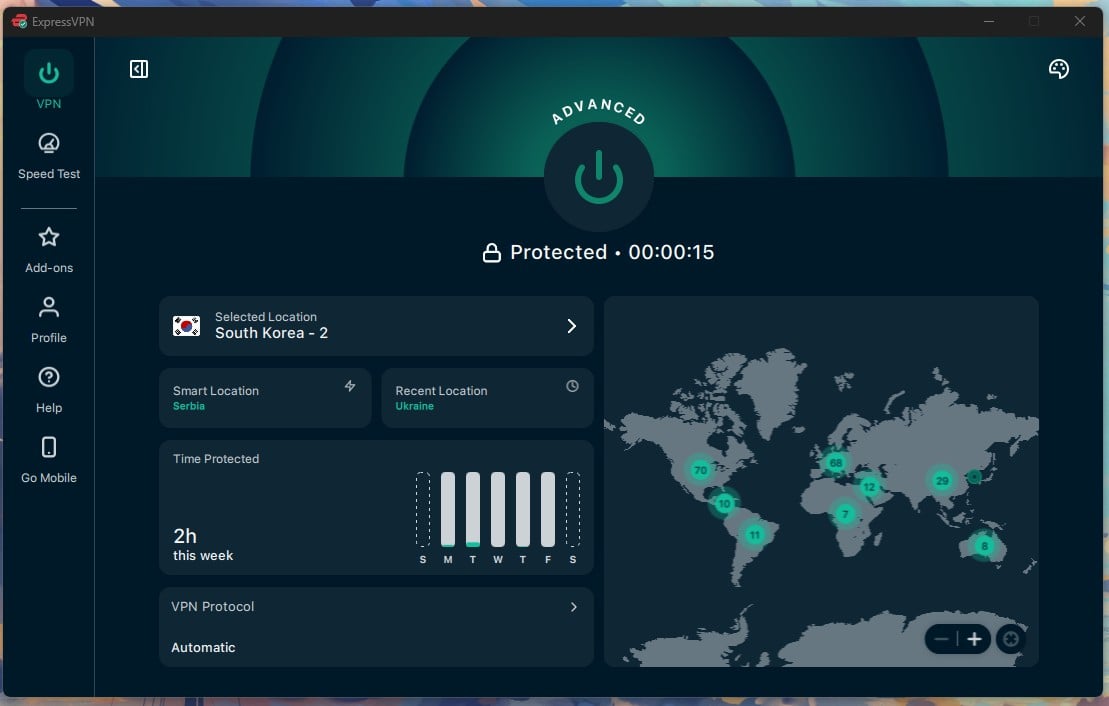
ExpressVPN recorded 118.70 Mbps at 265 ms, the lowest ping of the Seoul connections, which helps with Korean mobile games. It publishes no Korean server count. Wavve and Coupang Play opened, and Netflix Korea played after one detection screen that disappeared on a second server. TVING sat on a loading spinner here too.
Customization is thin, with settings limited to the protocol and the kill switch. Televisions connect through MediaStreamer, and every connection is obfuscated by default. Its Basic plan costs $83.72 across 28 months, renewing at $99.95 a year, and covers 10 devices. Gamers can pair it with our gaming VPN guide for the latency settings.
Free Plans Have No Korean Servers
None of the free tiers we tested list Seoul. Windscribe, PrivadoVPN, and Hide.me cover Europe and North America on their free plans. Proton VPN’s free tier assigns one of ten countries, Korea excluded, and TunnelBear offers free users no country choice. Korean content falls outside what any of them can do, though our free VPN rankings explain where they’re worth installing.
Free plans also struggle with distance. A Seoul connection from Europe already costs a quarter of the download speed on a paid server, and a congested free server would take a significantly larger cut.
Blocked Sites and Slow Traffic in Korea
Travelers and expats face the reverse problem. The Korea Communications Standards Commission maintains a blocklist, and a blocked site redirects to the government’s warning.or.kr page instead of loading, which covers well over 100,000 domains, mostly gambling and adult sites. Speed is the other complaint.
Korean ISPs charge content companies for the traffic their users generate, an arrangement found almost nowhere else, and international services have suffered for it. Twitch left the Korean market in February 2024, citing costs it called prohibitive. Connecting through a VPN to a server in Japan or Singapore often produces steadier video than the direct connection from Korea. Nothing in Korean law restricts VPN software itself.
Final Thoughts
NordVPN is the pick for a Korean IP address. It opened every service we tested, including TVING, and its Seoul server was fastest on a long connection where speed is scarce. Proton VPN has the most servers in Seoul and unblocked Netflix Korea, at half our baseline speed and with TVING out of range. ExpressVPN recorded the lowest ping, which helps with gaming and video calls back to Korea.
Expect latency of around 270 ms from Europe, whichever VPN service you install, and set playback quality accordingly. Our IP address guide repeats the process for other countries, and the cheapest VPN plans are worth checking if the Korean IP address is needed only for a week or two.
Try NordVPN Risk-Free for 30 Days
Korean IP Address FAQs
How do I get a South Korean IP address?
Install a VPN with Korean servers and connect to Seoul. NordVPN, Proton VPN, and ExpressVPN list South Korea, and the IP address changes a few seconds after the connection establishes.
Which VPN unblocks TVING?
NordVPN unblocks TVING from its Seoul servers. ExpressVPN and Proton VPN connect to Korea as well, though TVING leaves their Korean connections on a loading screen.
Can I get a Korean IP address for free?
No, the major free plans list no Korean server. Windscribe, PrivadoVPN, Hide.me, and TunnelBear leave Korea off their free country lists, so a Seoul IP address requires a paid plan.
Does Netflix Korea work with a VPN?
Yes, with a VPN that offers a Seoul server. NordVPN, Proton VPN, and ExpressVPN open the Korean catalog, and the library switches automatically once the Korean IP address is in place.
Is it legal to use a VPN in South Korea?
Yes, VPN use is legal in South Korea. The government blocks a long list of sites at the ISP level, and those blocks apply to Korean IP addresses instead of to VPN software.