South Korea has some of the fastest home internet in the world, yet thousands of foreign sites never load there. Type the address of a blocked site, and the browser jumps to warning.or.kr, a government notice page, instead. Adult sites, illegal betting sites, and pages the authorities consider pro-North Korean end up on that list.
The warning page isn’t the only reason to look for a VPN for South Korea. Free Wi-Fi covers every subway station, and that convenience comes with strangers on the same network. Meanwhile, Koreans living overseas face the reverse problem, with banks and TV services that expect a Korean connection.
So which VPN handles Korea from both sides? These five.
Our Korea Shortlist at a Glance
- NordVPN: Best Overall for South Korea. It unblocked every Korean service we tested and was the quickest on Seoul servers.
- Proton VPN: Best for Privacy. The largest published Seoul server count, backed by Swiss privacy law.
- ExpressVPN: Best for Easy Setup. Its apps connect in one tap, and its automatic obfuscation also helps on trips to China.
- Surfshark: Best Budget Option for Korean Servers. It unblocked TVING, Wavve, and Netflix Korea, and one plan covers every device you own.
- Private Internet Access: Best for Customization. Detailed settings and a strong ad blocker for everyday browsing in Korea.
Korean Servers and Results Side by Side
| VPN | Servers in South Korea | TVING | Wavve | Netflix Korea | Speed loss abroad (UK, US, Japan avg.) | Devices |
|---|---|---|---|---|---|---|
| NordVPN | 10+ in Seoul | Unblocked | Unblocked | Unblocked | 7.8% | 10 |
| Proton VPN | 66 in Seoul | Blocked | Unblocked | Unblocked | 10.2% | 10 |
| ExpressVPN | Seoul, count not published | Blocked | Unblocked | Unblocked | 7.8% | 10 on Basic |
| Surfshark | 12 | Unblocked | Unblocked | Unblocked | 9.6% | Unlimited |
| Private Internet Access | Seoul, count not published | Blocked | Unblocked | Blocked | 12.7% | Unlimited |
The Five VPNs We’d Use in Korea
Korea asks two different things of a VPN. In the country, it has to be fast on servers abroad. Outside it, the Seoul servers have to be quick enough for Korean TV and banking. For that reason, we judged the five on both counts.
1. NordVPN: Best Overall VPN for South Korea
Pros
- Unblocked TVING on Korean servers
- Fast on Seoul servers and abroad
- Dedicated IP address available in Seoul
- Double VPN for an extra layer of encryption
- No-logs claims verified by outside auditors
Con
- Renewal rate much higher than the intro price
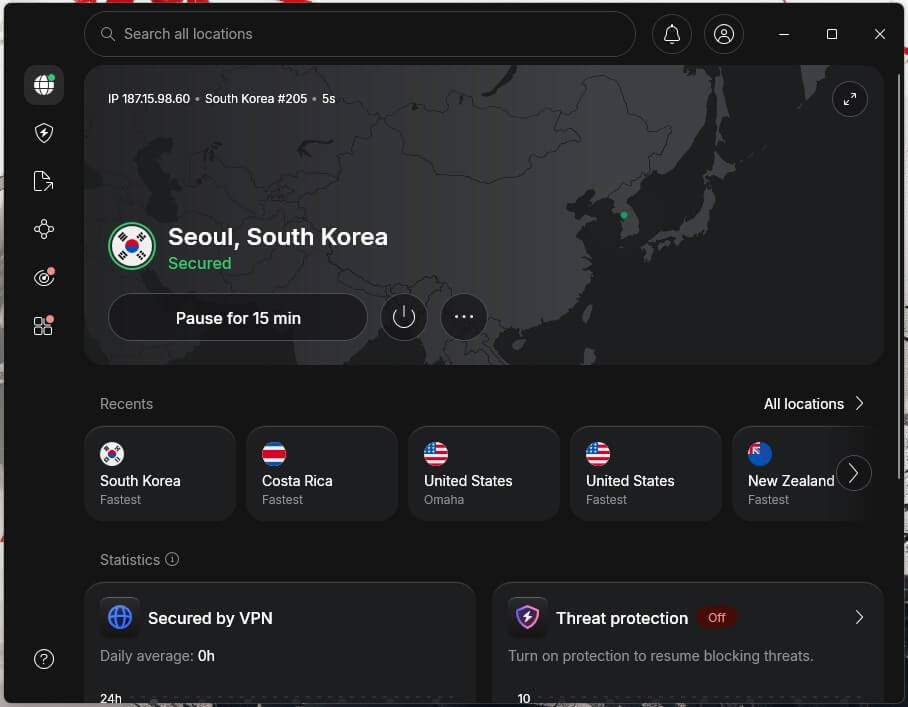
NordVPN earned the top spot because it combined access and speed on Korean servers. It unblocked TVING, CJ ENM’s streaming service and the home of tvN shows, which only Surfshark also managed. It also unblocked Wavve, Coupang Play, KBS, MBC, and Netflix Korea.
On top of that, it lost 27.8% of our speed in Seoul, the smallest loss we recorded there. For Koreans living abroad, that combination settles it. In Korea itself, the job is different. There, you connect to a server abroad to bypass the blocklist.
On those servers, NordVPN tied ExpressVPN as the fastest VPN we tested, with a 7.8% average speed loss across the UK, the US, and Japan. For extra privacy, its Double VPN sends your connection through two servers. That helps on a network you don’t trust, such as a hotel or a PC bang, Korea’s gaming cafés.
As for price, a two-year Basic subscription to NordVPN is about $3.50 a month, for up to 10 devices. It’s also one of the few VPNs that sells a dedicated IP address in Seoul, so Koreans abroad can log in to their bank from the same IP address every time.
However, the price more than triples at renewal, which is the one thing we’d change about NordVPN. For that reason, compare the renewal rate before the first term ends.
2. Proton VPN: Best for Private Browsing in Korea
Pros
- Widest choice of servers in Seoul
- Based in privacy-friendly Switzerland
- Can pass traffic through privacy-friendly countries first
- Built-in ad and malware blocker
- Port forwarding for torrent users
Cons
- Buffering on Korean Netflix in top quality
- Couldn’t unblock TVING
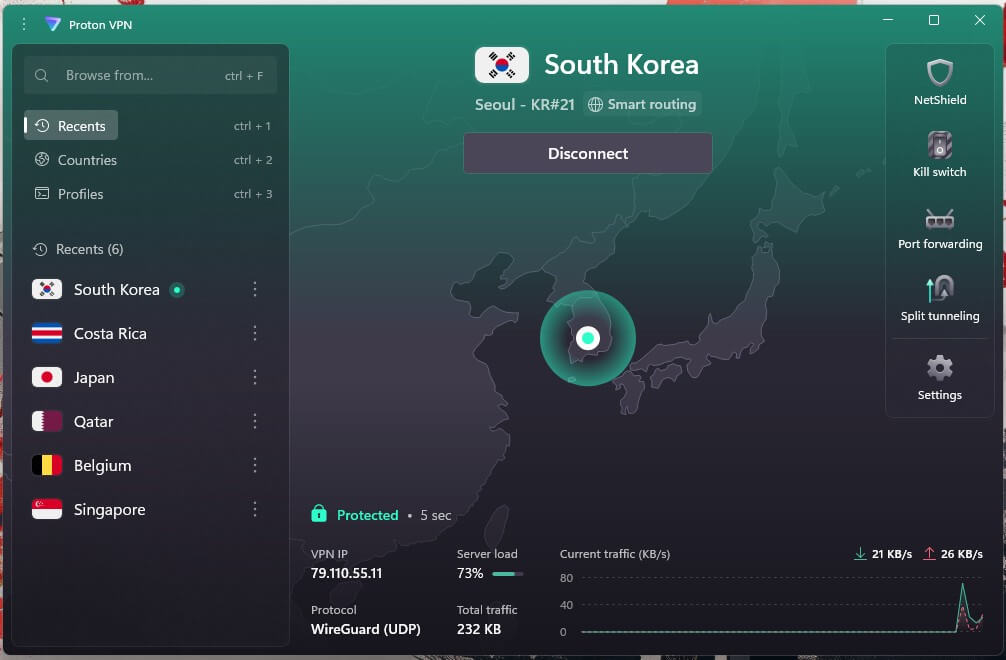
Proton VPN comes second because privacy is its strength, and in Korea that begins with server choice. It lists 66 servers in Seoul, so if one is busy, there are dozens of others to connect to. On those servers, it unblocked Wavve, Coupang Play, KBS, MBC, and Netflix Korea.
Speed was its weak point, however: it lost 51.1% in Seoul, and Netflix Korea buffered until we lowered the stream to HD. It also couldn’t unblock TVING. In practice, that makes it a better VPN for privacy in Korea than for Korean TV from abroad. That privacy record is the reason it ranks second.
Proton VPN is based in Switzerland, and its no-logs policy is independently audited. On top of that, Secure Core adds a first stop in Switzerland, Iceland, or Sweden, so a compromised server elsewhere can’t trace traffic back to you. NetShield, its blocker, removes ads and malware sites.
It’s also much faster on servers abroad, with a 10.2% average speed loss, helped by the WireGuard protocol it uses by default. VPN Plus, Proton VPN’s paid plan, is about $3 a month when you sign up for two years, with 10 devices allowed.
Torrent users also receive port forwarding, which can speed up downloads. There’s no Smart DNS, though, so for a Korean smart TV that can’t install a VPN app, set Proton VPN up on your router instead.
3. ExpressVPN: Best for Easy Setup in South Korea
Pros
- One-tap apps for beginners
- Unblocked Netflix Korea and Wavve
- Automatic obfuscation for restrictive networks
- Post-quantum encryption
- Works on TVs without a VPN app
Cons
- Couldn’t unblock TVING
- Short settings menu
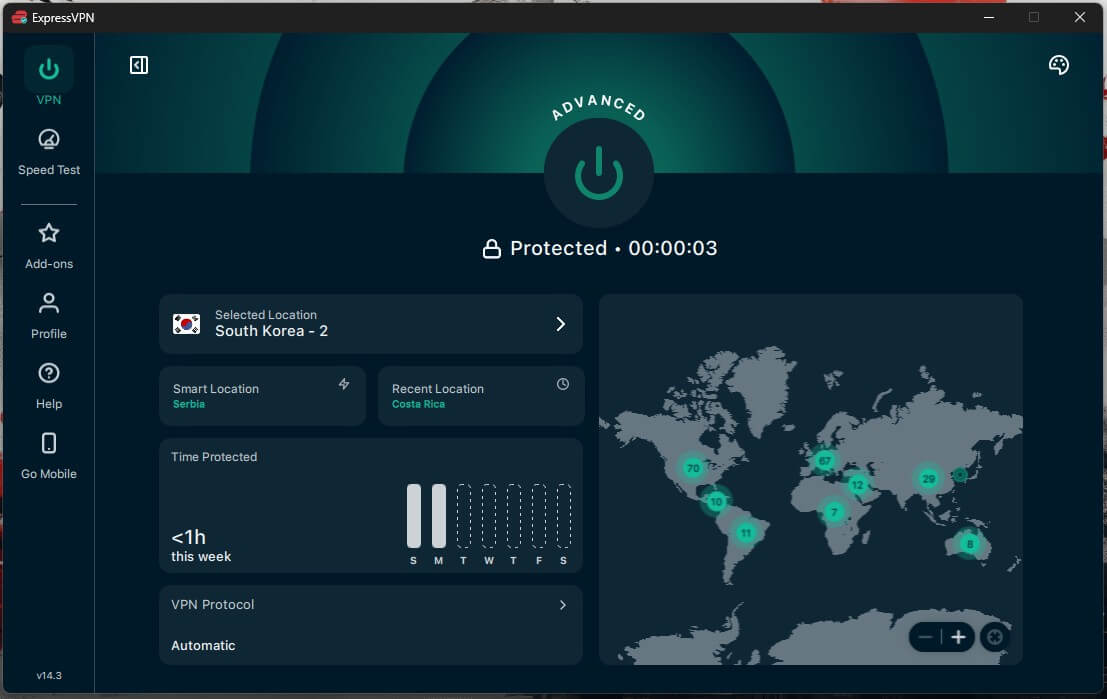
ExpressVPN is the easiest of the five to live with, because its apps require almost no setup. Open one and tap connect, and the app chooses a fast server and connects over Lightway, ExpressVPN’s own protocol. In Seoul, it had the lowest ping we recorded and a 37.6% speed loss.
It unblocked Wavve, Coupang Play, KBS, MBC, and Netflix Korea, even if Netflix detected it once before the stream started. Like Proton VPN, though, it couldn’t unblock TVING. Abroad, it tied NordVPN as the fastest VPN, with a 7.8% average speed loss. That also makes it one of the quickest ways to get a Korean IP address for a site back home.
Beyond Korea, its obfuscation works automatically, which is why it’s one of the most reliable VPNs in China. Travelers heading on to China won’t have to change a setting. Two years of ExpressVPN’s Basic plan average about $3 a month, and that tier covers 10 devices.
The trade-off for its simplicity is a short settings list, with little to adjust beyond the protocol, the kill switch, and split tunneling. A kill switch blocks traffic the moment the VPN connection fails, and split tunneling sends chosen apps outside the VPN. For most people in Korea, those three settings cover everything they’ll touch.
4. Surfshark: Best Budget VPN for Korean Servers
Pros
- Unblocked TVING, Wavve, and Netflix Korea
- No limit on connected devices
- Ad and tracker blocker on every plan
- Masked email for private sign-ups
- Low first-term price
Cons
- Renewal costs well above the first term
- Occasionally slow to connect
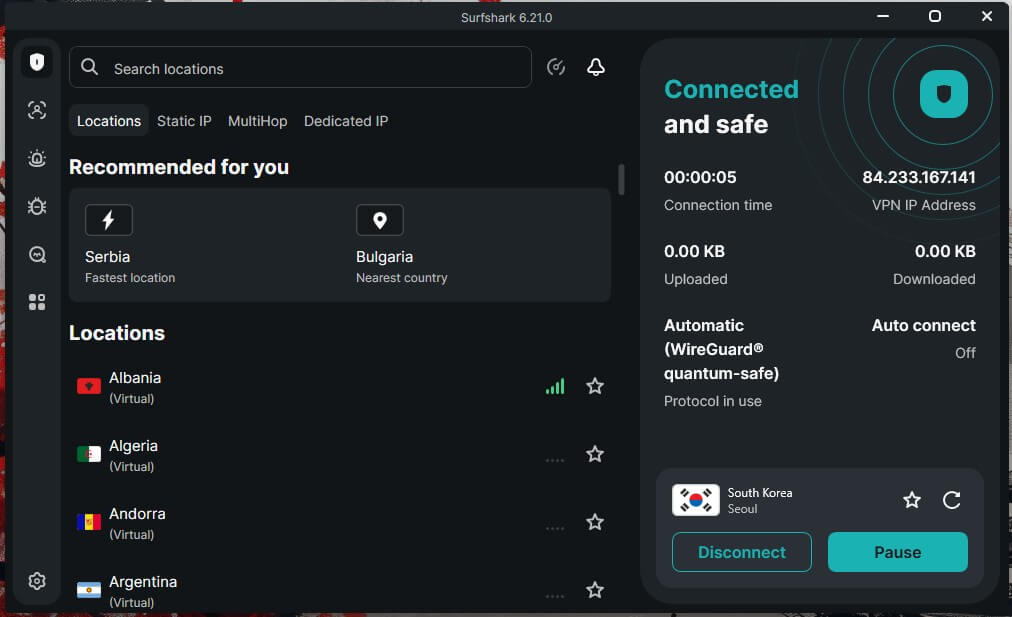
Surfshark comes fourth, yet on Korean servers it kept pace with NordVPN. On its Korean servers, it unblocked TVING, Wavve, and Netflix Korea, so it covers the services Koreans abroad care about most. It lists 12 servers in South Korea, a smaller choice than Proton VPN’s, but enough to change servers when one is busy.
Its speed abroad backs that up. Surfshark lost 9.6% on average across UK, US, and Japanese servers, close behind NordVPN and ExpressVPN. For daily use in Korea, CleanWeb blocks ads and trackers on every plan. Alternative ID also creates a masked email address and profile for sign-ups, which helps on shopping sites you don’t fully trust.
As for price, Surfshark’s Starter plan is about $2.50 a month on its longest term. One subscription also covers unlimited devices, from a phone to a smart TV. Now and then, however, a connection hangs for a few seconds before it starts. Reconnecting to the same Korean server usually clears it.
5. Private Internet Access: Best for Customization in South Korea
Pros
- Unblocked Wavve on Seoul servers
- Detailed encryption and protocol settings
- Strong ad and tracker blocker
- Unlimited simultaneous connections
Cons
- Couldn’t unblock TVING or Netflix Korea
- Dated, crowded desktop app
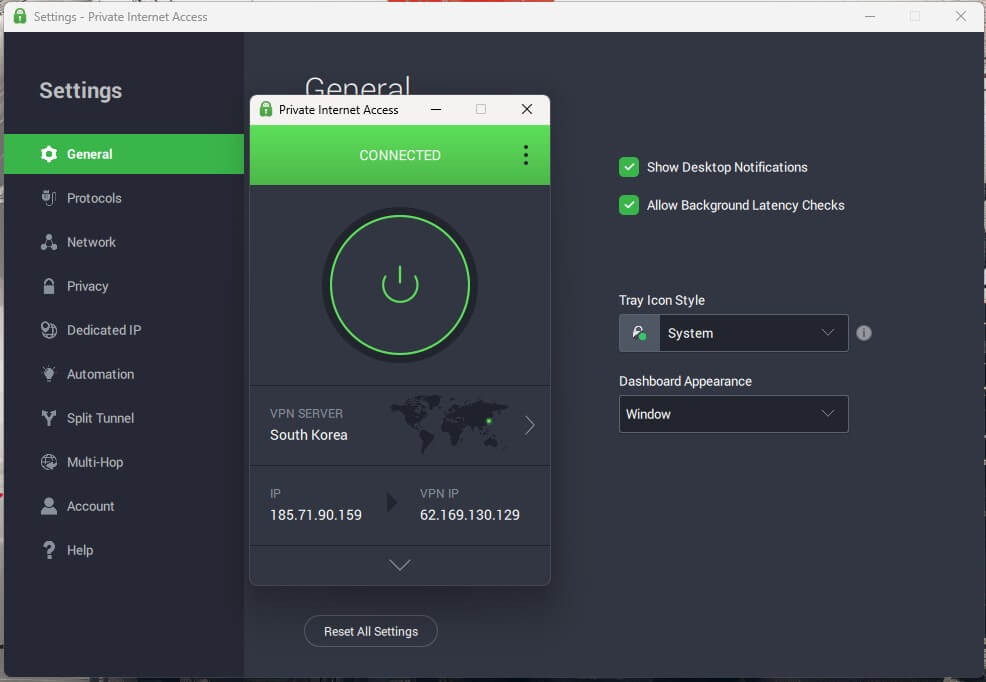
PIA ranks fifth because Korean streaming is where it fell short. On its Seoul servers, it unblocked Wavve but couldn’t unblock TVING or Netflix Korea. So Koreans abroad who want their shows should choose NordVPN or Surfshark instead. For everyday use in Korea, however, it’s a capable VPN at a low price.
Control is its strength. PIA lets you switch between AES-128 and AES-256 encryption, and it supports WireGuard and OpenVPN. In addition, MACE, its built-in blocker, stopped 96% of ad and tracker requests in our test, the best result of any VPN we tested.
Its speed abroad was the slowest of the five, at a 12.7% average loss, which is still quick enough for browsing and HD video. PIA costs around $2 a month on its longest plan, and one account covers unlimited devices. The desktop app looks dated and crowded, so keep the default settings until you know what each option does.
Try Private Internet Access Now
Free VPNs and Korean Servers
Free VPNs leave Korea out: not one of the free plans we tested lists a Seoul server, so Koreans abroad gain nothing from them. In Korea, a free VPN can still bypass the blocklist. Even so, data limits and crowded servers make streaming difficult, and most free VPNs struggle to unblock Netflix and other major platforms.
Some also make money by logging and selling what you do online, the opposite of what a VPN is for. Proton VPN’s free plan is the safest of them, with no data limit and the same no-logs policy as the paid version. However, it connects you to a random country from its free list, and changing servers repeatedly makes you wait.
So it works for browsing on public Wi-Fi, but not for streaming. If you want Korean servers or reliable streaming, NordVPN’s 30-day money-back guarantee covers a test run of a paid VPN.
What a VPN Changes in South Korea
South Korea’s internet is fast and open by most measures. Even so, a few rules shape what you can access, and they affect visitors and residents in different ways.
Blocked Sites and the warning.or.kr Page
The Korea Communications Standards Commission (KCSC) decides which sites Korean ISPs block. Blocked sites redirect to warning.or.kr, and the list covers adult sites, illegal gambling and betting sites, unregistered crypto exchanges, and content praising North Korea, which the National Security Act prohibits.
Because ISPs filter by domain name, connecting to a server abroad makes those pages available again. VPNs are legal in South Korea, for residents and visitors alike. The activity still has to be legal, however. For example, Korean law bans most online gambling for residents, with or without a VPN.
If you bet where it’s allowed, our comparison of VPNs for gambling and sports betting covers how to protect a legitimate account.
Public Wi-Fi in Seoul and Beyond
Free Wi-Fi is everywhere in Korea, from subway stations to cafés and PC bangs. That convenience comes with risk, because anyone on the same open network can set up a fake hotspot with a familiar name.
With a VPN on, everything you send is encrypted, so passwords and card details remain unreadable even on a network you don’t control. In practice, connect before you log in to anything on public Wi-Fi.
Korean Services From Abroad, and Global Services From Korea
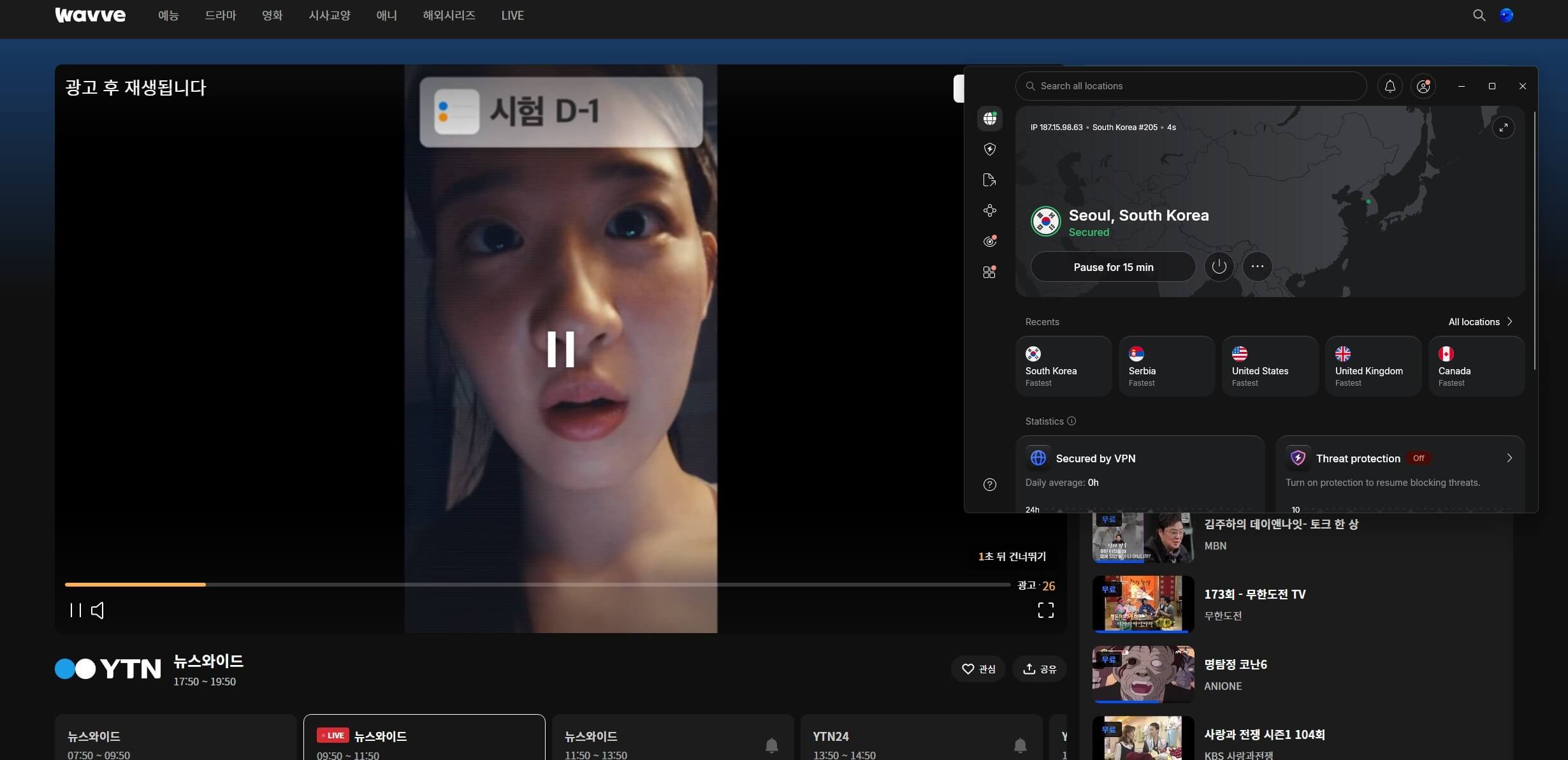
For Koreans abroad, a Seoul server lets banking sites, government portals, and Korean games recognize a Korean connection. Korean TV works the same way, and our guide to watching Korean TV abroad explains which services require a Korean phone number.
The opposite applies to visitors in Korea. Netflix in Korea shows a Korean catalog that lacks many US titles, and many American channels block Korean IP addresses. A US server fixes that, and our guide to watching US TV from South Korea explains how.
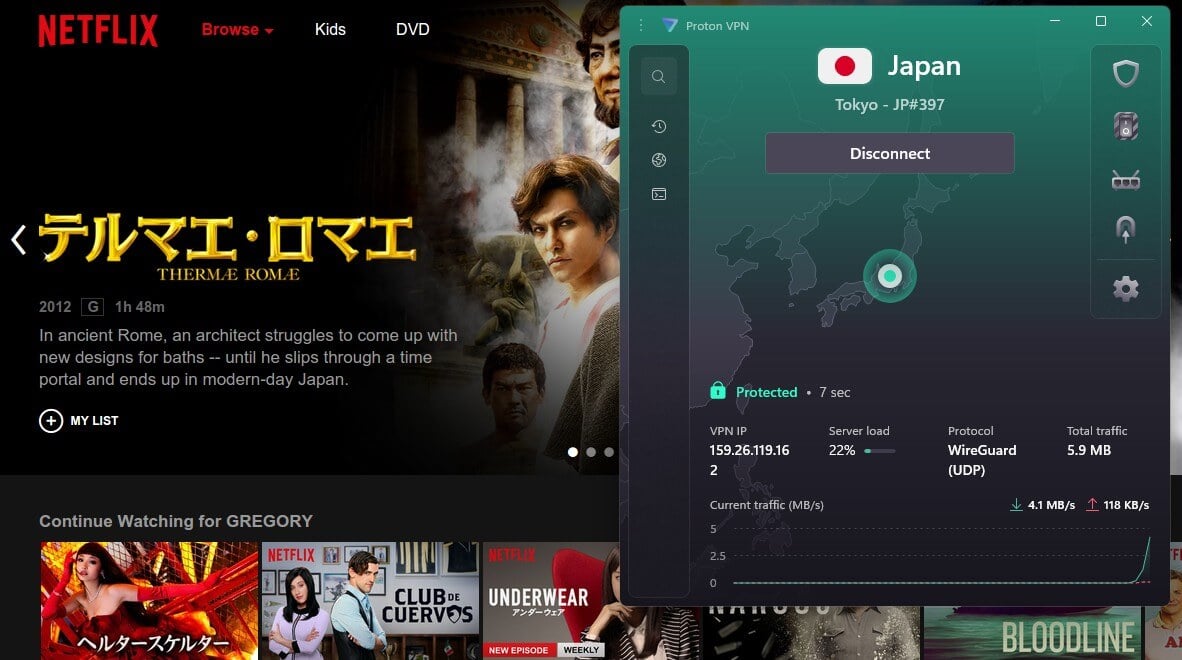
As a result, visitors on a long trip keep the shows they already pay for, from Paramount+ to the American Netflix catalog.
Verdict
For Korea, a VPN has to work in two directions, and NordVPN is the one we’d trust with both. We’d install it whether you’re logging in to a Korean bank from Toronto or using café Wi-Fi in Busan, so it’s the best VPN for South Korea in our book.
We’d choose differently in only one case: privacy at home. If you live in Korea, rarely need a Korean server, and care most about who can see your traffic, go with Proton VPN instead. Explore other options on the list as you see fit.
Frequently Asked Questions
Does South Korea censor the internet?
Yes, partly. The Korea Communications Standards Commission orders ISPs to block adult sites, illegal gambling sites, unregistered crypto exchanges, and pro-North Korean content. Most news, social media, and streaming sites remain available.
What happens when a site is blocked in South Korea?
The browser redirects to warning.or.kr, a government page stating that the site contains illegal information. Korean ISPs block sites by domain name, so the same address works normally from other countries.
Which VPN has the most servers in South Korea?
Proton VPN lists the most servers in Seoul. NordVPN, ExpressVPN, Surfshark, and Private Internet Access also offer Korean servers, and NordVPN sells dedicated Korean IP addresses.
Do you need a VPN when visiting South Korea?
No, but it helps. A VPN protects logins on the public Wi-Fi found across Korea, and it lets visitors use streaming services and sites from home that block Korean IP addresses.