WireGuard is faster, lighter on battery and data, and now the default protocol in most VPN apps. OpenVPN is older, slower to connect, and still better at one job: getting through censorship. Both are open source, both have been audited heavily, and neither has a known cryptographic weakness.
If your app is set to “Automatic,” it’s almost certainly picking WireGuard already, and that’s the right call for most people. The rest of this page explains the differences that decide the exceptions.
WireGuard vs OpenVPN: Summary
Our comparison round by round:
- Security and Privacy: Tie ⚖️
- Speed: WireGuard ✅
- Compatibility: Tie ⚖️
- Bypassing Censorship: OpenVPN ✅
- Data and Battery Consumption: WireGuard ✅
- Post-Quantum Readiness: Tie ⚖️
WireGuard takes 2 rounds, OpenVPN takes 1 round, and 3 rounds finish even. That makes WireGuard the better default, with OpenVPN held in reserve for restricted networks.
OpenVPN vs WireGuard: Head-to-Head
| OpenVPN | WireGuard | |
| 📅 First released | 2001 | 2016 |
| 💻 Lines of code | Around 70,000 | Around 4,000 |
| 🌐 Transport | UDP and TCP | UDP only |
| 🔐 Encryption | Configurable (AES-GCM, AES-CBC, ChaCha20) | Fixed (ChaCha20-Poly1305) |
| 🕓 Connection time | 1 to 2 seconds slower | Near instant |
| ⚡ Data overhead | Roughly 20% above unprotected | Roughly 5% above unprotected |
| ⭐ Censorship resistance | Good over TCP | Weak without a wrapper |
| 🧬 Post-quantum | Not native | Not native |
What are OpenVPN and WireGuard protocols?
A VPN protocol is the set of rules that builds the encrypted tunnel between your device and the VPN server. It decides how keys get exchanged, which cipher scrambles your traffic, and how packets travel. Everything else your VPN does happens on top of that foundation.
OpenVPN Explained
OpenVPN arrived in 2001, written by James Yonan to secure connections in and out of Asia and Russia. It’s open source, it’s free, and after two decades of scrutiny, it remains one of the most examined pieces of security software in existence.

It moves data two ways:
- UDP (User Datagram Protocol), quicker, the default in most apps
- TCP (Transmission Control Protocol), slower but more reliable, and much harder for a censor to spot
That second option is the reason OpenVPN survives in 2026. TCP traffic on port 443 looks a lot like ordinary HTTPS, which matters in Iran, China, Russia, and Turkey. Its weakness is bulk. Around 70,000 lines of code make it slower to audit, slower to connect, and heavier on hardware.
OpenVPN 2.6 offers Data Channel Offload, which moves encryption into the kernel and narrows the speed gap, though most consumer VPNs haven’t deployed it. NordVPN and PIA both still use the standard implementation.
WireGuard Explained
WireGuard was first released in 2016 by Jason Donenfeld, and merged into the Linux kernel in March 2020. That kernel integration is a large part of why it performs the way it does. The design philosophy is subtraction.

Around 4,000 lines of code vs OpenVPN’s 70,000, one cipher suite instead of a menu, and no negotiation phase at connection time. A smaller codebase means fewer places for a bug to hide and a realistic prospect of one person auditing the whole thing. The trade-off is rigidity.
WireGuard speaks UDP, and nothing else, and its cryptography can’t be reconfigured. Those constraints are why it struggles against national firewalls.
WireGuard vs OpenVPN Comparison: Who Wins?
These six rounds will tell you everything.
OpenVPN vs WireGuard: Security and Privacy Compared
Neither protocol has a known break. The difference is philosophy. OpenVPN offers cipher agility. You can select AES-256-GCM, AES-128-CBC, ChaCha20-Poly1305, and others, which means a compromised cipher can be swapped out without touching the protocol. It also means a badly configured setup can be weaker than it looks. Older ciphers like Blowfish have been dropped from current releases for that reason.
WireGuard fixes its cryptography. ChaCha20 for encryption, Poly1305 for authentication, Curve25519 for key exchange, BLAKE2s for hashing. No options, no negotiation, no misconfiguration. If one of those primitives ever falls, the protocol version gets replaced instead of reconfigured. Privacy had one wrinkle. WireGuard assigns each user a static internal IP address and keeps it on the server.
This conflicts with a no-logs policy. VPNs solved it independently: NordVPN’s NordLynx uses a double NAT system that separates your identity from your tunnel, and others apply similar mitigations. Any reputable provider has addressed this by now. Protocol choice matters less than provider choice here. A VPN that keeps logs will keep them whichever protocol you select.
Winner: Tie 🟰
Two sound designs reaching the same place by different routes.
Speed Comparison of WireGuard and OpenVPN
WireGuard is quicker, and the gap shows up in two places: throughput and connection time. WireGuard established a tunnel 1 to 2 seconds faster than OpenVPN on every VPN we tried, which you notice most in daily use.
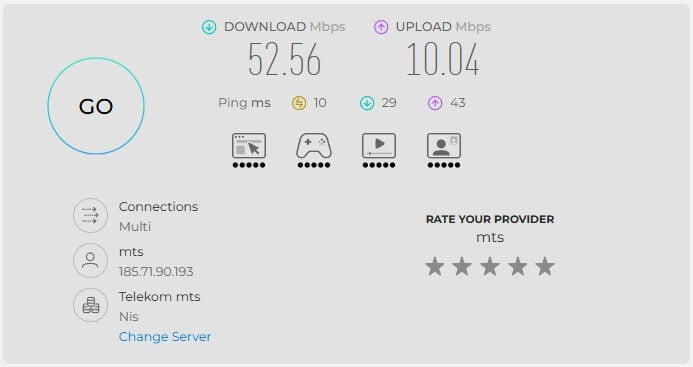
We tested both protocols on two providers, using UDP for OpenVPN since it’s the faster of its two transports. The NordVPN vs Private Internet Access comparison covers how the two stack up more broadly.
NordVPN OpenVPN vs WireGuard Download/Upload Speed
| OpenVPN | WireGuard (NordLynx) | |
| UK Server | 47.47/9.37 Mbps | 49.64/9.49 Mbps |
| US Server | 39.09/8.49 Mbps | 44.40/9.41 Mbps |
| Japanese Server | 35.55/8.21 Mbps | 39.84/8.66 Mbps |
For now, let’s shift our attention to these tables:
PIA VPN OpenVPN vs WireGuard Download/Upload Speed
| OpenVPN | WireGuard | |
| UK Server | 42.18/9.28 Mbps | 44.26/9.59 Mbps |
| US Server | 35.87/8.85 Mbps | 37.07/9.19 Mbps |
| Japanese Server | 32.85/8.15 Mbps | 33.49/6.10 Mbps |
WireGuard was faster on all six tests. The margin depended on the VPN. NordVPN’s NordLynx gained 9.6% on average over OpenVPN, stretching to 13.6% on the US server. PIA’s advantage was slimmer at 3.5%, and its Japanese result was close to a dead heat. Uploads told a different story. The two protocols were within a fraction of each other almost everywhere.
PIA’s Japanese server dropped from 8.15 Mbps on OpenVPN to 6.10 Mbps on WireGuard. Download speed is where the protocol choice shows up. Neither VPN tested here has Data Channel Offload, so these figures show OpenVPN in its standard form. Latency favored WireGuard, which is what matters for gaming.
Winner: WireGuard ✅
Faster throughput, lower latency, and a tunnel up a second or two sooner.
Compatibility Comparison
Both protocols work everywhere that matters. Windows, macOS, Linux, iOS, and Android support WireGuard, and most VPN apps now default to it. Routers were OpenVPN’s last stronghold and no longer are. WireGuard works on a growing list of router firmware, including ASUS models and most builds of OpenWrt, though older hardware may still be OpenVPN-only.
Mobile is where WireGuard’s design pays off. It handles a Wi-Fi to mobile data switch without renegotiating the tunnel, so the connection survives moving between networks on an iPhone or Android phone.
Winner: Tie 🟰
The compatibility argument that once favoured OpenVPN has closed. Only ageing router firmware still tips the balance.
Bypassing Censorship
This is OpenVPN’s round, and it isn’t close. WireGuard uses UDP, and its packets have a recognisable signature. Deep packet inspection systems in China and Iran identify and drop them without much difficulty. OpenVPN over TCP on port 443 resembles ordinary HTTPS traffic, far harder to block without breaking the rest of the internet. NordVPN’s obfuscated servers, the ones that work from mainland China, use OpenVPN TCP for exactly this reason.
Astrill VPN, another VPN with a track record in China, uses its StealthVPN and OpenWeb solutions instead of WireGuard. The gap is narrowing. Providers now wrap WireGuard in obfuscation layers to disguise the traffic, and NordWhisper handles filtered school and office networks by tunnelling through web traffic. National firewalls remain a different problem.
Winner: OpenVPN ✅
TCP transport is the one capability WireGuard can’t replicate, and it’s the capability that gets you online in a censored country.
Bypass Censorship With NordVPN
Data and Battery Consumption
Mobile users should pay attention. Encryption always adds overhead, but the two protocols add very different amounts. OpenVPN increases data consumption by roughly 20%. A 1 GB download becomes 1.2 GB, which accumulates fast on a capped plan. WireGuard adds roughly 5%.
Its smaller codebase and kernel-level operation also mean less CPU work, and less CPU work means less battery drain. On a phone or laptop, that difference is noticeable across a full day of use.
Winner: WireGuard ✅
Lighter on data, lighter on battery, and the margin favors it on every mobile device we’ve tested (smartphones, tablets, and laptops).
Post-Quantum Readiness
A sufficiently powerful quantum computer could break the key exchange both protocols rely on, and encrypted traffic captured today could be decrypted later once that hardware exists. Neither includes post-quantum protection natively. WireGuard’s fixed Curve25519 key exchange has no quantum-resistant option. OpenVPN has no standard implementation either.
Providers are filling the gap themselves. NordVPN offers a post-quantum toggle on NordLynx, and Avast SecureLine has it in its advanced settings. Surfshark’s Dausos protocol is post-quantum resilient by design.
Winner: Tie 🟰
Both protocols need a provider to solve this for them. Check what your VPN offers instead of what the protocol does. NordVPN, ExpressVPN, and Surfshark now offer post-quantum ciphers, but mostly on in-house protocols.
What About Proprietary VPN Protocols?
Most proprietary protocols are existing technology with a brand name attached, and we don’t say this to criticize. NordLynx is WireGuard with NordVPN’s double NAT layer solving the static IP problem, and it topped our VPN speed rankings. Lightway is ExpressVPN’s own protocol, built on wolfSSL instead of being borrowed from either contender. It’s open source, with a post-quantum option available.
The newer arrivals target specific gaps. Mimic in Avast SecureLine and Stealth in Proton VPN disguise VPN traffic where it’s blocked. NordWhisper tunnels through web traffic for filtered networks. Dausos in Surfshark is the most ambitious of them, built from scratch with AEGIS-256X2 encryption, a separate tunnel per user, and post-quantum resilience. A proprietary name isn’t a reason to pick a provider on its own.
What it usually signals is that the provider found something the standard protocols don’t do, and it’s almost always good news.
Which VPNs Support WireGuard?
Nearly all of them, including several free services. Our picks from the best VPN services we tested in October 2026 include:
- NordVPN: the fastest provider, with NordLynx and OpenVPN
- Proton VPN: Swiss privacy, with WireGuard even on the free plan
- ExpressVPN: WireGuard alongside its own Lightway protocol
- Private Internet Access: 26,000+ servers and unlimited devices
- Surfshark: affordable, with servers in 100 countries
- CyberGhost: purpose-built streaming and P2P servers
- Hide.me, IPVanish, TunnelBear, and dozens more
OpenVPN vs WireGuard: Our Conclusion
WireGuard is better, and most VPN apps have already made that decision for you. It’s faster, connects instantly, uses less data and battery, and its 4,000-line codebase is far easier to verify than OpenVPN’s 70,000. OpenVPN keeps one advantage that matters in the right circumstances. TCP gets you online where WireGuard can’t, whether that’s a hotel network, a corporate firewall, or the Great Firewall.
Keep it as your fallback and switch to it the moment a connection refuses to establish. The protocol choice ranks below VPN choice. A VPN with no logs, audited infrastructure, and servers where you need them will protect you on either protocol.
OpenVPN vs WireGuard FAQ
↔️ Is WireGuard safer than OpenVPN?
No, and neither is safer than the other. Both are open source, heavily audited, and free of known cryptographic weaknesses. WireGuard's smaller codebase reduces the surface area for bugs, while OpenVPN's configurable ciphers allow a compromised algorithm to be replaced without changing the protocol. The provider's logging policy affects privacy far more than the protocol choice does.
🤔 Should you use OpenVPN TCP or UDP?
UDP for everyday use, since it's faster and handles streaming and gaming better. TCP for brestrictive networks, because TCP traffic on port 443 resembles standard HTTPS and is much harder for censorship systems to identify and block.
⛔ Why is WireGuard blocked in China?
Deep packet inspection can recognise WireGuard's packet signature, and the protocol only supports UDP, which offers no way to disguise itself as ordinary web traffic. OpenVPN over TCP blends in with HTTPS instead, which is why obfuscated servers designed for China use it.
🔋 Does WireGuard use less battery than OpenVPN?
Yes. WireGuard's codebase is roughly 4,000 lines against OpenVPN's 70,000, and it operates at the kernel level on most platforms. Less processing work means less CPU load and lower battery drain.
🛡️ Is NordLynx the same as WireGuard?
Yes, with one modification. NordLynx is built on WireGuard with a double NAT system. That prevents the server from storing a static IP address against each user, which resolves the privacy concern in WireGuard's original design.