As typically is the case with AI, whether it truly adds any value to human work depends on the user’s intentions. For science, that means that, technically, AI can try offering an answer to a question, but it’s up to the experts to check its work and decide if there’s more to be explored.
A couple years ago, physicists Giorgio Parisi and Francesco Zamponi reached a stalemate in their attempt to solve the jamming problem, a mathematical issue in physics concerning systems that suddenly turn rigid while remaining disordered. The pair from La Sapienza University of Rome in Italy tried asking the AI model Claude to come up with a solution. Claude’s initial proof reportedly had a lot of errors, but the underlying approach appeared to be a step in the right direction. Parisi and Zamponi pursued this idea and landed on a surprisingly simple resolution, showing their reasoning in a paper published today in the Journal of Statistical Mechanics: Theory and Experiment.
“Quite quickly, Claude came up with an initial idea that was essentially correct,” Zamponi said in a statement. “The answer was right there, and we simply hadn’t seen it.”
A mathematical traffic jam
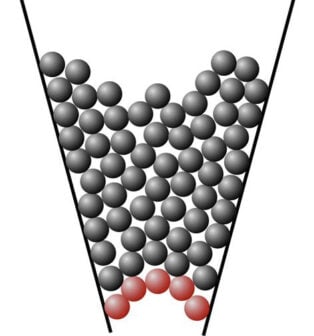
In physics, jamming refers to a process in which density increases in a granular material (think of a children’s ball pit), resulting in a system becoming rigid, sort of like a “traffic jam” of particles. Back in 2014, Parisi, Zamponi, and other collaborators mathematically described jamming, finding in the process that two parameters of the model would always add up to one.
“The result emerged clearly from numerical calculations from the very beginning, but no one could explain why it was true,” according to the statement. “For years, researchers searched for a mathematical proof of the relation, convinced that some deeper structure of the theory lay behind its apparent simplicity.”
A fresh pair of eyes, kind of
With quick advances in generative AI models, Parisi and Zamponi wondered if Claude’s relatively more advanced mathematical reasoning abilities could offer anything useful for the jam in the jamming conjecture. Initially, the pair asked Claude to replicate the group’s numerical calculations, then challenged the AI to try and come up with a proof for the two parameters always adding up to one.
“We were hoping this would reveal some new understanding of the equations,” Zamponi explained.
In short, the proof “contained errors and required several rounds of verification and revision by the authors.” However, the researchers were able to build upon the basic premises of Claude’s suggestions to arrive at a more solid proof.
AI and ‘impossible’ problems
AI’s increased use in mathematics seems to invoke both excitement and concern for experts. In an interview with Gizmodo, Princeton mathematician Will Sawin said that AI is definitely effective at searching the literature and finding patterns that humans might not have noticed before. In other words, it’s not necessarily that an AI model generated an entirely novel idea that humans couldn’t have found on their own, at least for now.
Something similar appears to have been the case for Parisi and Zamponi. In the paper, they write that it’s “difficult to say” why they hadn’t realized what Claude seemingly did. However, the human pair admitted that they were “looking for something deeper” and overlooked a more “conceptually simple case,” which Claude’s suggestion pointed them towards.