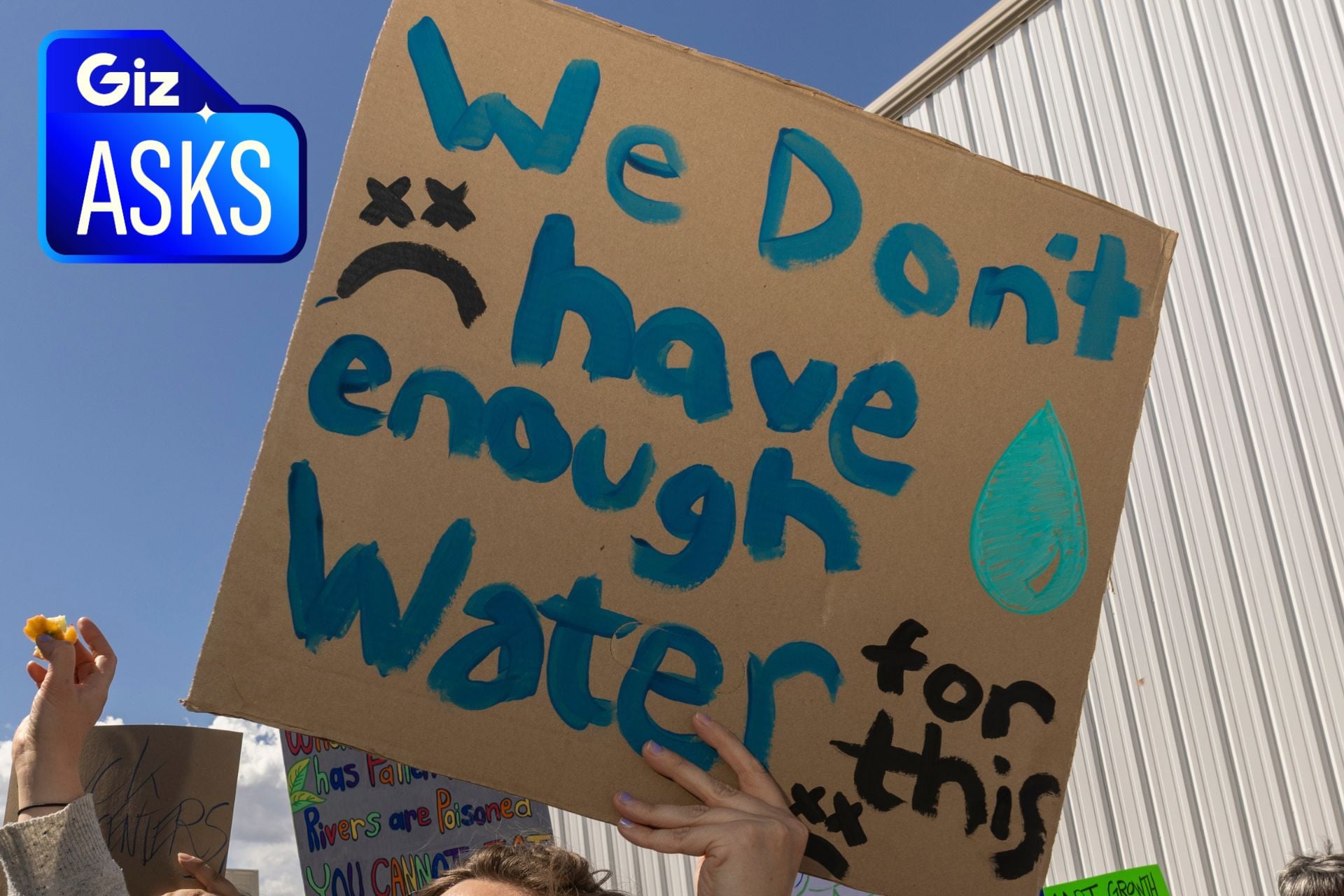
The proliferation of AI data centers has spurred protests across the United States. Last month, communities that had long fought separate battles against Big Tech’s intrusion into their hometowns organized for the first coordinated national demonstration, staging nearly 150 protests across 42 states.
Among their chief concerns is the amount of water these facilities consume to cool servers. Some communities are already feeling the impact. In Fayetteville, Georgia, a Quality Technology Services data center campus quietly sucked 30 million gallons (113 million liters) from the local water supply before ever receiving a utility bill, though QTS denied any improper use. In The Dalles, Oregon, Google’s data centers were responsible for nearly 40% of the city’s total water consumption in 2025, guzzling about 550 million gallons.
But there’s another side of this story, one in which some tech industry leaders, analysts, and engineers argue that the issue is overblown. They question the math behind eyebrow-raising usage statistics, praise the efficiency of closed-loop systems, and point to other water-intensive industries that have not triggered national panic.
So, where does the truth lie? For this Giz Asks, we asked experts how much AI data centers actually impact local water systems. The answer is as complicated as you might imagine.
The following responses may have been lightly edited for length and clarity.
Shaolei Ren
A professor of electrical and computer engineering at the University of California, Riverside. Ren’s research broadly focuses on AI, systems, and society.
Water can play an important role in improving the energy efficiency of data centers. Many facilities use evaporative or adiabatic cooling, particularly during the hottest hours of the year. These systems consume water, but they can require substantially less electricity for cooling than fully air-cooled systems under hot conditions.
This creates a real power-water tradeoff. During a heatwave, when electricity demand from homes and businesses may already be placing pressure on the grid, water-assisted cooling can help limit increases in a data center’s power demand. In regions where electricity generation is itself water-intensive, lower electricity consumption may also reduce some indirect water use. The net effect, however, depends on the local power mix, cooling system, climate, and water source.
At the same time, the local water impacts can be significant. Data centers are large and concentrated users, and their highest water demand may occur on hot days when other users also need more water. Annual consumption figures alone, therefore, do not provide a complete picture. A facility with relatively modest annual water use could still create infrastructure or reliability concerns if its peak demand exceeds the available treatment, storage, or distribution capacity of the local water system.
Location and water source are also critical. A facility using reclaimed or other non-potable water in a water-abundant region presents a different level of risk from one relying on potable water in a drought-prone community with limited infrastructure or supply.
These challenges can be effectively addressed through careful planning and operation. Options include using reclaimed or non-potable water, installing on-site storage, switching between water-saving and energy-saving cooling modes, shifting flexible computing workloads during periods of local stress, and coordinating with both water utilities and electric-grid operators.
The objective should not necessarily be to eliminate on-site water use in every case. It should be to evaluate the full local context and use water strategically and transparently, balancing energy efficiency, operational resilience, environmental impacts, and the needs of surrounding communities.
Fred Bloetscher
Associate dean for undergraduate studies and community outreach in the Department of Civil, Environmental and Geomatics Engineering at Florida Atlantic University. Bloetscher’s research interests include sustainable water resource planning and management.
The answer to this question is: it depends. It depends on how much water you have available, how much power you have available, how much land you have available, and the type of data center. We have traditionally thought about the data centers that someone like Amazon runs locally. Which are called “traditional data centers.” There are over 4,000 of them in the United States. They have a power demand between 10 and 30 kilowatts and use a combination of standard air conditioning system cooling, air cooling, and evaporative water cooling. Water cooling is more efficient than air cooling by a significant margin (25% or more). Most communities can handle data centers of this size.
In addition to additional traditional data centers, what is being proposed are AI hyperscale data centers—approximately 84 of those across the United States. These are a far different animal, using up to 1 megawatt of power (100 times traditional data centers) and consuming up to 5,000,000 gallons of water per day. Air cooling doesn’t work very well at this scale. These AI hyperscale data center campuses could be hundreds of acres—the Meta Hyperion proposal in Los Angeles is over 2,000 acres.
In many developed areas, this amount of land and power may not be readily available. While recycling water for cooling is practical, the power component still needs a cooling system, and water is the typical means to do it. For reference, 1 MW is a large power plant by itself, so fuel is also a concern.
The next challenge is that the AI users are in urban areas, while the land is not. Likewise, power is locally generated or moved through the grid, which has some inherent losses. The power grid is most robust in urban areas where the users are but is not where the land may be.
So the conflict is that the AI data centers are much larger than the current data centers, prefer to be located in urban areas (creating a land problem) and compete for power and water supplies with current urban users. This is a particular problem in dry areas (much of the west and southeast) that lack both resources, which is why there are many communities putting restrictions or moratoriums on data center creation (like you see in Florida).
The result may be that big data centers will target rural areas because of the regulations, but they have far less robust water and power systems than urban areas and therefore have the potential to be more disruptive to those communities. What is needed is a longer-term plan for building out these data centers nationwide to allow integration with the region that needs them. The current climate lacks the planning, regulatory, and thought process to minimize impacts on residents, hence communities opposing the centers due to a lack of full disclosure about the risks.
Arthur Harrington
Adjunct professor of law at Marquette University and chair of the Environmental and Energy Law Practice Group at Godfrey & Kahn Law. At Marquette, Harrington co-teaches an energy course to law and engineering students.
I have invested a significant amount of time studying and teaching energy law and policy in addition to emerging energy technology related to data centers. One of the emerging technologies I have been following is contact cooling systems for servers. The application of such technology would significantly reduce both water consumption and energy costs.
The racks containing processing units in data centers generate an enormous amount of heat. The fundamental problem is that air is an insulator, often used to keep heat from moving around. Fans are noisy and inefficient, and the waste heat they generate adds to the cooling burden. The large number of server racks in such centers are too hot for air to cool. For this reason, project developers are forced to add a facility-water loop in the white space. These water-cooling systems combined with fans blow the heat away.
Given significant opposition to the amounts of water required to cool data centers, developers are proposing a closed loop, using pumps and chillers to recirculate cooling water. While these water-reuse cooling systems reduce onsite water consumption, such systems use significantly more energy. This reuse system is simply shifting the adverse environmental impact burden to the power plant.
A data center designed for emerging contact cooling technology would not need chillers, air handlers, or water treatment systems, thereby significantly reducing capital outlays and energy costs associated with cooling. Contact cooling systems like LiquidCool Solutions (LCS) combine the energy efficiency of total immersion with the targeted cooling capability of direct-to-chip. By way of example, an LCS chassis fits into standard data center racks, so the transition from air to liquid cooling is inexpensive and seamless.
Such cooling technology is chassis-based single-phase immersion, where all electronics are submerged in a dielectric liquid [a fluid that absorbs heat without conducting electricity] and forced convection cools the hottest components. The system only requires two connections to the facility coolant loop.
By employing a contact cooling system using dielectric liquid, there are no chillers or air handlers to take up space and waste energy. Equipment maintenance and energy costs are reduced to pumps that circulate facility coolants from dry coolers to the racks and fans in the dry coolers.
LCS racks require no cooling water if the ambient temperature is less than 113 degrees Fahrenheit (45 degrees Celsius). In addition, rack output temperature can be as high as 140 degrees F (60 degrees C) if there is nearby commercial use for hot water. If data centers operated at 113 degrees Fahrenheit (45 degrees Celsius), which is feasible today with commercially available hardware, rather than 77 degrees F (25 degrees C), the current practice, water consumption would be eliminated in most parts of the world.
Advantages of LCS:
- Liquid circulation removes 100% of the heat.
- Servers are cooled without air or water.
- Waste heat can be recovered in liquid form at a commercially useful temperature.
- The dielectric liquid is inexpensive, has a Global Warming Potential of zero, and never needs to be replaced.
- Server racks in existing data centers can be modified and reused with this contact cooling technology.
- Maintenance is simple and dripless.
Chassis immersion is the lowest cost option, by far, for both new data center projects and retrofitting existing data centers that have conventional non-contact cooling technology. This emerging technology could not only substantially reduce the need for water for cooling but also result in a significant reduction in energy costs associated with existing water cooling systems.