Nvidia CEO Jensen Huang resigned in disgrace this week, a direct result of his extramarital affairs, including one with a woman suspected of working for Chinese intelligence. That woman, Alice Huang, was an executive at Singapore-based tech company Megaspeed, and questions have swirled about whether she’s actually a “spy” or an “asset.” Some people with a vested interest in the world of AI insist she’s none of the above.
China’s Foreign Ministry has called allegations that Jensen Huang was the target of a Chinese spy plot “groundless speculation” and “nothing more than an attempt to smear China.” U.S.-based venture capitalists and at least one former Trump administration official on X have also been insisting that Alice Huang wasn’t actually a spy, suggesting there was some kind of plot to take down Jensen.

“Innocent until proven guilty”
David Sacks, the former White House AI and crypto czar, pointed to a list of Trump-adjacent sources who claim there’s little evidence Alice was a spy. Sacks quoted Attorney General Todd Blanche, who said “no conclusions [had been] reached,” as well as the CIA, which had “not yet [been] convinced.”
“At this point, the only crime that we know for sure happened is the leaking of the classified memo. Who did that and why?” wrote Sacks.
Right-wing internet commentators have latched on to a clip of Marc Andreessen talking with Joe Rogan back in 2024 as evidence that Jensen’s downfall is all part of some government conspiracy to take over the entire AI industry.
This interview by @pmarca explains what is really behind Jensen Huang's ouster as Nvidia CEO. pic.twitter.com/JFjM39bgAX
— Kevin Bass (@kevinnbass) November 12, 2026
Jason Calacanis, David Sacks’s co-host on the All-In podcast, raised similar questions about whether Alice Huang is actually a spy and whether Jensen was set up as a fall guy for some nefarious purpose.
“My prediction was that the call (leak) came from inside the house (White),” Calacanis wrote on X about a memo leaked to the New York Times. “I’m putting 50%+ chance the NYT got this from the China hawks.”
“Innocent until proven guilty,” Calacanis wrote. “Story still doesn’t add up.”
Obviously, “innocent until proven guilty” is a legal standard that doesn’t need to be met when a CEO misleads his board and gets ousted. But there have been questions about Jensen’s culpability in any potential illegal behavior, especially since he lobbied President Trump to grant permission to export more chips to China. That’s not illegal. However, there’s no question that Jensen wanted those chips to flow.
Does Donald Trump care?
The U.S. has restricted the export of the most powerful chips since 2022, but Jensen Huang has long fought against those export controls. He argues that it benefits the U.S. and actually harms investment in Chinese tech if Americans can dominate that market.
The counter-argument is that providing such powerful chips to China just allows that country to develop more powerful AI models that compete with American models. It’s widely believed that the U.S. needs to win the race because Chinese tech dominance would threaten both national security and American soft power around the world.
There are still considerable questions about what different factions within the Trump administration knew and when they knew it. President Trump was briefed on Jensen’s affair with an alleged spy in Oct. 2025 then again in May 2026 aboard Air Force One while en route to China. Secretary of State Marco Rubio, a known hawk on China, apparently gave the latter briefing himself.
U.S. Treasury Secretary Scott Bessent blames Commerce Secretary Howard Lutnick over Nvidia chip mess: "Treasury, War, USTR and State were in favor of putting Megaspeed on the entity list for months." pic.twitter.com/0BTlHymwUY
— CNBC (@CNBC) November 13, 2026
Reporting from CNN on Thursday indicates the U.S. intelligence community intercepted communications suggesting that an executive at Megaspeed was having an affair with someone in the U.S. The name of the person in the U.S. was censored, but American officials requested that it be unmasked, revealing it to be Jensen Huang. That news was given to Trump, who has apparently viewed it as a personal matter rather than one involving national security. The CNN piece notes there’s still debate about whether Alice Huang was a “spy” or something else.
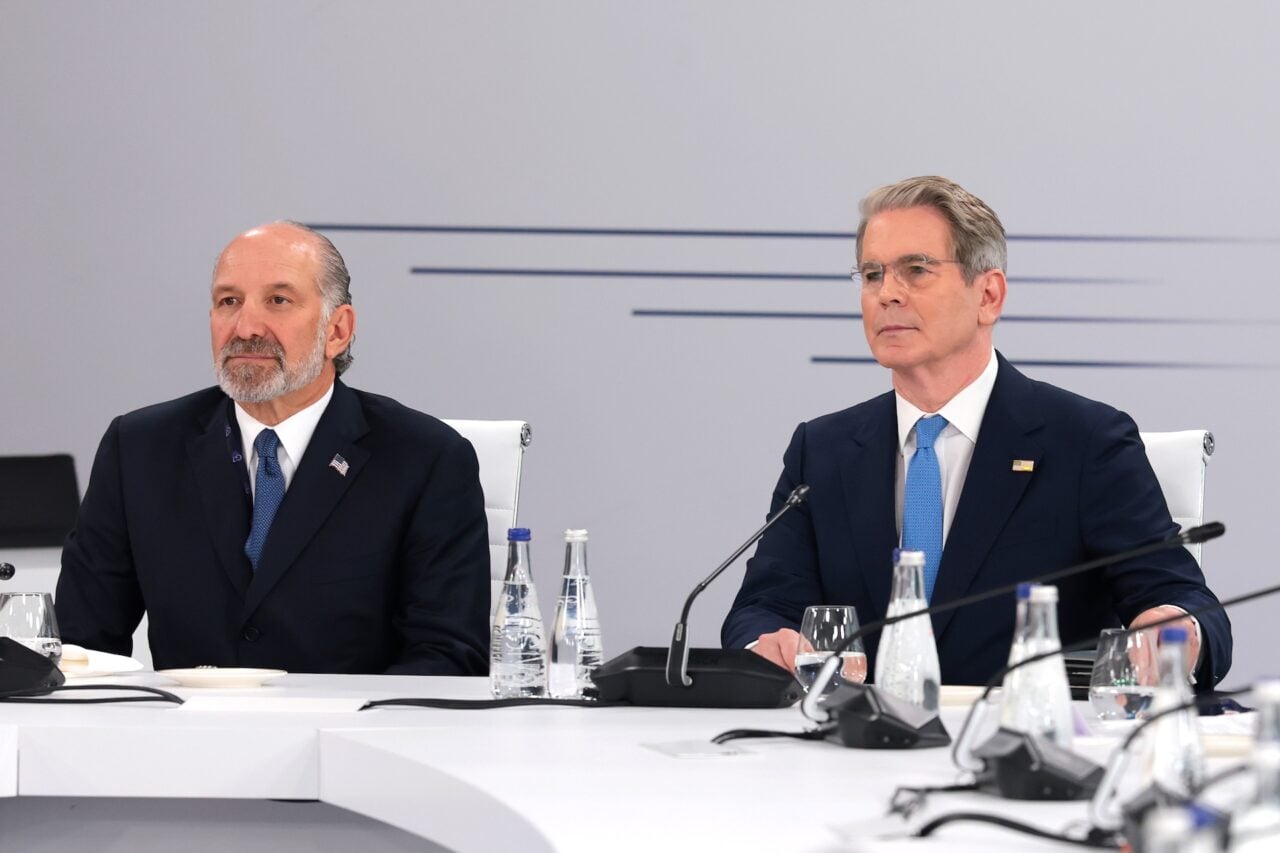
Reporting has also emerged that suggests many top U.S. officials, including Treasury Secretary Scott Bessent, were frustrated with Howard Lutnick for dragging his heels in restricting chip exports to Megaspeed. Bessent basically said as much Friday morning to CNBC. It’s all been portrayed as Lutnick going against the will of President Trump himself, a supposed China hawk, but there’s no real reason to take that explanation at face value.
For all we know, Trump and Lutnick may have been working toward the same goal of keeping Nvidia’s chips flowing to Chinese customers. And Lutnick was clearly close with Jensen, just as Trump has been.
And that’s what makes the debate over whether Alice Huang was technically a spy so convenient. While everyone argues over what she knew and who she worked for, there’s a much more concrete question about what the Trump administration knew and why it failed to act. Multiple agencies reportedly wanted to restrict Megaspeed’s access to American technology. Commerce, which had the authority to impose those restrictions, didn’t follow through. Whether Alice Huang was a Chinese intelligence operative or simply a businesswoman helping restricted chips find their way to China doesn’t change that.
Nvidia CEO Jensen Huang on Secretary Howard Lutnick’s role in America leading the AI revolution:
“Howard is the person I talk to most in the administration—he’s on top of the technology and learning the industry quickly. I announced a historic partnership today, and he was the… pic.twitter.com/ts9yYPb9FC
— U.S. Department of Commerce (@CommerceGov) September 26, 2025
Trump world in-fighting
The goal among VCs and Trump supporters seems to be to muddy the waters and create plausible deniability in the minds of the public for both Jensen and Trump. How could anyone know that chips were making their way into the hands of sanctioned entities? It’s not like Trump has a history of just flouting the law when it suits him, right? The president recently moved to permit imports of Russian diesel by temporarily waiving sanctions that Congress had codified into law. Fittingly, nobody wants to buy that diesel at the moment because buyers are fearful of breaking the law now that the political winds are changing, according to Bloomberg.
Jason Goldman, the former head of the Office of Digital Strategy in the White House during Barack Obama’s tenure, pointed out the absurdity of theories that some nefarious outside forces worked to take down Jensen.
In this post in Jason acknowledges the transparently obvious reality that it was the Trump Admin who turned on Jensen because of actions they perceived as (seemingly illegally) favoring China.
And then note it is a quote RT of his "who benefits" analysis in which he wonders if… https://t.co/SbDfF4hmoL
— Jason Goldman (@goldman) November 13, 2026
Goldman notes that when a top official in the Trump administration goes on national TV to accuse another top official in that same administration of dropping the ball, there’s no grand mystery to solve. Everyone is just stabbing each other out in the open.
Smuggler or spy?
It’s difficult to say whether Alice Huang was a spy, an asset, or something within that universe which may go by a more nuanced name. But new evidence is revealed every day that points to her at least potentially being a smuggler of U.S. chips.
Bloomberg reported Friday that a Chinese company founded by Alice Huang obtained restricted Nvidia AI chips that ended up in a Shanghai data center with ties to Megaspeed. Documents reviewed by Bloomberg establish connections between the equipment and the companies involved, although the precise route the servers took remains unclear. Bloomberg has not yet established whether Alice Huang was personally involved in procuring the chips.
CBS News also reported on Friday that Singapore seized Alice Huang’s passport in June 2025 for eight months and wouldn’t let her leave. The government of Singapore had been investigating her since at least February of 2025 and whether Megaspeed and Supermicro had been working to ship servers containing export-controlled Nvidia chips to China. Authorities in Singapore reached out to the Trump administration and received “no meaningful help from Washington,” according to CBS News. It seems to be more circumstantial evidence that the Trump regime was not worried about Nvidia chips getting to places they weren’t supposed to go.
The Financial Times also has new reporting Friday that chronicles Jensen’s efforts to get close to China. The former Nvidia CEO regularly traveled to Shanghai and Beijing to meet customers and suppliers in the region. He made no secret of his desire to sell more chips to China.
Does China even need U.S. tech?
Whatever Alice Huang’s role in getting chip tech to China, there’s still the question of what purpose it serves. Folks in China also say that Americans are somewhat arrogant in believing that only U.S. technology can provide what’s needed to create advanced AI tech.
Hu Xijin, a journalist who’s worked with Chinese state media, claims that Chinese models like Kimi and DeepSeek would require billions of dollars more investment if they only relied on Nvidia chips and there are “simply not enough to support all the large models of Chinese companies.”
“The biggest flaw of the American elite is arrogance. To this day, they firmly believe that China’s AI large model achievements were obtained by smuggling NVIDIA chips and distilling American models,” Hu wrote.
There are countless examples of the U.S. copying foreign technology. In fact, the U.S. was largely built on disrespect for international intellectual property norms. After the American Revolution, the newly created country regularly stole tech from Europe, which helped it become an industrial behemoth in the 19th century. A more recent example was the U.S. stealing the design of Iran’s Shahed drone.
It seems likely that we’ll continue to learn more in the days and weeks ahead about Alice Huang and internal battles within the Trump regime over the export of sensitive technology. The future of the U.S. economy seems to depend on AI dominance, at least if you listen to guys like Trump. But some in his administration are in no hurry to slow the export of chips to China. And it remains to be seen which camp will ultimately win out.
It seems likely that we’ll continue to learn more in the days and weeks ahead about Alice Huang and internal battles within the Trump regime over the export of sensitive technology. The future of the U.S. economy seems to depend on AI dominance, at least if you listen to guys like Trump. But while his allies argue over whether Alice Huang deserves to be called a “spy,” there’s far less debate about the administration’s failure to act on warnings about Megaspeed. Some in the administration were apparently in no hurry to slow the flow of chips to China. The question is why, and which camp will ultimately win out.