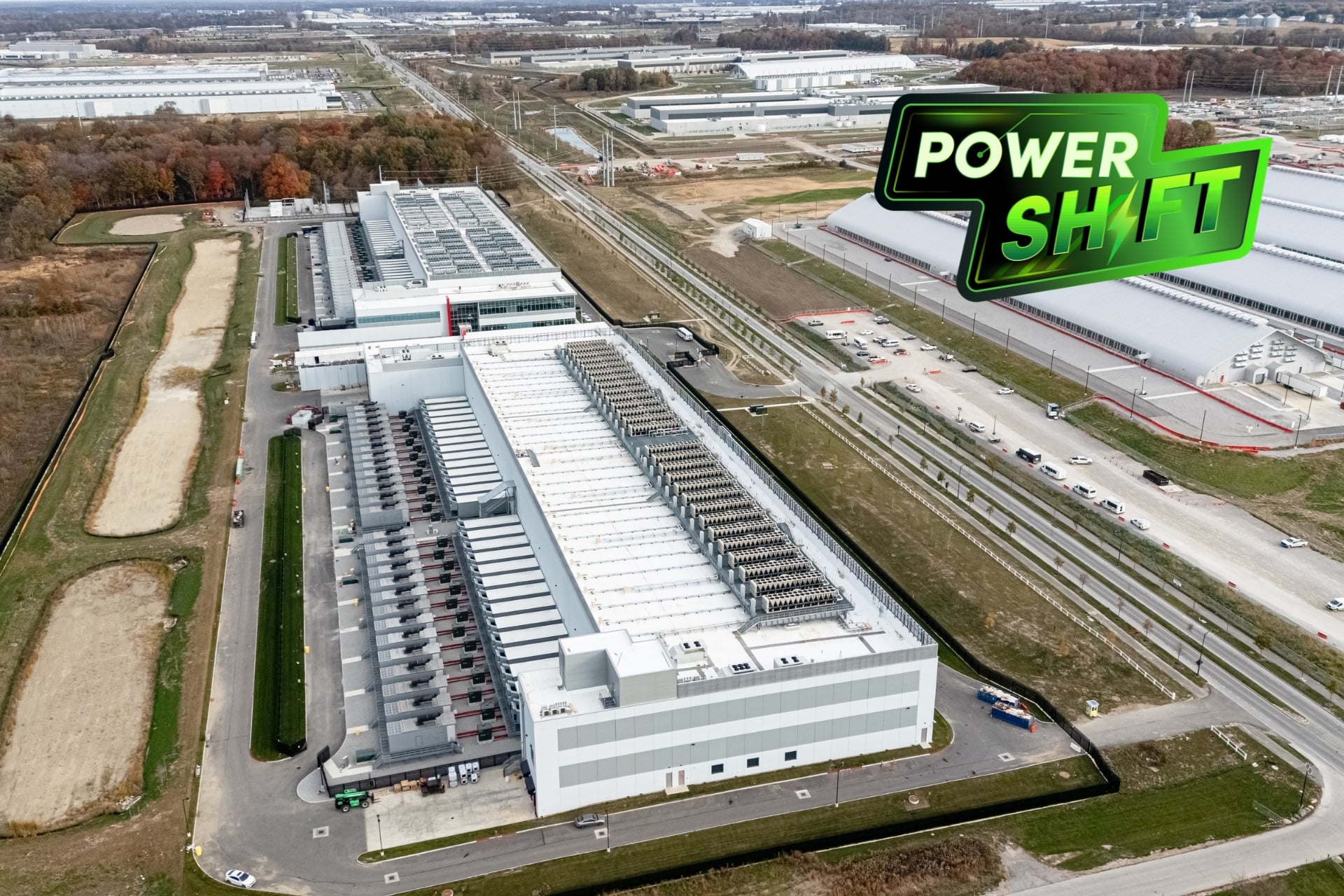
Power Shift is Ellyn Lapointe’s ongoing Gizmodo series that explores advancements in green technology, with a focus on renewable energy, grid modernization, and emissions reduction.
As data centers have proliferated across the United States, they have quickly become one of America’s most contentious political issues. Analysts believe voter opposition to the resource-hungry facilities played a key role in shaping the results of the midterm elections, but the thing is, scientists are still working to understand exactly how much energy U.S. data centers consume—and how much carbon they emit.
A new estimate has researchers concerned. The study, published today in the journal Nature Sustainability, found that hyperscale data centers—massive facilities engineered for extreme scalability and large workloads—were associated with 1.8% of national electricity consumption between May 2024 and April 2025, generating about 28 million tons of carbon dioxide (CO2).
“We already have over a thousand hyperscale facilities operating and another 2,000 planned,” lead author Gianluca Guidi, a postdoctoral researcher studying AI’s resource consumption and environmental impact at the Harvard T.H. Chan School of Public Health, told Gizmodo in an email. “So, the data starts to raise a red flag about where we’re going, and whether we’re building these AI data centers in the most responsible way we can.”
Hungry hyperscalers
Guidi and his colleagues started this project in 2024, motivated by the rapid expansion of generative AI. They wanted to capture a full year of data center electricity consumption and associated carbon emissions to better understand their current impact, rather than focusing exclusively on future projections. Establishing a more accurate baseline would help improve those projections and guide policy decisions.
To that end, the researchers analyzed facility-level data on 403 hyperscale data centers operating across the U.S. between May 2024 and April 2025, estimating their electricity consumption, energy sources, and attributable CO2 emissions. It’s important to note that the analysis did not encompass all hyperscale data centers in the U.S., and the available data did not allow for differentiation between general-purpose and AI-specialized operations at each facility.
“For each of the 403 data centers, we know where it is, how big it is, some basic characteristics, and its power consumption,” Guidi explained. They also had data on which power plants supply their electricity, the fuel mix of each plant, and the plants’ CO2 emissions.
“These are all actual measurements. The only assumption is what percentage each power plant contributes to a data center,” he said. Guidi’s team assumed that each power plant provides an equal share of the facility’s energy mix, a previously validated method for estimating data centers’ carbon emissions.
Accounting for 1.8% of the nation’s electricity consumption may not sound like a big deal, but Guidi emphasized that this is a small number of facilities eating a huge amount of electricity.
“We’re talking about just 403 facilities consuming approximately 82 terawatt-hours of electricity in a single year—approaching the annual electricity consumption of an entire mid-sized American state, including its homes, businesses, and industries,” he said. “And perhaps what surprised me most throughout the research was how little independently verified information is publicly available about infrastructure that’s already consuming electricity on this scale.”
The researchers were also struck by the data centers’ dependence on fossil fuels and the scale of their carbon emissions. They found that about 54% of the electricity attributed to the facilities they investigated rely on fossil fuels, with 38% using natural gas and 15% using coal. The new estimate for their cumulative carbon emissions is two to three times larger than previous estimates and roughly equivalent to the carbon footprint of a country the size of Denmark.
While there has been recent progress toward renewable energy sources for hyperscale facilities, that wasn’t the priority during the first wave of construction, according to Guidi.
“The priority was getting these facilities built and running as soon as possible, with power found as quickly and cheaply as possible,” he said.
Growing public health risks
The energy demand of hyperscale data centers is not spread out evenly across the country. The study found that four states alone account for more than half the electricity consumption of the 403 facilities studied: Virginia, Oregon, Ohio, and Iowa.
Virginia has more data centers than any other state, with more than 660 already operating and another 600 planned as of January. Residents of “data center alley,” a section of northern Virginia that hosts the world’s densest concentration of the facilities, have launched a grassroots movement against new projects due to concerns about strained power grids and rising utility bills, environmental damages, quality of life impacts, and public health risks.
Better quantifying pollution exposure and public health is the next step for Guidi’s research. In a forthcoming study, he and his colleagues will compare the air pollution and impact of data centers attached to the grid versus those that generate their own electricity on site.
“At the highest level, if you demand more electricity and that electricity comes from fossil fuels, an increase in emissions is inevitable,” he explained. “With chemistry models, we can track those emissions as they become air pollution exposure. That pollution can travel pretty far, and some populations will be more affected than others.”
Planet-warming CO2 threatens public health by exacerbating heat waves, wildfire smoke, flooding, and other extreme weather events. But the fossil fuel power plants running data centers emit other harmful pollutants too, including fine particulate matter, nitrogen oxides, and sulfur dioxide. Exposure to these airborne chemicals has been linked to heart and lung disease as well as premature death.
“When data centers draw heavily on fossil fuel power, the people living near and downwind of those power plants may bear health costs, even if they’re far from the data center itself,” Guidi said.