“Every tool is a weapon, if you hold it right,” as that oft-quoted lyric by Ani DiFranco goes. But the irony may be even more apparent when it comes to so-called nonlethal weapons, which law enforcement officers in the U.S. have repeatedly used in ways that can cause serious injuries and, in some cases, death.
The problem has gotten pretty bad in the past year, as you can imagine, thanks to the Trump administration’s brutal (and yet perversely haphazard) execution of its immigration enforcement agenda. Now that damage has been quantified. Doctors with the nonprofit Physicians for Human Rights (PHR) working with the University of California, Berkeley, have determined that law enforcement misused crowd-control weapons at least 412 times during immigration enforcement protests between June 2025 and May 2026. By PHR’s count, 119 people have been maimed by government agents unsafely firing nonlethal projectiles at close range, launching tear gas canisters directly at protestors, and/or other breaches of established protocol for these tools.
“We documented over 100 cases of injuries caused when law enforcement agencies deployed crowd-control weapons in ways that violated manufacturer guidance, agency policies, widely accepted policing norms or international use-of-force standards,” emergency physician Rohini Haar, a medical advisor to PHR and lead author of the new report, said in a statement.
Haar noted that these injuries—which led to medical care for roughly half (47.1%) of those harmed—raise “serious concerns under constitutional and international human rights law.”
A (nonlethal) bullet to the head
One disturbing trend that Haar and her research partners identified, according to their report, was a high number of head injuries: 19 impacting the brain, 10 damaging victims’ eyes, and at least one leading to hearing loss. The findings suggest “a pattern of force directed towards the head,” they wrote. And, whether premeditated or accidental, each case violated official use-of-force guidelines for deployment of these nonlethal weapons.
“Harms caused by the misuse of crowd-control weapons are almost always foreseeable, particularly when these weapons are deployed against vulnerable populations like children or […] contrary to manufacturers’ guidance or international use-of-force standards,” Haar noted.
The PHR and UC Berkeley team noted that its findings were almost guaranteed to be underestimates, given that “visual investigative techniques cannot adequately assess invisible injuries, such as chemical injury or chronic pain or hearing loss.” While the team recorded 119 people injured—via a dataset that included press photos, court filings, and police body-cam footage—a total of 203 sustained injuries were documented, as many individuals were attacked more than once.
Haar added that these remote forensic methods were unfortunately the best accounting available of these probable human rights violations.
“[M]eaningful public oversight of incidents during the recent surge in U.S. immigration enforcement protests is nearly impossible because of the very limited reliable official reporting,” she said.
The Bovino effect
“Surges in violence during operations, including those in Los Angeles, Chicago, and Minneapolis, can be directly attributed to the leadership of Border Patrol agent Greg Bovino and his supervisors,” according to the new report. “Each time Bovino was present at the site of major protests, incidents rose dramatically.”
In fact, the researchers found that over 90% of these damaging incidents were documented in just five major U.S. cities: Chicago, Los Angeles, Minneapolis, Newark, and Portland. Among these injuries, 86% were directly attributable to Department of Homeland Security actions, as they came amid sieges DHS officials led themselves, each time with dimwitted, self-aggrandizing names like operations “Midway Blitz” (Chicago) and “Metro Surge” (Minneapolis).
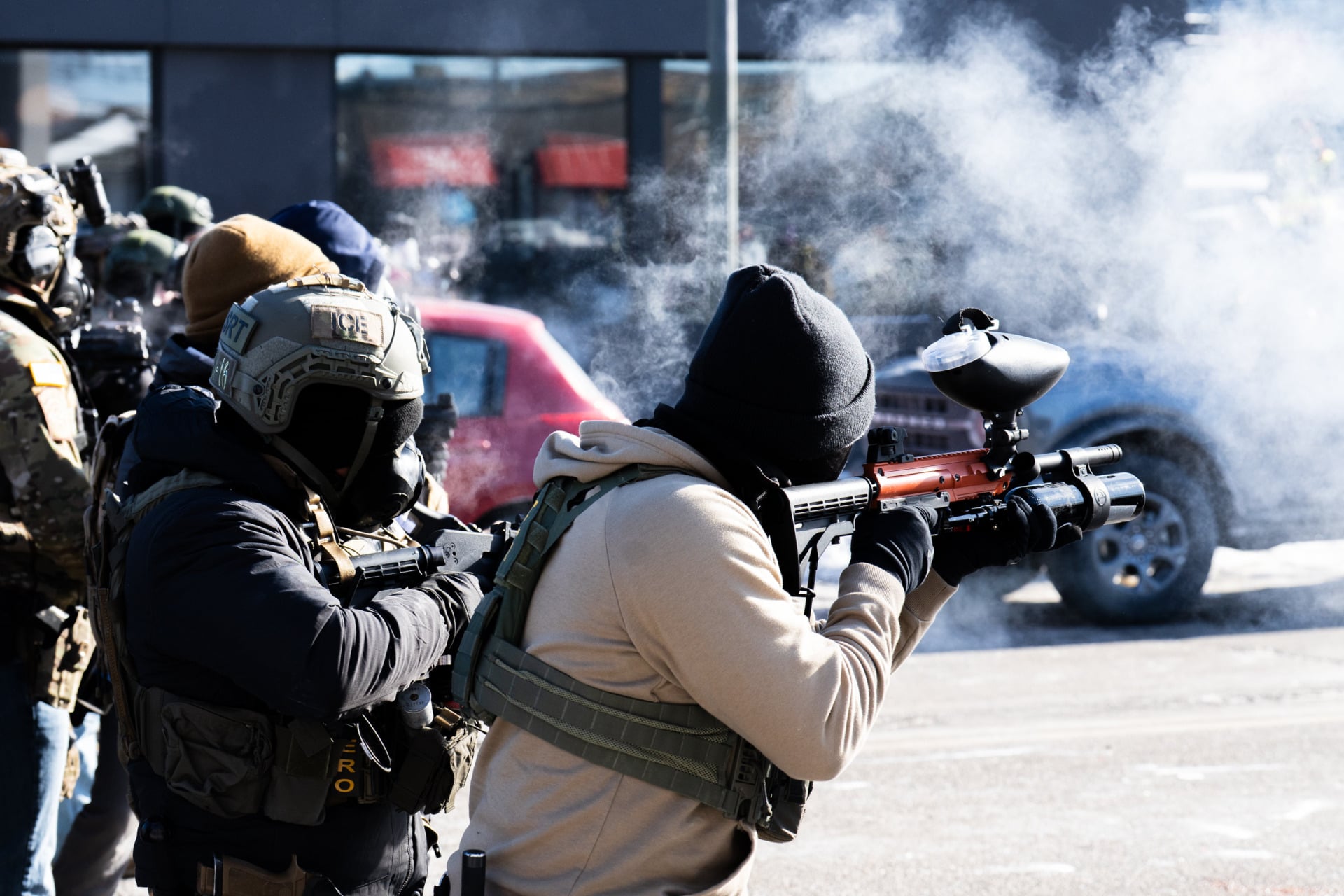
Law enforcement officers misusing chemical irritants, like tear gas, and kinetic impact projectiles, like rubber bullets, contributed to the vast majority of these avoidable injuries. But particularly damaging hybrid weapons, pepper balls, made up over 25% of the 203 total injuries, the data show.
“We built our own dataset documenting severe injuries and permanent disabilities caused by the misuse of these weapons,” Haar said. “We invite the Department of Homeland Security, Congress and state authorities to examine these findings and act immediately to prevent further suffering.”