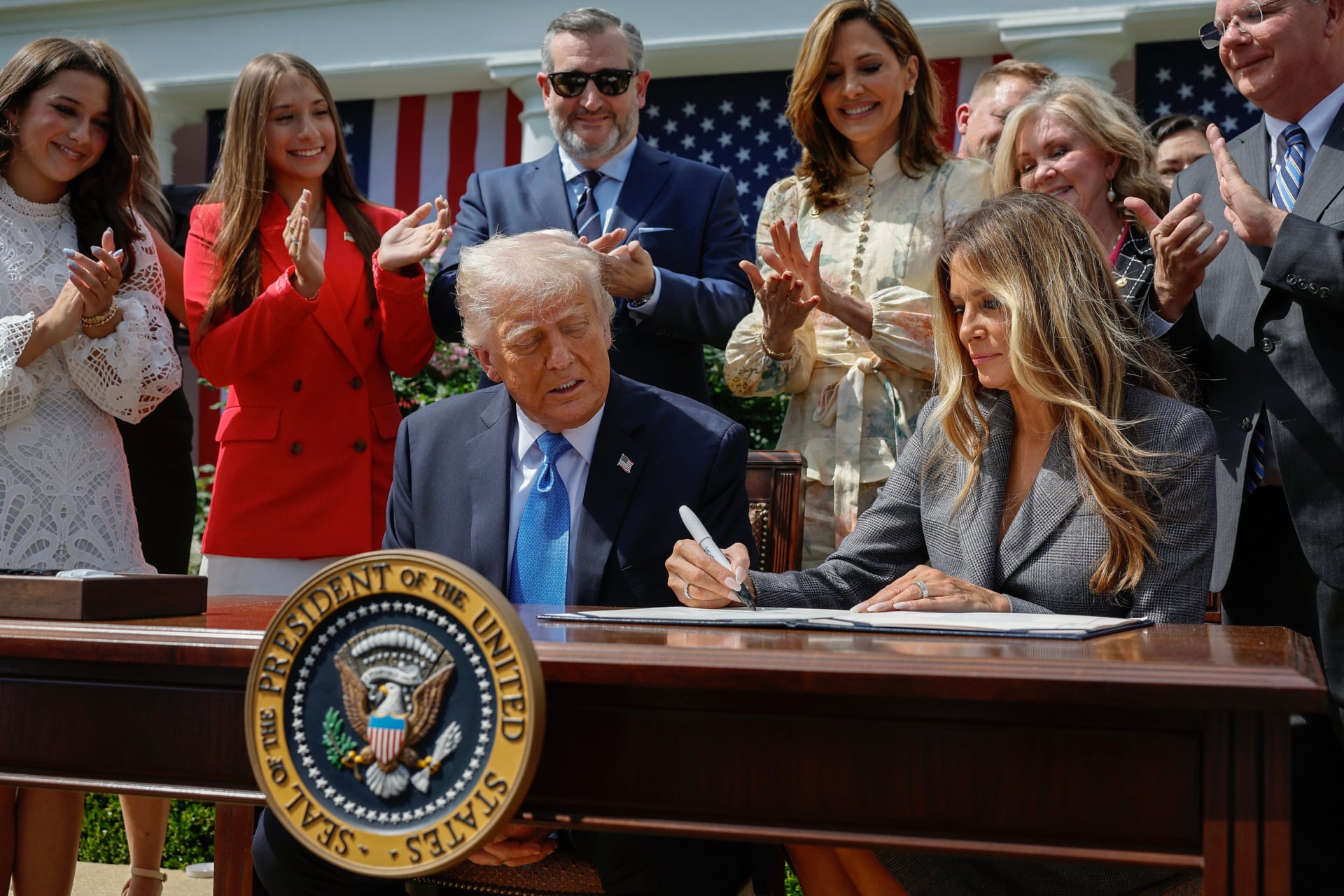
Roughly one year ago today, President Trump signed into law the Take It Down Act (TIDA), a first-of-its-kind federal law aimed at curbing the proliferation of nonconsensual intimate photos and videos online.
Now, starting on Tuesday, the Federal Trade Commission will finally begin enforcing one of its key provisions, Section 3.
When it was enacted into law, TIDA allowed the prosecution of anyone who knowingly distributes deepfakes or intimate images of any minor or non-consenting adult. Last month, a 37-year-old man from Columbus, Ohio, became “the first person in the United States to be convicted under the Take It Down Act,” in the words of U.S. Attorney Dominick S. Gerace II. The perpetrator used more than 120 AI platforms and models to create and distribute sexual images of minors and non-consenting adult women on various digital platforms.
Though the law has been in effect for a year now, the FTC gave digital platforms operators until May 19, 2026, to comply with Section 3, which holds the platforms partially liable for the distribution of such images. That deadline has now arrived.
Specifically, Section 3 of the Act requires digital platforms to establish a clear and easy process for victims of nonconsensual intimate imagery to request the removal of photos or videos and any identical copies within 48 hours. Victims won’t be required to find and report each identical copy themselves. The FTC is also requiring the platform operators to make the reporting process available for everyone, regardless of whether or not the victim has an existing account on the platform. Once a request is submitted, the victims should be provided with an identifying number to track their request, which they can also provide to law enforcement.
“The FTC will vigorously enforce TIDA,” FTC Chairman Andrew Ferguson wrote in a letter sent to more than a dozen tech companies earlier this month, threatening potential civil penalties of $53,088 per violation. The recipients of that letter included Amazon, Apple, Alphabet, Bumble, Match Group, Discord, Meta, Microsoft, Reddit, TikTok, and X, which has been embroiled in controversy over the past few months due to the rampant spread of nonconsensual deepfakes on the platform.
Will it actually make a difference?
Victims of online sexual abuse have been advocating for tougher regulation for years, even before the radical advances in AI image and video generation compounded the problem. TIDA is a welcome step in that direction, but its critics are worried that it won’t be an effective solution.
One reason is that since the Act became law a year ago, nonconsensual sexual deepfakes haven’t gone anywhere, even becoming trendier on some platforms. Elon Musk’s Grok chatbot has become the notorious poster child of this online epidemic.
Late last year, X users started a disturbing trend where they used Grok to generate nonconsensually undressed or otherwise sexualized photos, often of women and children. Musk engaged with the trend, reposting photos of sexualized toaster machines on his own X profile before seemingly trying to make money off of the freshly popular feature. Though TIDA could not yet hold Musk and his company liable for these photos, xAI got into considerable trouble abroad, where such regulations already existed.
Even once Section 3 is enforced, though, the bill might not be the most effective at curbing the negative impact of sexual deepfakes.
“The reality, though, is that this means that the burden of identifying, documenting, and reporting harmful AI-generated content still lies with the victims themselves,” Columbia University PhD candidate Kaylee Williams told Gizmodo. “Research shows that the reporting process can expose victims to immense trauma, on top of the adverse consequences they’re likely to face as a result of the initial abuse.”
Williams is also unsure whether the major social media companies “will make a good faith effort to comply with the new rules.”
“At the end of the day, the question is whether these fines will provide enough incentive for the companies to build digital infrastructures to make a meaningful difference for victims, or simply absorb the costs of noncompliance, as many have done in the past,” Williams said. “Abusive content is now easier to make and distribute than it has ever been before, so policing this harm at scale will be both costly and laborious, both for the platforms and the FTC.”
The TIDA penalties are high considering that it’s per violation, but are considerably less harsh than those imposed by a similar online safety law enacted in the United Kingdom, where companies can be fined up to 10% of their qualifying worldwide revenue. For a company like Meta, for example, that could be worth millions of dollars.
Other critics are worried that the Act will pose a significant threat to online privacy.
“The Take It Down Act gives the powerful a dangerous new route to manipulate platforms into removing lawful speech that they simply don’t like,” digital rights non-profit Electronic Frontier Foundation’s director of federal affairs India McKinney told Gizmodo. “Lawmakers should have focused on strengthening and enforcing existing legal protections for victims, rather than inventing new takedown regimes that are ripe for abuse.”
The concern is that, due to the 48-hour turnaround, digital platforms could choose to solely rely on the report in deciding to take down certain posts. Bad actors could abuse this as a loophole to take down anything they don’t want to see on the internet, including posts by government critics.
“President Trump himself has said that he would use the law to censor his critics, and that’s exactly the kind of abuse the public should fear,” McKinney said.
When the bill had just passed the Senate and was still awaiting a House vote in March 2025, Trump told a joint session of Congress that he was eagerly looking forward to it.
“I’m going to use that bill for myself too if you don’t mind, because nobody gets treated worse than I do online, nobody,” Trump said.