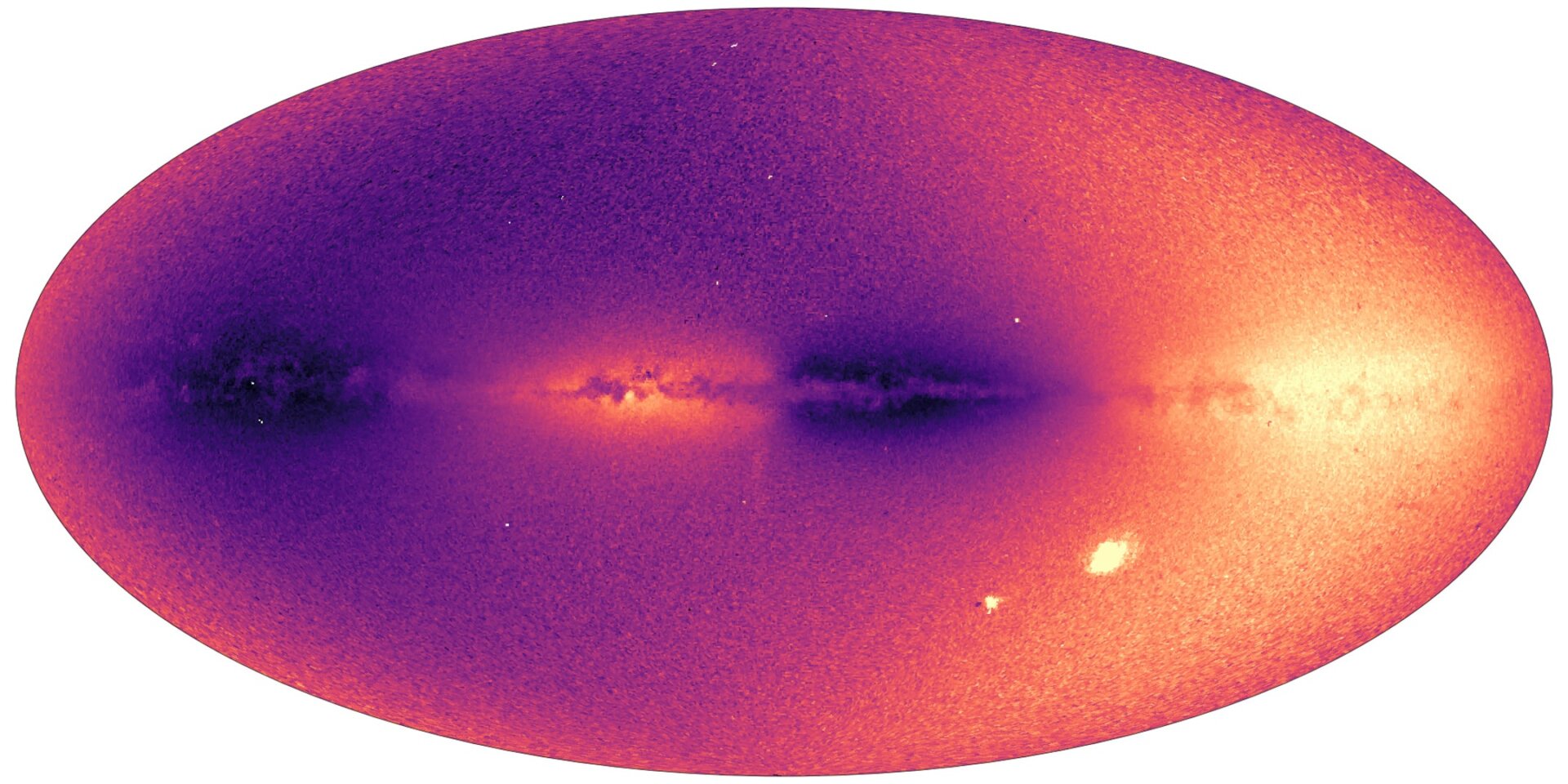
The ebb and flow of the Milky Way disc
The Gaia spacecraft has two telescopes on board, and it observes the Milky Way galaxy from an orbital perch called the Lagrange 2, or L2, point, located about 1 million miles (1.5 million kilometers) away from Earth (that’s the same orbit currently being used by NASA’s Webb Space Telescope).
The above visualization shows the Milky Way’s disc, which stretches about 100,000 light-years across. The rotation of the disc is illustrated through different colors, with darker shades indicating objects moving toward us and brighter shades indicating objects moving away. Meanwhile, there are some outliers that aren’t quite traveling with their surrounding group, which can be spotted as tiny dots in the crowd.
Correction: A previous version of this slide stated that the Milky Way disc is 10,000 light-years across, when actually it is 100,000 light-years wide.