The suggestion that humans will soon set up bustling, long-lasting colonies on Mars is something many of us take for granted. What this lofty vision fails to appreciate, however, are the monumental—if not intractable—challenges awaiting colonists who want to permanently live on Mars. Unless we radically adapt our brains and bodies to the harsh Martian environment, the Red Planet will forever remain off limits to humans.
Mars is the closest thing we have to Earth in the entire solar system, and that’s not saying much.
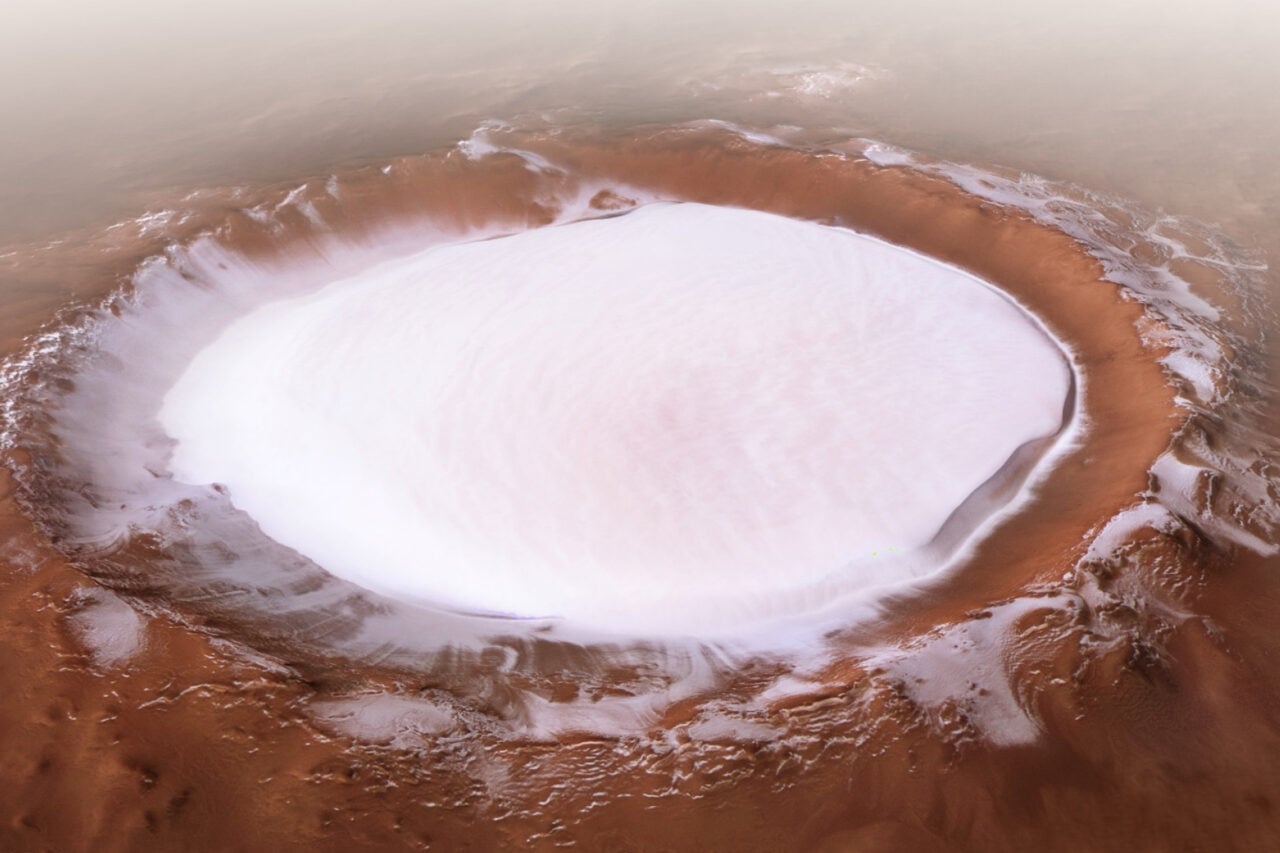
The Red Planet is a cold, dead place, with an atmosphere about 100 times thinner than Earth’s. The paltry amount of air that does exist on Mars is primarily composed of noxious carbon dioxide, which does little to protect the surface from the Sun’s harmful rays. Air pressure on Mars is very low; at 600 Pascals, it’s only about 0.6 percent that of Earth. You might as well be exposed to the vacuum of space, resulting in a severe form of the bends—including ruptured lungs, dangerously swollen skin and body tissue, and ultimately death. The thin atmosphere also means that heat cannot be retained at the surface. The average temperature on Mars is -81 degrees Fahrenheit (-63 degrees Celsius), with temperatures dropping as low as -195 degrees F (-126 degrees C). By contrast, the coldest temperature ever recorded on Earth was at Vostok Station in Antarctica, at -128 degrees F (-89 degrees C) on June 23, 1982. Once temperatures get below the -40 degrees F/C mark, people who aren’t properly dressed for the occasion can expect hypothermia to set in within about five to seven minutes.
Mars also has less mass than is typically appreciated. Gravity on the Red Planet is 0.375 that of Earth’s, which means a 180-pound person on Earth would weigh a scant 68 pounds on Mars. While that might sound appealing, this low-gravity environment would likely wreak havoc to human health in the long term, and possibly have negative impacts on human fertility.
Yet despite these and a plethora of other issues, there’s this popular idea floating around that we’ll soon be able to set up colonies on Mars with ease. SpaceX CEO Elon Musk is projecting colonies on Mars as early as the 2050s, while astrobiologist Lewis Darnell, a professor at the University of Westminster, has offered a more modest estimate, saying it’ll be about 50 to 100 years before “substantial numbers of people have moved to Mars to live in self-sustaining towns.” The United Arab Emirates is aiming to build a Martian city of 600,000 occupants by 2117, in one of the more ambitious visions of the future.

Sadly, this is literally science fiction. While there’s no doubt in my mind that humans will eventually visit Mars and even build a base or two, the notion that we’ll soon set up colonies inhabited by hundreds or thousands of people is pure nonsense, and an unmitigated denial of the tremendous challenges posed by such a prospect.
Pioneering astronautics engineer Louis Friedman, co-founder of the Planetary Society and author of Human Spaceflight: From Mars to the Stars, likens this unfounded enthusiasm to the unfulfilled visions proposed during the 1940s and 1950s.
“Back then, cover stories of magazines like Popular Mechanics and Popular Science showed colonies under the oceans and in the Antarctic,” Friedman told Gizmodo. The feeling was that humans would find a way to occupy every nook and cranny of the planet, no matter how challenging or inhospitable, he said. “But this just hasn’t happened. We make occasional visits to Antarctica and we even have some bases there, but that’s about it. Under the oceans it’s even worse, with some limited human operations, but in reality it’s really very, very little.” As for human colonies in either of these environments, not so much. In fact, not at all, despite the relative ease at which we could achieve this.
After the Moon landings, Friedman said he and his colleagues were hugely optimistic about the future, believing “we would do more and more things, such as place colonies on Mars and the Moon,” but the “fact is, no human spaceflight program, whether Apollo, the Space Shuttle Program, or the International Space Station,” has established the necessary groundwork for setting up colonies on Mars, such as building the required infrastructure, finding safe and viable ways of sourcing food and water, mitigating the deleterious effects of radiation and low gravity, among other issues. Unlike other fields, development into human spaceflight, he said, “has become static.” Friedman agreed that we’ll likely build bases on Mars, but the “evidence of history” suggests colonization is unlikely for the foreseeable future.
Neuroscientist Rachael Seidler from the University of Florida says many people today fail to appreciate how difficult it’ll be to sustain colonies on the Red Planet.
“People like to be optimistic about the idea of colonizing Mars,” Seidler, a specialist in motor learning and the effects of microgravity on astronauts, told Gizmodo. “But it also sounds a bit pie-in-the-sky,” she said. “A lot of people approach it as thinking we shouldn’t limit ourselves based on practicalities, but I agree, there are a lot of potential negative physiological consequences.”
Seidler said NASA and other space agencies are currently working very hard to create and test countermeasures for the various negative impacts of living on Mars. For example, astronauts on the ISS, who are subject to tremendous muscle and bone loss, try to counteract the effects by doing strength and aerobic training while up in space. As for treating the resulting negative health impacts, whether caused by long-duration stays on the ISS or from long-term living in the low-gravity environment of Mars, “we’re not there yet,” said Seidler.
In his latest book, On the Future: Prospects for Humanity, cosmologist and astrophysicist Martin Rees addressed the issue of colonizing Mars rather succinctly:
By 2100 thrill seekers… may have established ‘bases’ independent from the Earth—on Mars, or maybe on asteroids. Elon Musk (born in 1971) of SpaceX says he wants to die on Mars—but not on impact. But don’t ever expect mass emigration from Earth. And here I disagree strongly with Musk and with my late Cambridge colleague Stephen Hawking, who enthuse about rapid build-up of large-scale Martian communities. It’s a dangerous delusion to think that space offers an escape from Earth’s problems. We’ve got to solve these problems here. Coping with climate change may seem daunting, but it’s a doddle compared to terraforming Mars. No place in our solar system offers an environment even as clement as the Antarctic or the top of Everest. There’s no ‘Planet B’ for ordinary risk-averse people.
Indeed, there’s the whole terraforming issue to consider. By terraforming, scientists are referring to the hypothetical prospect of geoengineering a planet to make it habitable for humans and other life. For Mars, that would mean the injection of oxygen and other gases into the atmosphere to raise surface temperature and air pressure, among other interventions. A common argument in favor of colonizing Mars is that it’ll allow us to begin the process of transforming the planet to a habitable state. This scenario has been tackled by a number of science fiction authors, including Kim Stanley Robinson in his acclaimed Mars Trilogy. But as Friedman told Gizmodo, “that’s thousands of years in the making at least.”
Briony Horgan, assistant professor of planetary science at Purdue University, said Martian terraforming is a pipedream, a prospect that’s “way beyond any kind of technology we’re going to have any time soon,” she told Gizmodo.

When it comes to terraforming Mars, there’s also the logistics to consider, and the materials available to the geoengineers who would dare to embark upon such a multi-generational project. In their 2018 Nature paper, Bruce Jakosky and Christopher Edwards from the University of Colorado, Boulder sought to understand how much carbon dioxide would be needed to increase the air pressure on Mars to the point where humans could work on the surface without having to wear pressure suits, and to increase temperature such that liquid water could exist and persist on the surface. Jakosky and Edwards concluded that there’s not nearly enough CO2 on Mars required for terraforming, and that future geoengineers would have to somehow import the required gases to do so.
To be clear, terraforming is not necessarily an impossibility, but the timeframes and technologies required preclude the possibility of sustaining large, vibrant colonies on Mars for the foreseeable future.
Until such time, an un-terraformed Mars will present a hostile setting for venturing pioneers. First and foremost there’s the intense radiation to deal with, which will confront the colonists with a constant health burden.
Horgan said there are many big challenges to colonizing Mars, with radiation exposure being one of them. This is an “issue that a lot of folks, including those at SpaceX, aren’t thinking about too clearly,” she told Gizmodo. Living underground or in shielded bases may be an option, she said, but we have to expect that cancer rates will still be “an order of magnitude greater” given the added exposure over time.
“You can only do so much with radiation protection,” Horgan said. “We could quantify the risks for about a year, but not over the super long term. The problem is that you can’t stay in there [i.e. underground or in bases] forever. As soon as you go outside to do anything, you’re in trouble,” she said.
Horgan pointed to a recent Nature study showing that radiation on Mars is far worse than we thought, adding that “we don’t have the long-term solutions yet, unless you want to risk radiation illnesses.” Depending on the degree of exposure, excessive radiation can result in skin burns, radiation sickness, cancer, and cardiovascular disease.
Friedman agrees that, in principle, we could create artificial environments on Mars, whether by building domes or underground dwellings. The radiation problem may be solvable, he said, “but the problems are still huge, and in a sense anti-human.”
Life in a Martian colony would be miserable, with people forced to live in artificially lit underground bases, or in thickly protected surface stations with severely minimized access to the outdoors. Life in this closed environment, with limited access to the surface, could result in other health issues related to exclusive indoor living, such as depression, boredom from lack of stimulus, an inability to concentrate, poor eyesight, and high blood pressure—not to mention a complete disconnect from nature. And like the International Space Station, Martian habitats will likely be a microbial desert, hosting only a tiny sample of the bacteria needed to maintain a healthy human microbiome.
Another issue has to do with motivation. As Friedman pointed out earlier, we don’t see colonists living in Antarctica or under the sea, so why should we expect troves of people to want to live in a place that’s considerably more unpleasant? It seems a poor alternative to living on Earth, and certainly a major step down in terms of quality of life. A strong case could even be made that, for prospective families hoping to spawn future generations of Martian colonists, it’s borderline cruelty.
And that’s assuming humans could even reproduce on Mars, which is an open question. Casting aside the deleterious effects of radiation on the developing fetus, there’s the issue of conception to consider in the context of living in a minimal gravity environment. We don’t know how sperm and egg will act on Mars, or how the first critical stages of conception will occur. And most of all, we don’t know how low gravity will affect the mother and fetus.
Seidler, an expert in human physiology and kinesiology, said the issue of human gestation on Mars is a troublesome unknown. The developing fetus, she said, is likely to sit higher up in the womb owing to the lower gravity, which will press upon the mother’s diaphragm, making it hard for the mother to breathe. The low gravity may also “confuse” the gestational process, delaying or interfering with critical phases of the fetus’ development, such as the fetus dropping by week 39. On Earth, bones, muscles, the circulatory system, and other aspects of human physiology develop by working against gravity. It’s possible that the human body might adapt to the low-gravity situation on Mars, but we simply don’t know. An artificial womb might be a possible solution, but again, that’s not something we’ll have access to anytime soon, nor does it solve the low-gravity issue as it pertains to fetal development (unless the artificial womb is placed in a centrifuge to simulate gravity).
A strong case can be made that any attempt to procreate on Mars should be forbidden until more is known. Enforcing such a policy on a planet that’s 34 million miles away at its closest is another question entirely, though one would hope that Martian societies won’t regress to lawlessness and a complete disregard of public safety and established ethical standards.
For other colonists, the minimal gravity on Mars could result in serious health problems over the long term. Studies of astronauts who have participated in long-duration missions lasting about a year exhibit troubling symptoms, including bone and muscle loss, cardiovascular problems, immune and metabolic disorders, visual disorders, balance and sensorimotor problems, among many other health issues. These problems may not be as acute as those experienced on Mars, but again, we simply don’t know. Perhaps after five or 10 or 20 years of constant exposure to low gravity, similar gravity-related disorders will set in.
Seidler’s research into the effects of microgravity suggests it’s a distinct possibility.
“Yes, there would be physiological and neural changes that would occur on Mars due to its partial-gravity environment,” she told Gizmodo. “It’s not clear whether these changes would plateau at some point. My work has shown an upward shift of the brain within the skull in microgravity, some regions of gray matter increases and others that decrease, structural changes within the brain’s white matter, and fluid shifts towards the top of the head.”
Seidler said some of these changes scale with the duration of microgravity exposure, from two weeks up to six months, but she hasn’t looked beyond that.

“Some of these effects would have to eventually plateau—there is a structural limit on the fluid volume that the skull can contain, for example,” she said. “And, the nervous system is very adaptable. It can ‘learn’ how to control movements in microgravity despite the altered sensory inputs. But again, it’s unclear what the upper limits are.”
The effects of living in partial gravity compared to microgravity may not be as severe, she said, but in either case, different sensory inputs are going into the brain, as they’re not loaded by weight in the way they’re used to. This can result in a poor sense of balance and compromised motor functions, but research suggests astronauts in microgravity eventually adapt.
“There are a lot of questions still unanswered about how microgravity and partial gravity will affect human physiology,” Seidler told Gizmodo. “We don’t yet understand the safety or health implications. More needs to be done.”
Astronauts who return from long-duration missions have a rough go for the first few days back on Earth, experiencing nausea, dizziness, and weakness. Some astronauts, like NASA’s Scott Kelly, never feel like their old selves again, including declines in cognitive test scores and altered gene function. Work by NASA’s Scott Wood has shown that recovery time for astronauts is proportionate to the length of the mission—the longer the mission, the longer the recovery. Disturbingly, we have no data for microgravity exposure beyond a year or so, and it’s an open question as to the effects of low gravity on the human body after years, or even decades, of exposure.
With this in mind, it’s an open question as to how Martian colonists might fare upon a return visit to Earth. It might actually be a brutal experience, especially after having experienced years in a partial gravity environment. Children born on Mars (if that’s even a possibility) might never be able to visit the planet where their species originated.
And these are the health issues we think might be a problem. A host of other problems are likely to exist, giving rise to Martian-specific diseases affecting our brains, bodies, and emotional well-being. The human lifespan on Mars is likely to be significantly less than it is on Earth, though again, we simply don’t know.
Finally, there’s the day-to-day survival to consider. Limited access to fundamental resources, like food and water, could place further constraints on a colony’s ability to grow and thrive.
“Establishing stable resources to live off for a long period of time is possible, but it’ll be tough,” said Horgan. “We’ll want to be close to water and water ice, but for that we’ll have to go pretty far north. But the further north you go, the rougher the conditions get on the surface. The winters are cold, and there’s less sunlight.”

Colonists will also need stable food sources, and figure out a way to keep plants away from radiation. The regolith, or soil, on Mars is toxic, containing dangerous perchlorate chemicals, so that also needs to be avoided. To grow crops, colonists will likely build subterranean hydroponic greenhouses. This will require specialized lighting, genetically modified plants designed specifically for Mars, and plenty of water, the latter of which will be difficult to source on Mars.
“People don’t realize how complicated this is,” said Horgan. “Trying to think about establishing colonies to point of what we would consider safe will be a big challenge.”
Technological solutions to these problems may exist, as are medical interventions to treat Martian-specific diseases. But again, nothing that we could possibly develop soon. And even if we do develop therapies to treat humans living on Mars, these interventions are likely to be limited in scope, with patients requiring constant care and attention.
As Martin Rees pointed out, Mars and other space environments are “inherently hostile for humans,” but as he wrote in his book,
[We] (and our progeny here on Earth) should cheer on the brave space adventurers, because they will have a pivotal role in spearheading the post-human future and determining what happens in the twenty-second century and beyond.
By post-human future, Rees is referring to a hypothetical future era in which humans have undergone extensive biological and cybernetic modifications such that they can no longer be classified as human. So while Mars will remain inaccessible to ordinary, run-of-the-mill Homo sapiens, the Red Planet could become available to those who dare to modify themselves and their progeny.
A possible solution is to radically modify human biology to make Martian colonists specially adapted to live, work, and procreate on the Red Planet. As Rees wrote in On the Future:
So, because they will be ill-adapted to their new habitat, the pioneer explorers will have a more compelling incentive than those of us on Earth to redesign themselves. They’ll harness the super-powerful genetic and cyborg technologies that will be developed in coming decades. These techniques will be, one hopes, heavily regulated on Earth, on prudential and ethical grounds, but ‘settlers’ on Mars will be far beyond the clutches of the regulators. We should wish them good luck in modifying their progeny to adapt to alien environments. This might be the first step towards divergence into a new species. Genetic modification would be supplemented by cyborg technology—indeed there may be a transition to fully inorganic intelligences. So, it’s these space-faring adventurers, not those of us comfortably adapted to life on Earth, who will spearhead the posthuman era.
Indeed, modifying humans to make them adaptable to living on Mars will require dramatic changes.
https://gizmodo.com/your-children-wont-be-able-to-live-in-space-without-a-1712230217
Our DNA would have to be tailored specifically to enable a long, healthy life on Mars, including genetic tweaks for good muscle, bone, and brain health. These traits could be made heritable, such that Martian colonists could pass down the characteristics to their offspring. In cases where biology is not up for the task, scientists could use cybernetic enhancements, including artificial neurons or synthetic skin capable of fending off dangerous UV rays. Nanotechnology in the form of molecular machines could deliver medicines, perform repair work, and eliminate the need for breathing and eating. Collectively, these changes would result in an entirely new species of human—one built specifically for Mars.
Synthetic biologist and geneticist Craig Venter believes this is a distinct possibility—and a tantalizing prospect. While delivering a keynote address at a NASA event in 2010, Venter said, “Not too many things excite my imagination as trying to design organisms—even people—for long-term space flight, and perhaps colonization of other worlds.”
Like some of the other solutions proposed, this won’t happen any time soon, nor will it be easy. And it may not even happen. Which brings a rather discouraging prospect to mind: We may be stuck on Earth.
As Friedman pointed out, this carries some rather heavy existential and philosophical implications. If humans can’t make it to Mars, it means we’re destined to be “a single-planet species,” he said. What’s more, it suggests extraterrestrial civilizations might be in the same boat, and that the potential for “intelligent life to spread throughout the universe is very, very gloomy,” he told Gizmodo.
“If we can’t make it to a nearby planet with an atmosphere, water, and a stable surface—which in principle suggests we could do it—then certainly we’re not going to make it much beyond that,” said Friedman. “But if we’re doomed to be a single-planet species, then we need to recognize both psychologically and technologically that we’re going to have live within the limits of Earth.”
Which is a good point. That we may eventually become an interplanetary or interstellar species remains an open question. We must work to make this futuristic prospect a reality, but until then, we have to make sure that Earth—the only habitable planet we know of—remains that way.