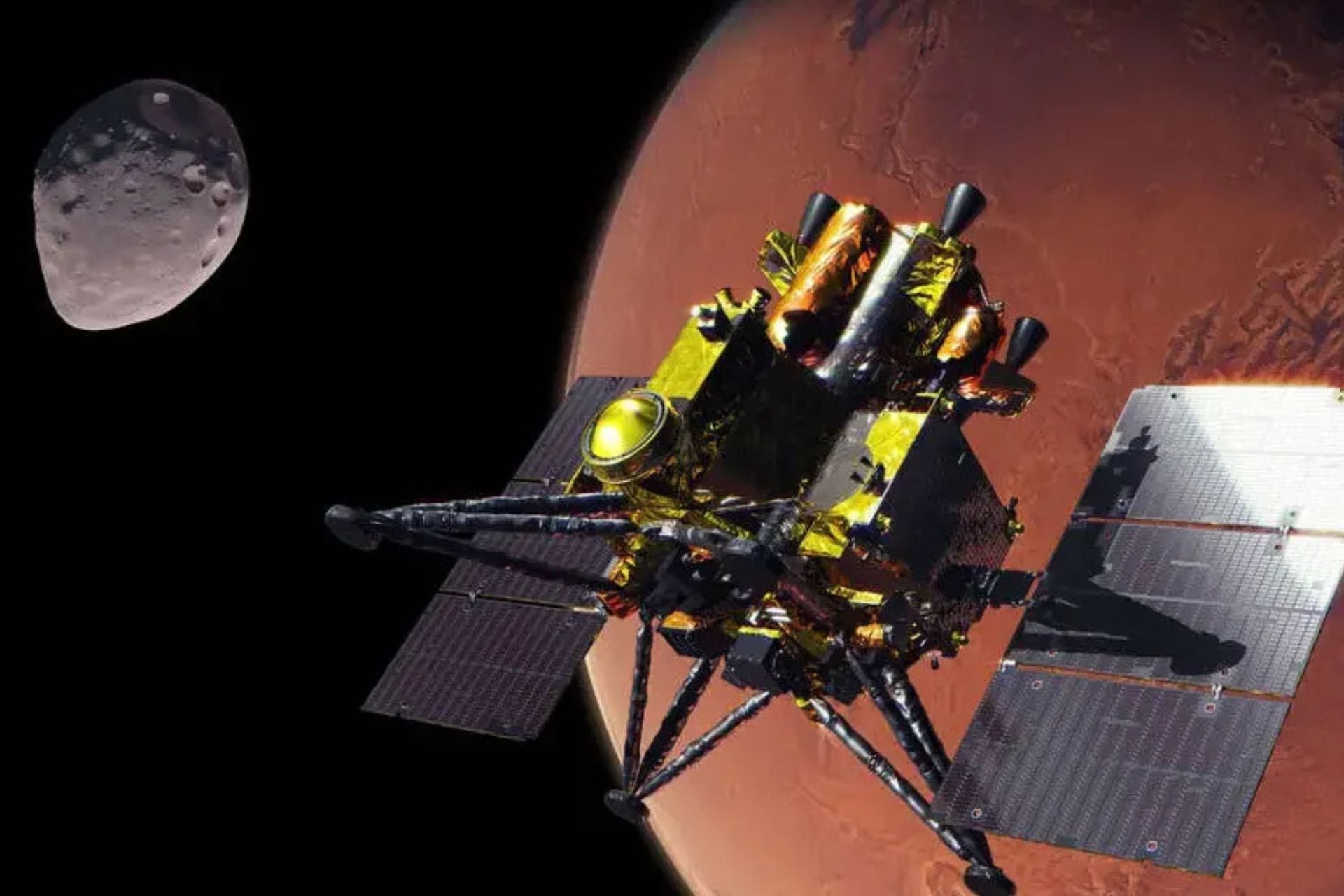
Rovers have traversed Mars’s rocky terrain for nearly 30 years, analyzing surface samples to help scientists unravel the Red Planet’s geological history. But its two moons, Phobos and Deimos, remain largely unexplored. That’s finally about to change.
The Japan Aerospace Exploration Agency (JAXA) plans to launch its Martian Moons eXploration (MMX) mission today at 3:41 p.m. ET. The first-of-its-kind endeavor will send a spacecraft to survey both of Mars’s moons, collect a sample of Phobos, and bring it back to Earth for more extensive analysis. If all goes according to plan, MMX could become the first mission to return home from Mars orbit and the first to return samples from the Martian system.
MMX will launch aboard an H3 rocket from Japan’s Tanegashima Space Center. JAXA will begin livestreaming the launch at 2:45 p.m. ET, and you can watch right here.
The mysterious origins of Mars’s moons
Many mysteries about the Red Planet remain unsolved, but the question of how Mars got its moons is among the most hotly debated. Scientists are currently divided over whether Phobos and Deimos are ancient asteroids that were ensnared by Mars’s gravity billions of years ago, or the coagulated remains of a massive impact on Mars that blasted material into orbit.
The MMX mission could not only help scientists figure out what these moons are and where they came from, but also provide insight into Mars itself.
“This is not going to be just a Phobos sample return mission,” Kris Zacny, vice president of exploration systems at Honeybee Robotics, which built one of MMX’s sample extractors, recently told Science. “It’s going to be Phobos and Mars.”
That’s because the moons—regardless of their origins—are likely dusted in material blasted off the Red Planet. Kiyoshi Kuramoto, a planetary scientist at Hokkaido University and leader of the mission’s international team of scientists, told Science that 1% of the material MMX retrieves from Phobos could come from Mars.
That would make MMX the first mission to return Red Planet material to Earth. NASA’s Mars Sample Return mission was effectively canceled in January, leaving dozens of rock cores collected by the Perseverance rover in limbo. The MMX sample will contain a treasure trove of information about the Martian system, offering new hope for planetary scientists working to understand its history and past habitability.
What’s more, piecing together the genesis of Phobos and Deimos “will help illuminate that early era when Earth and the other inner planets may have been acquiring much of their water and organic compounds,” Tom Statler, MMX program executive and program scientist at NASA, said in a statement.
The journey begins
If today’s launch goes according to plan, the MMX spacecraft will embark on a 10-month journey to Mars. Its first stop will be Phobos, where it will spend about three years studying the little moon. MMX will attempt at least one landing to extract a sample from Phobos, but ideally it will land twice to extract samples from different locations. This will help scientists better analyze the moon’s composition.
After gathering at least 10 grams of material, MMX will depart Phobos and move on to observe Deimos, though it will not attempt a landing on this smaller moon. The spacecraft will then begin the long flight back to Earth. JAXA is currently targeting a 2031 return, but that remains to be seen.
MMX is by far the most challenging mission JAXA has ever attempted. Reaching the Martian system will be a feat in itself, and it didn’t go so well last time. The agency’s only previous mission to Mars failed to enter the planet’s orbit, so it was a bust. This time, JAXA’s spacecraft will also need to land on an itty bitty moon with treacherous terrain and minimal gravity, plus complete the journey back to Earth.
There are countless ways this mission could go awry, but recently successful asteroid sample return missions—two of which were launched by JAXA—have paved the way for MMX. The Hayabusa and Hayabusa 2 missions proved that the agency can return samples from small, rocky solar system bodies, though MMX will travel much farther from Earth.
Today’s launch could mark the beginning of a new era for Mars exploration. Holding a piece of the Red Planet system in their hands would allow scientists to conduct analyses that rovers spacecraft just aren’t capable of, bringing them closer to answering longstanding questions about Mars, its moons, and our solar system.