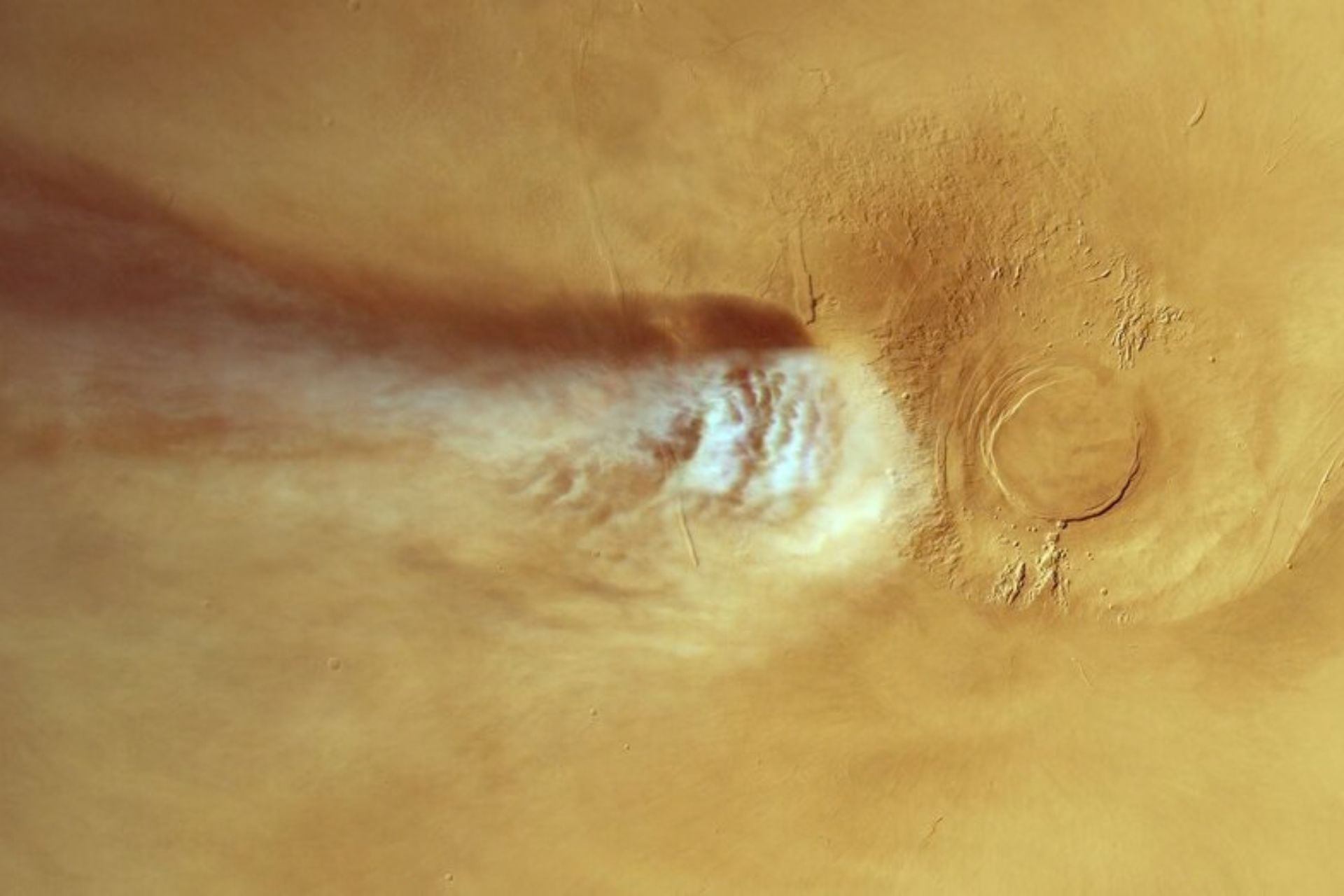
During Mars’s dusty season, which runs through spring and summer in the Red Planet’s southern hemisphere, a wispy cloud of water ice appears downwind of the enormous Arsia Mons volcano. Aptly named the Arsia Mons Elongated Cloud (AMEC), this thin white line forms each day at sunrise, grows up to 1,100 miles (1,800 kilometers) long in just three hours, detaches from the volcano, and then disappears.
The European Space Agency’s Mars Express orbiter first spotted the AMEC back in 2018, according to the agency. Its bizarre behavior has perplexed scientists ever since. Studying the satellite’s observations has revealed that it is an orographic cloud, which forms when a mass of air is forced upward by elevated terrain. Orographic clouds appear on Earth too, and the physical mechanisms behind their formation are well understood. But attempts to model how the AMEC forms couldn’t reproduce the cloud accurately.
It turns out the researchers may have been relying on the wrong physics.
In a study published Wednesday in the journal Nature Geoscience, a team of planetary scientists finally managed to model what Mars Express had long observed. The trick, according to lead author Jorge Hernández-Bernal of Sorbonne Université in Paris, France, was including some exotic physics—theoretical phenomena thought impossible to work in an actual atmosphere.
“It certainly hasn’t been seen in action before,” Hernández-Bernal said in an ESA statement. “Once we included this physics in our simulations, the AMEC emerged just as we hoped.”
No nuclei necessary
Here on Earth, clouds form via heterogeneous nucleation, when water vapor condenses on microscopic particles of dust, sea salt, or other dry materials in the atmosphere. However, it is theoretically possible for clouds to form without these particles, or nuclei. That process, called homogeneous nucleation, requires extreme levels of atmospheric moisture, so it’s not considered a viable cloud formation process under Earthly conditions.
“Water vapor turns directly into icy cloud particles without any middle step,” Hernández-Bernal explained. “It’s akin to droplets of condensation appearing in the middle of a room, rather than on a window.”
That would certainly be bizarre. But just because a phenomenon doesn’t occur naturally on Earth doesn’t mean it couldn’t elsewhere in the solar system. Indeed, when Hernández-Bernal and his colleagues incorporated homogeneous nucleation into a meteorological model of Mars, they successfully reproduced the unique characteristics of the AMEC.
“This finding demonstrates that homogeneous nucleation happens on Mars, provides the first evidence of homogeneous nucleation of water vapor in a planetary atmosphere, and challenges current assumptions about cloud formation processes, which is also relevant for certain clouds on Earth and potentially on other planets,” the researchers write in their report.
Evidence for a soggy Martian atmosphere
Previous research has shown that homogeneous nucleation on Mars would require atmospheric saturation levels about 100,000 times greater than those needed for ice to form under normal conditions. Due to the abundance of dust in Mars’s atmosphere, such levels were considered implausible, as heterogeneous nucleation would deplete excess water vapor before those extreme moisture levels could be reached.
And yet, both observations and model simulations suggest that substantial levels of “supersaturation” can appear in the Martian atmosphere. The new findings add to this evidence, pointing to supersaturation-enabled homogeneous nucleation as the physical mechanism behind the AMEC’s formation.
“We’ve not seen these conditions on Mars before, but our finding now strongly suggests that the planet’s humidity can indeed reach these extreme levels,” Hernández-Bernal said.
His team believes that as winds flow past Arsia Mons, the sharp rise in elevation creates a powerful wave that rapidly lifts moist parcels of air high into the atmosphere. The atmosphere then suddenly cools, and humidity levels spike, causing water vapor to spontaneously freeze into cloud particles and form the AMEC.
Confirming this hypothesis will require further investigation, but this work offers an intriguing explanation for one of the biggest mysteries of Mars’s atmosphere.