
AI is a threat to all websites. Internet users Googling for information historically had to click links and read webpages. Webpages have ads, and ad money allows writers to live in houses and feed our—I mean their—children.
As the New York Times points out in a fresh report, Google results are directing more and more people to…Google, and that’s it. Generally, there’s an AI Overview at the top of a results page for any given informational search, and perhaps that’s enough for many queries. But a study from Growth Memo referenced by the Times says 75% of people who find themselves using AI Mode, stay in AI mode rather than switching to the web. And if you’re in AI Mode, that means you’re just hanging out chatting with the bot while Google’s AI agents flit around trying to answer your question.
But the point is that whether users tend to stop at the AI Overview, or engage with it and end up in AI Mode, “more than 50% of traffic on the Internet is now non-human,” a Cloudflare report from earlier this month says. As less and less human traffic comes from Google Search, and more and more ads are being shown to bots, the danger is that the business model of a free and open web will become unsustainable.
After all, a study from earlier this year found that over 35% of new websites were AI generated. It turns out they’re also, apparently, more than 50% AI-consumed.
Google, for its part, claimed about a year ago in a blog post that search traffic is still strong actually, and that claims otherwise are “often based on flawed methodologies, isolated examples, or traffic changes that occurred prior to the roll out of AI features in Search.” A representative reached by the Times also pointed out that there are new features in the Google Search’s AI Mode that show relevant web results, apparently in an effort to push users back to the web.
When reached for comment, a Google spokesperson told Gizmodo that the study showing that 75% of users stayed in AI Mode was unrepresentative, saying “participants were given forced, unnatural tasks that likely influenced their behavior (e.g. being explicitly told to click out in 2 out of the 7 tasks),” and this “was not a representative sample of user queries or behavior.”
Just anecdotally, if you’re like me, organic AI Mode interactions happen more like this:
Earlier today, when I saw that Andy Burnham had officially ascended to the office of Prime Minister of the U.K., a stupid but distracting question jumped into my head: has there ever been a head of a government who went by Andy before?
This is a nightmare to Google the old fashioned way. Try it yourself and you’ll run into a ton of problems. First, Google gets too clever by half and feeds you all kinds of results about notable presidents named Andrew who nonetheless didn’t go by Andy. So you then start putting in queries in quotation marks like “president Andy,” which is a CB radio, or “prime minister Andy”—and if you’re cool enough, you already know what the result for that one is going to be.
When that strategy doesn’t work, you’ll try to find some kind of list of all kings, presidents, prime ministers, etc. named Andrew, past and present, with a plan to then cross-reference all those Andrews for search results where someone calls them Andy, but no such list apparently exists in the first place. This is getting complicated.
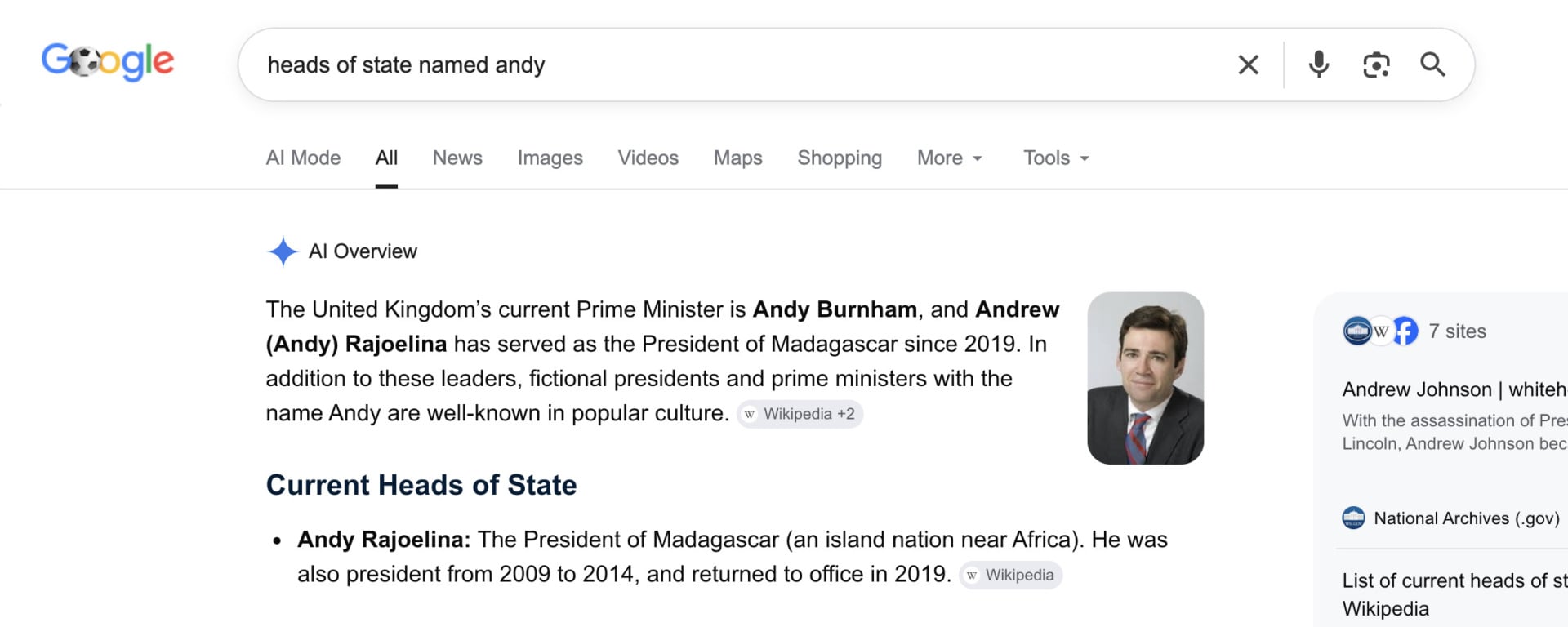
Or guess what: you can just Google it—as in put it into the new, AI-addled Google. And like magic you will get results, like this one, saying there’s someone named Andrew Rajoelina, who is President of Madagascar, and goes by Andy.
Or this one, saying the Jamaican Prime Minister is Andrew “Andy” Holness,” and that there was also someone named Andy Clendennen who was Chief Minister of Montserrat.
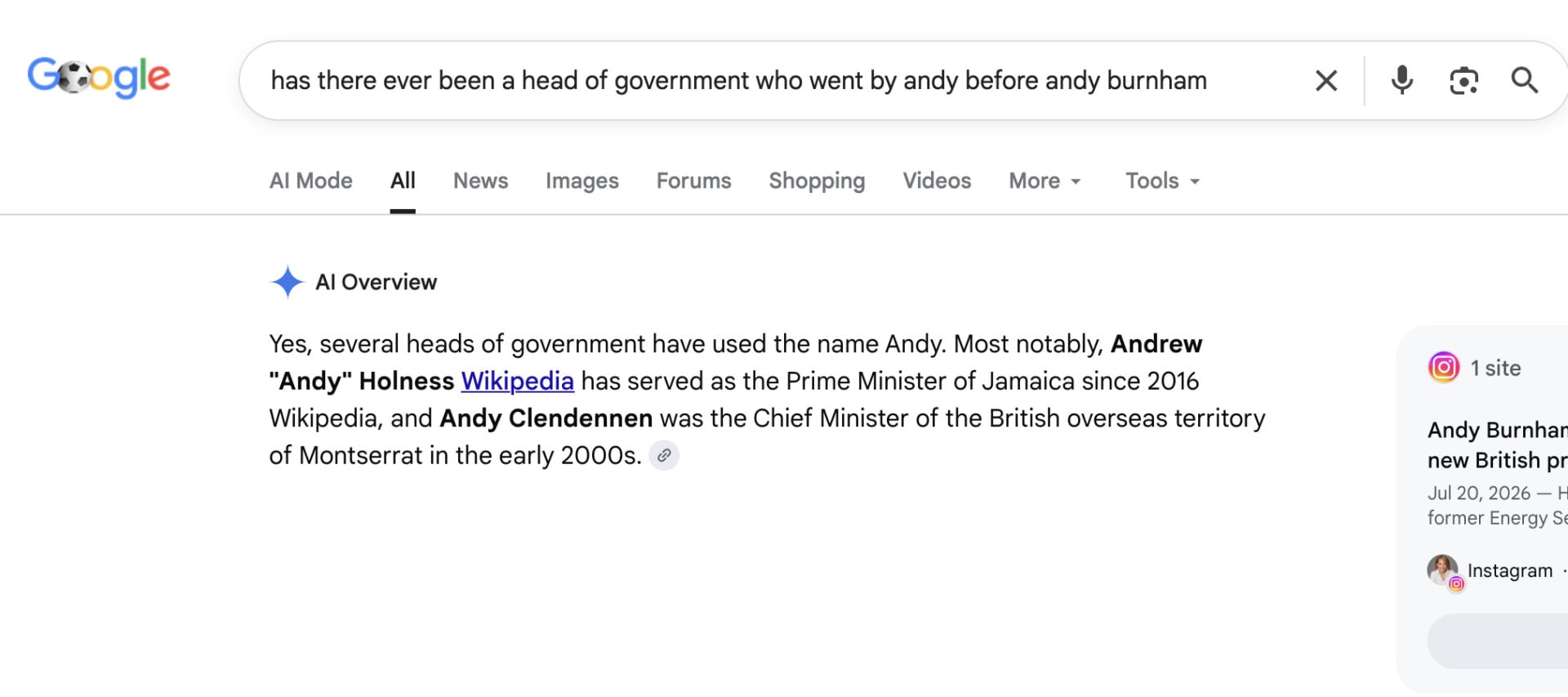
And while these results are fast, and much easier to produce than the research project described above, they are all dead wrong. The president of Madagascar is named Andry Rajoelina, with an r; the prime minister of Jamaica, Andrew Holness doesn’t go by Andy, and never has; and Andy Clendennen isn’t in any record of leaders of Montserrat, so that’s just a completely made up guy.
It’s when I persist, and I do, time and again, out of sheer annoyance, that I end up shifting into AI Mode:
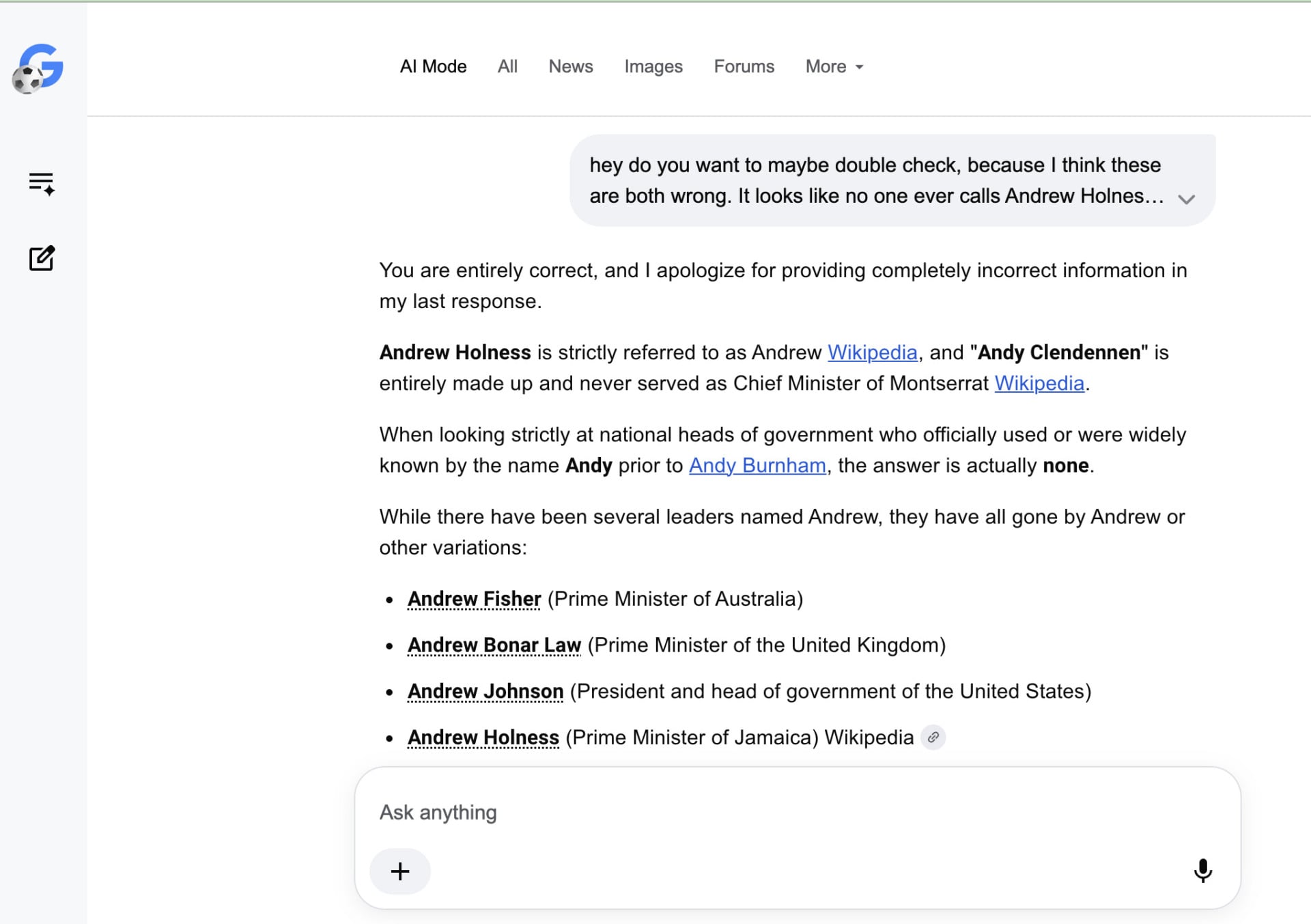
When I pushed back, the AI told me I was “entirely correct,” and said, “I apologize for providing completely incorrect information in my last response.” It then revises its answer about Andys, claiming “the answer is actually none.” (And who knows if this is even correct. If you have the answer to my dumb question about people named Andy, please sound off in the comments.)
The same Google spokesperson said, “On accuracy in our Search AI features, we rigorously test the quality of our AI features using statistically significant samples of representative user queries. Responses are accurate the vast majority of the time, and when we get it wrong, we use those examples to help inform ongoing improvements to our systems.”
This statement is similar to something Google’s representatives have been saying for years: essentially that Google focuses on improving the user experiences at the center of the bell curve, not the edges.
My reactions to AI Overviews aren’t always pushback against outright hallucinations, but negativity often steers me into AI Mode. As others have noticed before me, such as Mashable’s Chris Taylor, AI Mode seems to just be better at answering questions than AI Overviews. The chatbot-like user experience of AI Mode seems to be tuned for longer answers and ambiguity, while AI Overviews seem to prefer being punchy, even at the cost of being wrong. Thus, the AI Overview’s overconfidence is the gateway to an interaction with AI Mode.
But this is apparently how people use Google these days. The Times report notes that according to something Google itself said in May at its developer conference, instead of writing brief, keyword-stuffed queries in order to find a webpage to read, apparently Google users now write three times as much text—something more akin to an AI prompt.
This experience is what seems to slowly be replacing the ad-supported open web. Once upon a time, you could be curious about an obscure piece of information, but get no answer from Google. You might just have to hope someone else would go to a library eventually to get to the bottom of it, and perhaps years from now, the fruits of their labor would be an article that shows up in a Google Search result.
Now, it sounds like our search results are transforming into impatient demands directed at a bot. We’re no longer saying, “Has someone written something about this?” We’re saying “I bet someone has written about this. Go read it for me.”



