
I’ve always hated gas generators. They’re noisy and heavy, they can be a pain in the ass to start, they fart out polluting fumes, and filling them usually involves a trip to the gas station. If I had to make a short list of great technology products that have come into their own in the last five years or so, high-capacity home backup batteries would be on it, because they free me from the tyranny of their gas-powered forebears.
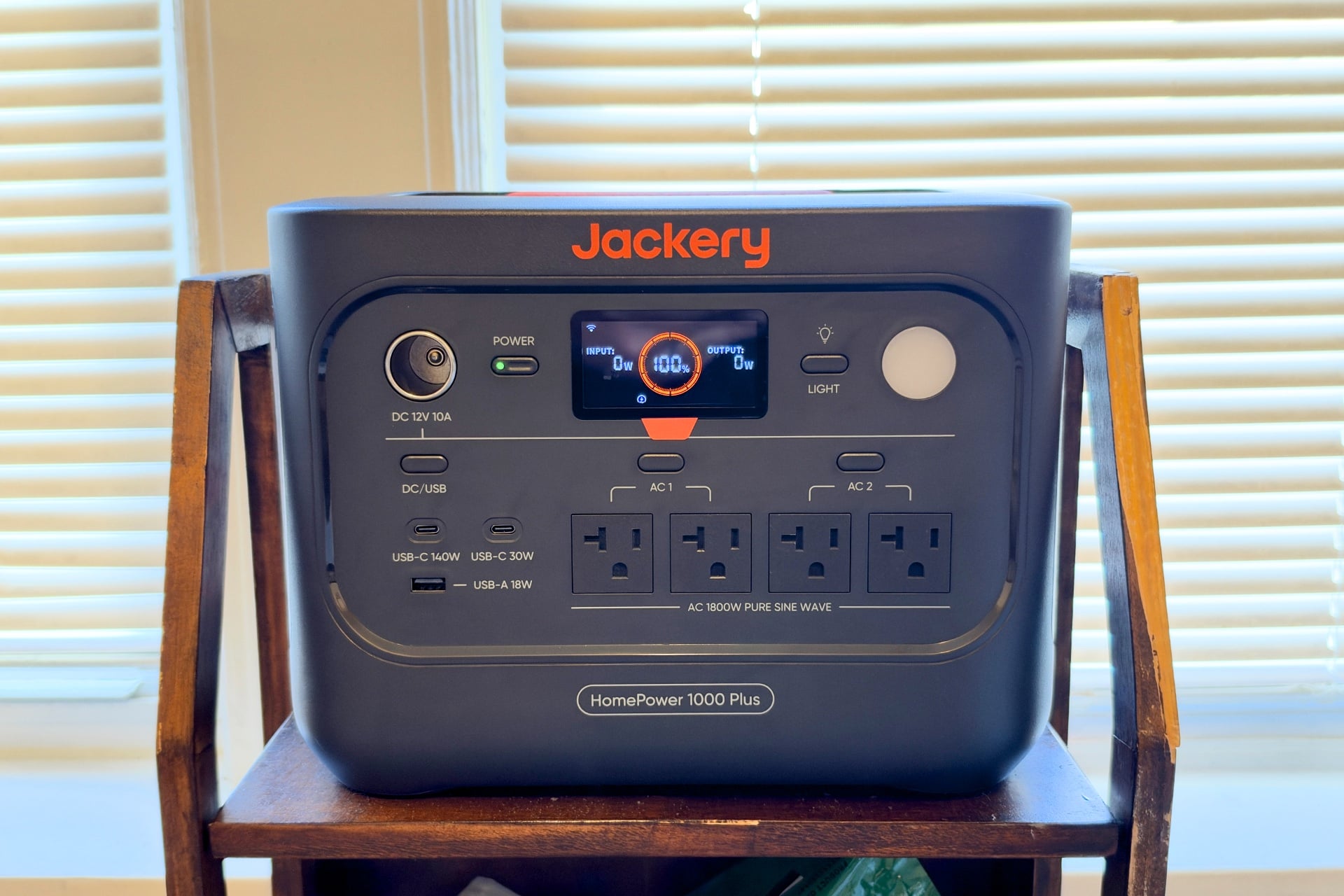
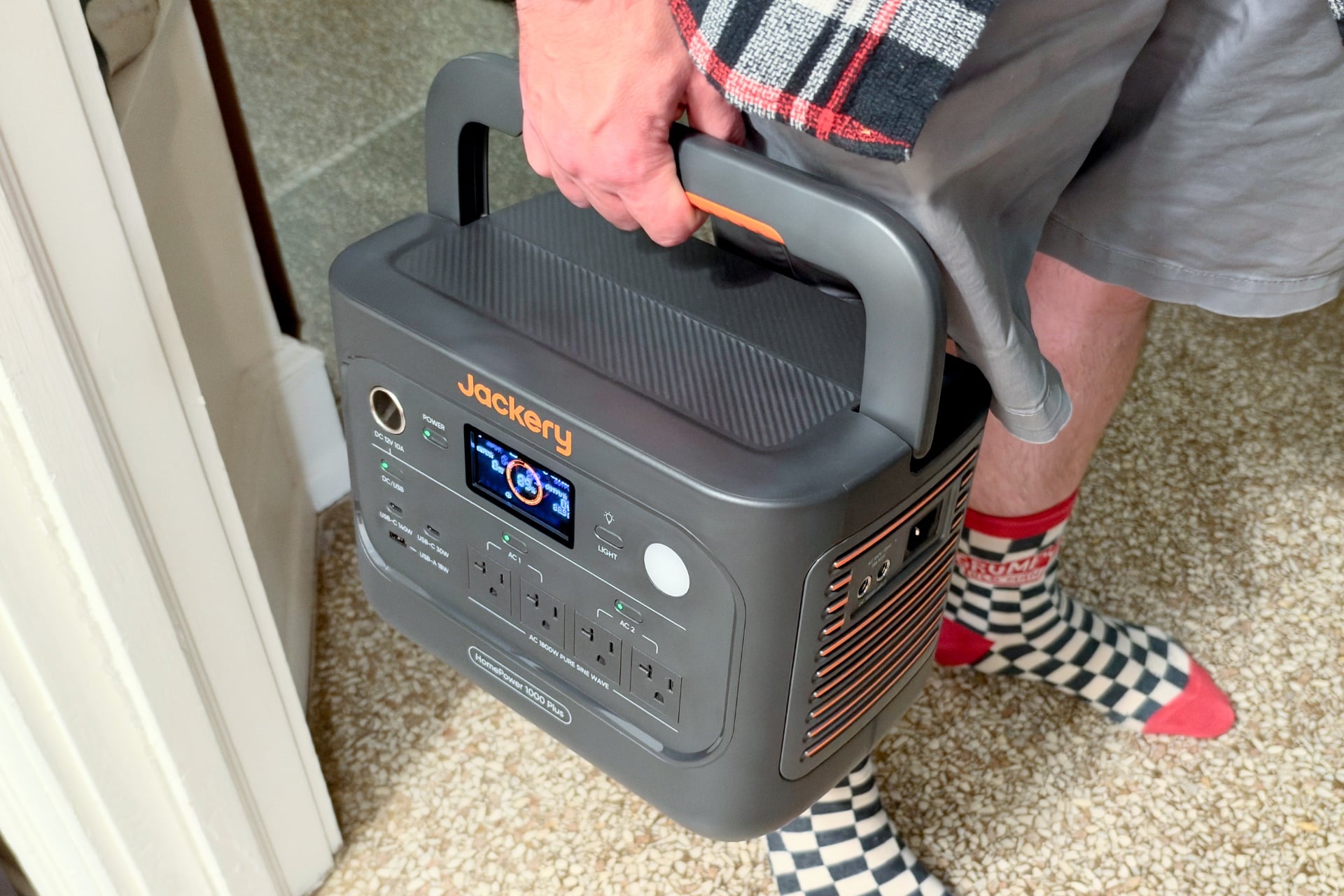
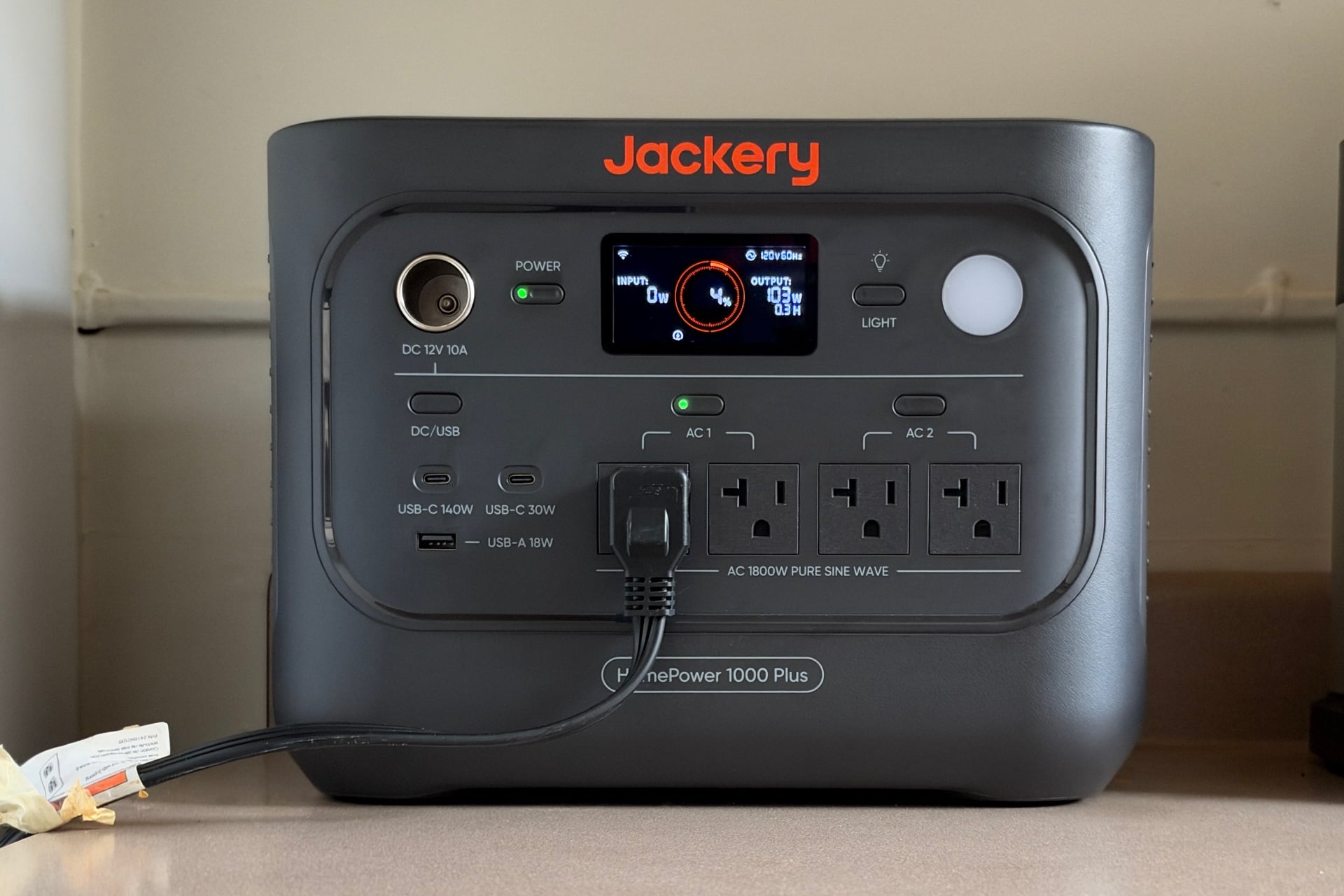
I’ve been trying out the $760 Jackery HomePower 1000 Plus v2, one of the latest in the company’s lineup of portable power packs. It’s a compact little box of energy that can crank out a steady 1,800W and features four three-prong AC outlets, two USB-C ports, one USB-A, and even a 12V lighter socket. It’s also super lightweight, at just under 24 pounds, and even has a nice swinging handle to help you carry it around.
Jackery HomePower 1000 Plus v2
A compact, powerful-enough backup battery with plenty of ports.
Pros
- Compact and lightweight
- Expandable to 11kWh
- 140W USB-C output
- Very configurable
- Supports ToU scheduling
- Intuitive app
Cons
- Noisy fan
- No thunderstorm prep charging mode
- Pricier than similar options
The 1000 Plus v2 is not totally perfect. It’s got a noisy, eager cooling fan, it takes a little doing to get it to recharge to full power, and it doesn’t have the full UL certification I’d like to see. But if you don’t need the larger batteries out there, it’s an ideal companion for camping trips, small power-tool use, and one-day outings where you need highly portable power.
The power is yours
There’s no real setup for the HomePower 1000 Plus out of the box—you can start using it right away when you unpack it. (The unit I received arrived with a 28% battery charge.) You should still connect it to Jackery’s app, which just involves scanning for the device over Bluetooth, tapping its icon when it appears, then going through a brief setup that involves adding it to your Wi-Fi network, if you’d like.
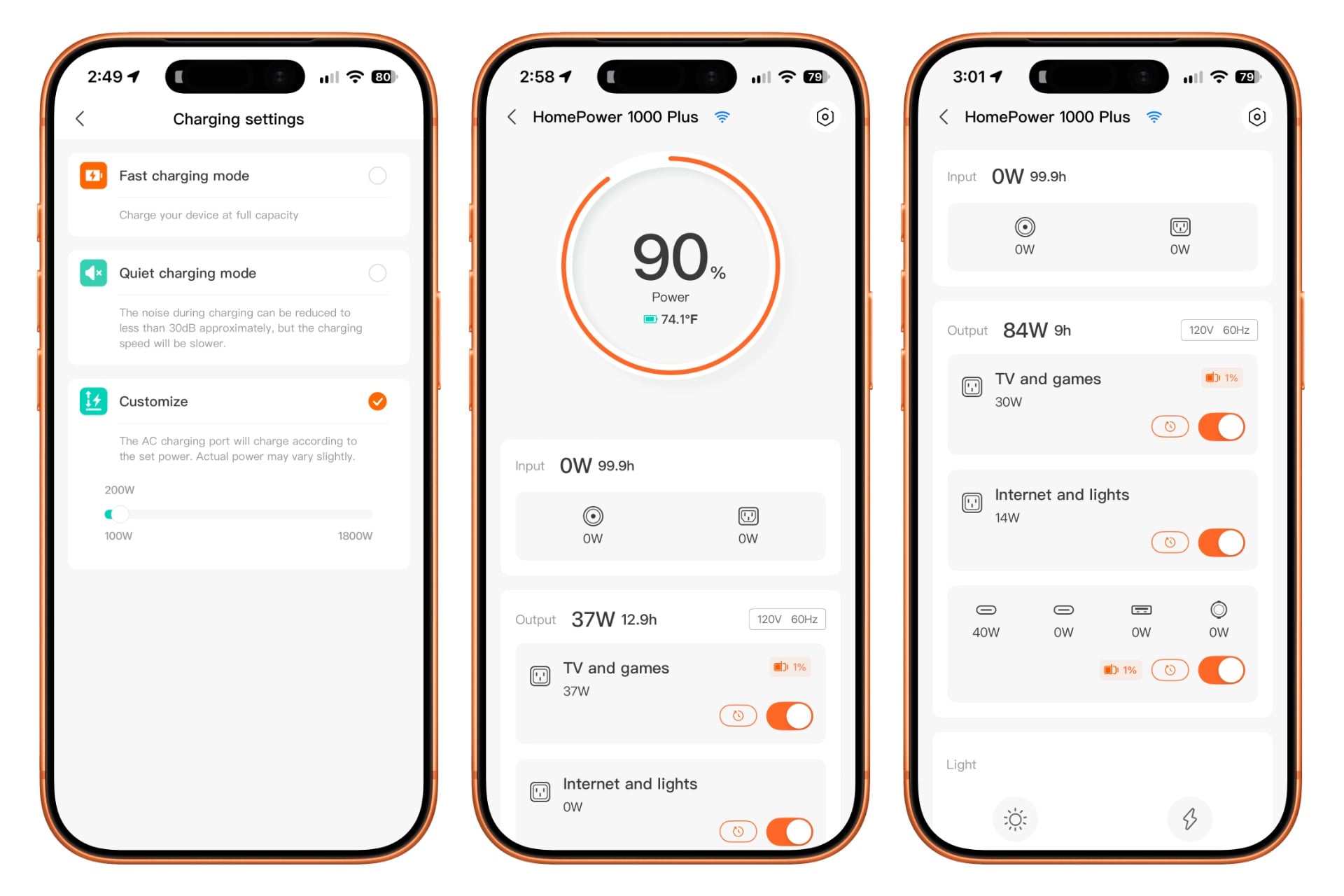
Once added to the app, the 1000 Plus v2’s home screen shows the battery’s current percentage and operating temperature, which ports are in use, and how many watts they’re outputting. This screen also contains basic controls like toggling ports on and off, activating the bright LED light on the device’s front, and flipping on the battery’s display.
If your electric company offers a time-of-use (ToU) plan, you can use the 1000 Plus v2 to save a little money by diving into the app’s settings and configuring it to deliver power during peak hours (when energy costs more) and recharge when electricity is cheaper. When getting that ready, you can also enter your per-kWh prices for peak and off-peak hours. Back on the battery’s home page, you’ll then see an estimate of how much ToU mode has saved you.
Another setting purportedly lets you limit the charging speed to anywhere between 100W and 1,800W. That’s a little confusing, since the device is actually limited to 1,600W recharging, according to its official specs. It also only climbed to (and stayed at) 1,060W when I first tested it; I had to turn on “Emergency Charging” in the app’s settings to reach 1,600W. I asked Jackery if the 1,800W option is a mistake or if there’s actually a way to reach that, and will update this story if it responds.
Elsewhere in the settings, you can set some outlets to “priority” and others to “non-priority,” which tells the battery to shut off the latter when it reaches a level you set. That can be nice if you want to shut off other devices but keep a key appliance running as the battery wanes. The AC ports on other backup batteries I’ve tested—the DJI Power 2000 and the Anker Solix S2000—lack this kind of control and are either all on or all off. Most of the remaining settings focus on battery-saving measures, such as turning off Wi-Fi, turning off the battery if nothing has drawn power from it for a set period, and so on.
These options are more or less the same ones that you’ll find on the Solix S2000, although the Jackery lacks any sort of analog to that device’s “Storm Guard” feature, which allows the battery to automatically recharge itself if the National Weather Service issues a storm warning for your area. That’s not a problem if you’re using the 1000 Plus v2 only as needed, but you could be left in a lurch if the power goes out after it’s been discharging all day during peak hours in ToU mode.
Small, mighty, and noisy
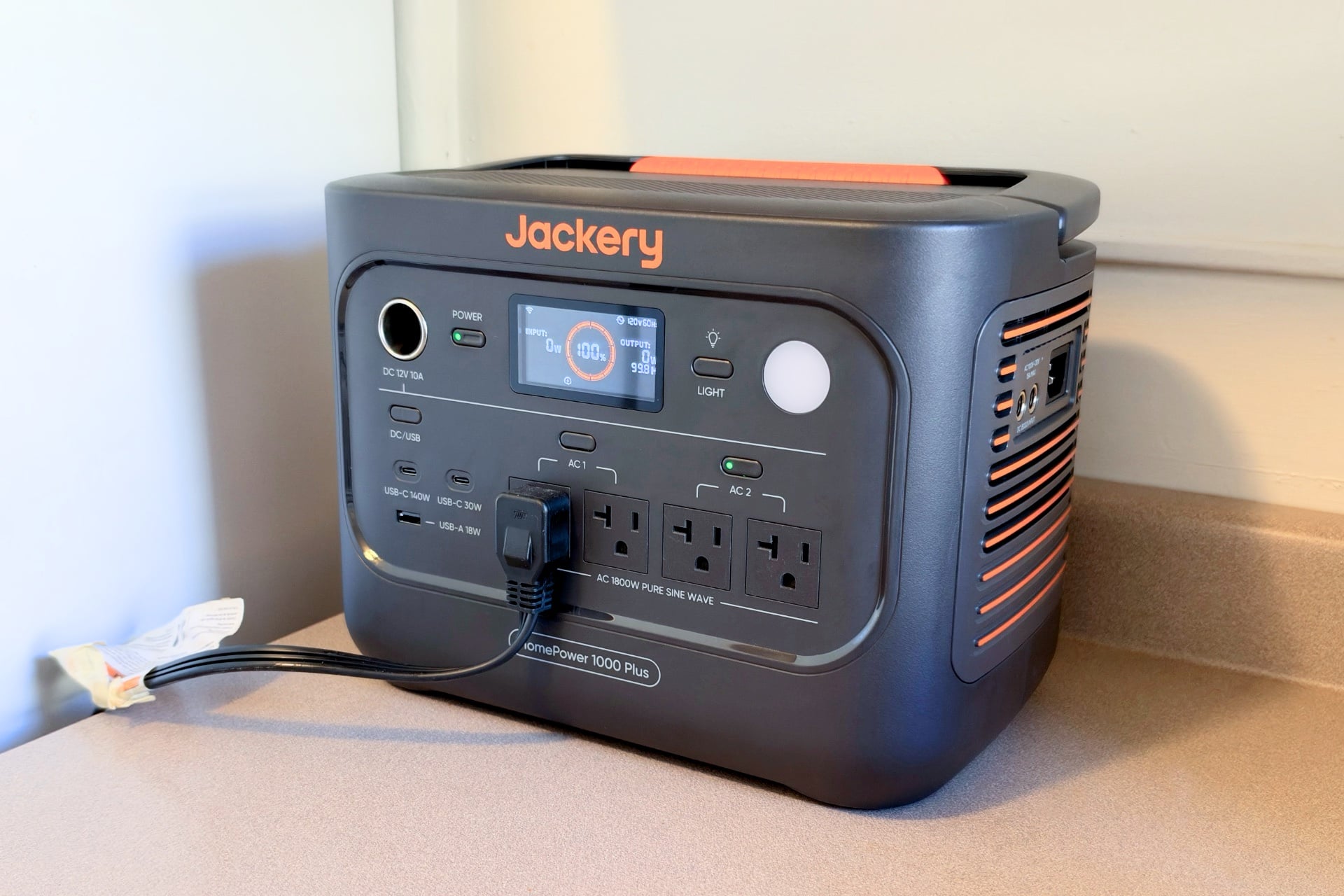
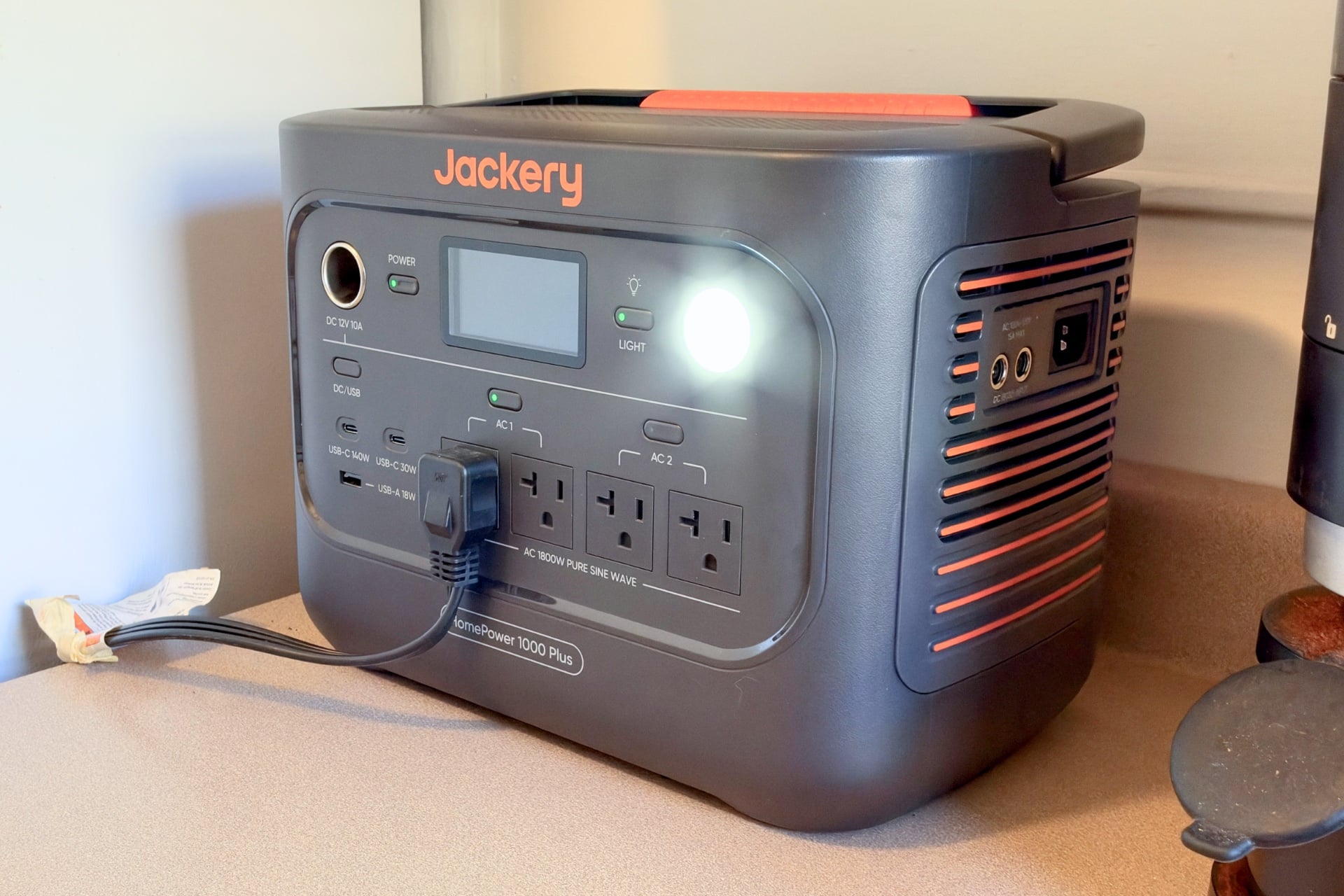
Jackery packed a lot into this little guy, although things can get crowded—the four AC outlets are necessarily very close together, which could be an issue if you’re using large wall-wart-style plugs. Other than that, it’s all gravy: one of its USB-C ports outputs 140W, which is higher than the 100W you see on most 1kWh batteries. (The other is 30W.) And there’s a bright, circular LED that’s about the size of a quarter. It would be helpful when camping, although I could see the broad light strip on the front of the similar Anker Solix C1000 being even nicer.
When using the HomePower 1000 Plus V2 around my apartment, I really appreciated its 24-pound weight, compact size, and swinging handle. It was easy to schlep from one room to the next, and its 12-inch-by-9-inch footprint is very forgiving in terms of placement. I started testing by checking how long the 1000 Plus v2 could last with its AC ports, display, and wireless connections active but nothing else drawing power. It lost 14% of its battery while running only the AC inverter for 24 hours. Just doing some back-of-the-envelope math, that’s an ambient loss of about 246Wh, or roughly 10W per hour, which is on the low end for 1kWh batteries like this.
I also redid the refrigerator test I ran with the Solix S2000, which involved, well, plugging my fridge into the battery and seeing how long it could last with normal use. I found that I missed the S2000’s rear AC outlets, which let me hide the fridge’s cable in the back. Once I plugged the thing into the front, it ran for about 22.5 hours before the Jackery’s battery dropped to 3% and I switched the appliance back to the wall. That’s a little past the 19 hours quoted in a chart on the 1000 Plus’s product page, although my result is probably a best-case scenario because I don’t open my fridge more than three or four times in a day. The Solix S2000, which has twice the capacity, could power it about twice as long.
Jackery’s specs mostly held up when I challenged them. Its AC ports handled higher wattages just fine; at a peak of over 1,700W, it seemed to keep going as long as it had the charge to run. If I exceeded 1,800W, as I did when I threw a hair dryer and a small space heater at it that pushed a combined 2,070W (well shy of the Jackery’s 3,600W peak surge capacity), the device ran both for about a minute until its AC output cut off and the Jackery app sent an AC output failure push notification on my phone. That was what I’d expected would happen, but all the same, it’s good to know you shouldn’t expect this battery to run a hair dryer and space heater simultaneously. It also shows that the 1000 Plus can clearly handle the initial surge required to start the motors of many smaller electric power tools.
The 140W and 30W USB-C ports worked as expected, too. The battery hit 170W while powering an Anker Prime 300W power bank, which can simultaneously charge itself via its own dual USB-C ports. I particularly like that Jackery includes a 12V cigarette lighter DC port on this and other batteries, which handled the 100W my lightweight AstroAI portable air compressor requires just fine. It has always felt silly to turn on a whole car just to use this thing, and midwestern winters have made me wary of ever using my car’s battery for anything other than starting the engine. Using a compact battery is much more convenient.
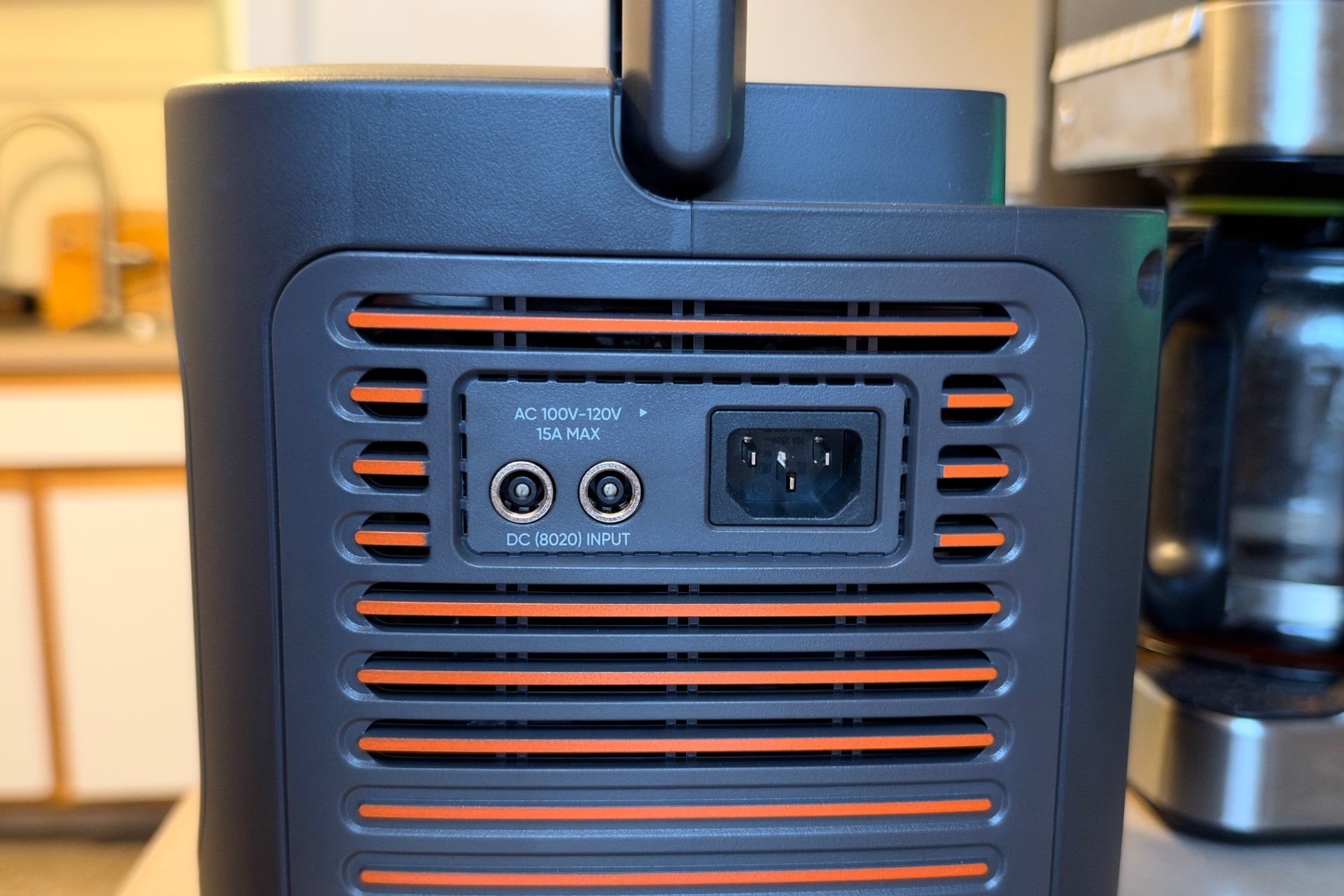
I wasn’t able to test the two DC8020 inputs on the battery’s side, which can accept up to 400W of solar charging from as many as four solar panels if you have a splitter that Jackery sells. It’s inconvenient that the company went with the DC8020 over other, more common ports used by most portable solar panels. As one reviewer at GearJunkie noted, that means you’re likely to need an adapter for third-party equipment, which just adds a point of failure. Jackery says it uses the DC8020 to bridge various connector standards, such as MC4 and XT60. I don’t have enough experience with solar power to have a strong opinion about this, except to say that my life has been better since most small tech moved to USB-C, and these various solar connector standards remind me of the bad times before that.
Something I didn’t like about the HomePower 1000 Plus v2 was its fan noise. A degree of loud whirring is inevitable when you’re using a station, but Jackery’s is definitely louder than the only slightly larger Solix S2000. When I used it to power my TV and other devices in UPS mode, its fan periodically spun up loudly enough that I needed to turn the volume up a few clicks. That only happened when the battery was charging and discharging at the same time, though—in ToU mode or with the battery unplugged from the wall, it stayed quiet.
On the plus side, the 1000 Plus v2 otherwise makes for a solid uninterruptible power supply, or UPS. Jackery says the machine can switch your devices from wall power to battery within 10 milliseconds. When I tested that claim by unplugging the 1000 Plus while playing games on my TV, I couldn’t tell the difference. If the 1000 Plus v2 unexpectedly loses wall power, you’ll get a push notification from the Jackery app, so you can find out about an outage even if you’re watching TV in complete darkness.
Another plus is that the HomePower 1000 Plus v2 is expandable to 11kWh with Jackery’s $1,000 Battery Pack 2000 Plus v2, a stackable battery pack that adds an extra 2kWh of capacity. That’s quite a bit higher than similar portable 1kWh power stations like the EcoFlow Delta 3 Portable Power Station, which can only be expanded to 5kWh, or the Solix C1000, which has a max expansion of 2,112Wh.
A power-packin’ buddy
The Jackery HomePower 1000 Plus v2 is a great compact power station. Its 1,024Wh capacity makes it a solid option for backing up low-power appliances during power outages, and its 1,800W output is sufficient for many around-the-house, short-term use cases. Plus, its lightweight, roughly foot-wide body is a boon for placement around the house or packing for camping trips.
My complaints about this device are few and mostly concern the absence of nice-to-haves. I wish it would charge itself if a storm is imminent, for instance, if I’m using it to save money on a ToU plan. The fan noise is also a bit much compared to that of other, larger 2kWh power stations I’ve tested, but it’s not disqualifyingly loud by any means.
One reason not to buy the HomePower 1000 Plus v2 is its $760 price tag. While it does beat competitors on expandability, the EcoFlow Delta 3 and Anker Solix C1000 can both be had for $700 and $600, respectively, and each features six AC outlets rather than four (although three of the EcoFlow’s are two-prong). They may both be easier to justify, depending on what you’re after. But if being able to add more batteries later is a big deal to you, it’s hard to beat the compact, lightweight HomePower 1000 Plus v2.