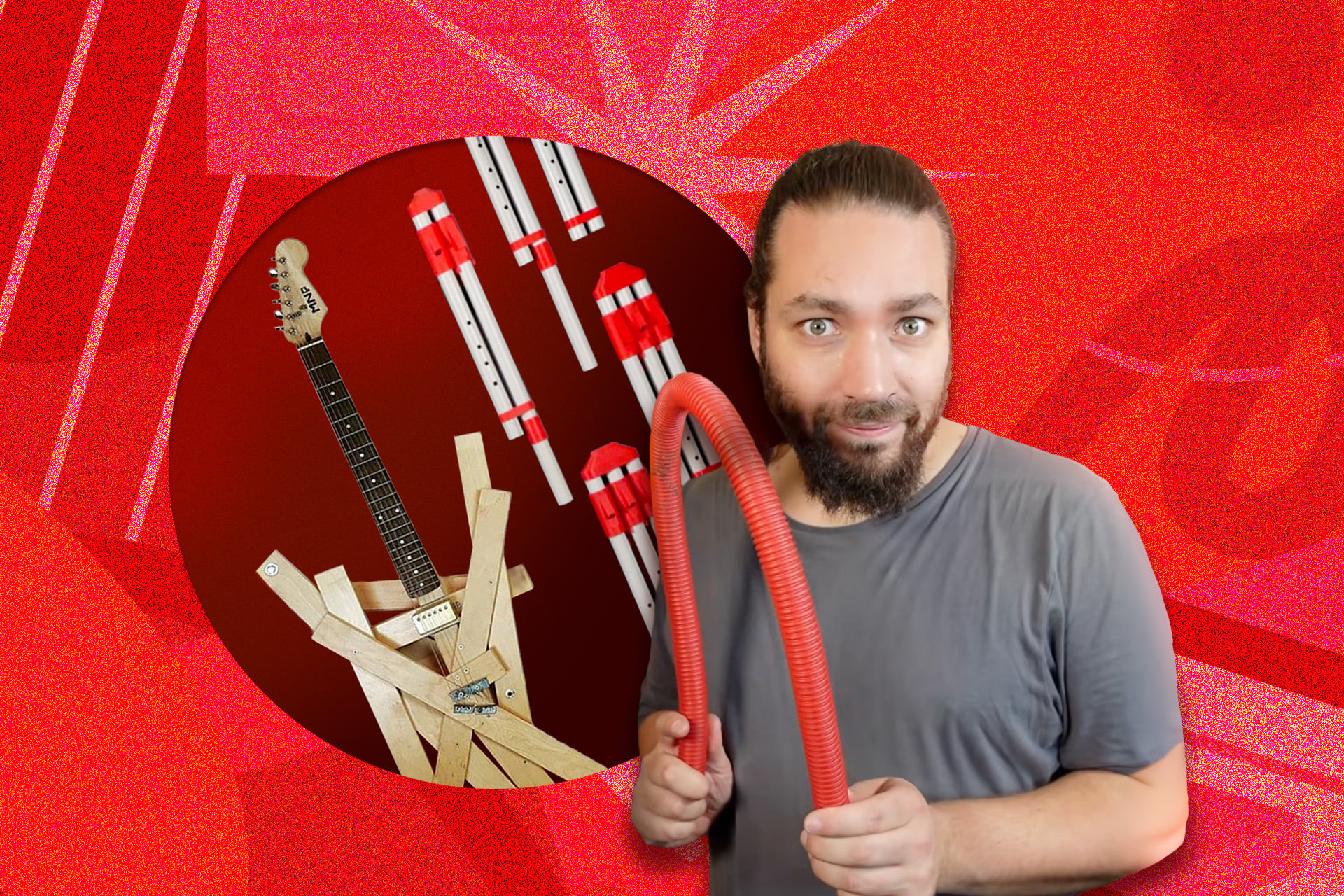
For most of his life, Nicolas Bras has had music stuck in his head. While some earworms are derived from TV jingles and top-40 hits, the instruments in Bras’ mind couldn’t be replicated—because they didn’t exist. Over the last decade and a half, Bras has created unorthodox instruments from scrap metal, pallet wood, pipes, and 3D-printed parts to bring the music in his head to life.
A self-taught multi–instrumentalist, Bras was only 17 when he put together a crude PVC pipe didgeridoo with a candlewax mouthpiece. A few years later, he traveled to the ancient Indian city of Varanasi to hone his tabla skills under a master’s tutelage. When he returned to Paris, the creator decided to dedicate his life to building instruments made almost entirely from reclaimed materials. Then he met his first 3D printer.
“I suddenly had the opportunity to design all the parts I’d had in my head,” Bras told Gizmodo. “My 3D printer became my little factory that could make almost anything.”
Though he’s quick to downplay his talents, Bras has created over 1,500 unique instrument prototypes, and he says fewer than 10 have failed.
“They’re not all masterpieces, but something always comes from the experiment. Every instrument is a kind of tool,” Bras said. “As the designer and creator, I decide the rules and purpose of that tool, and then my job is to make the design fit those goals.”
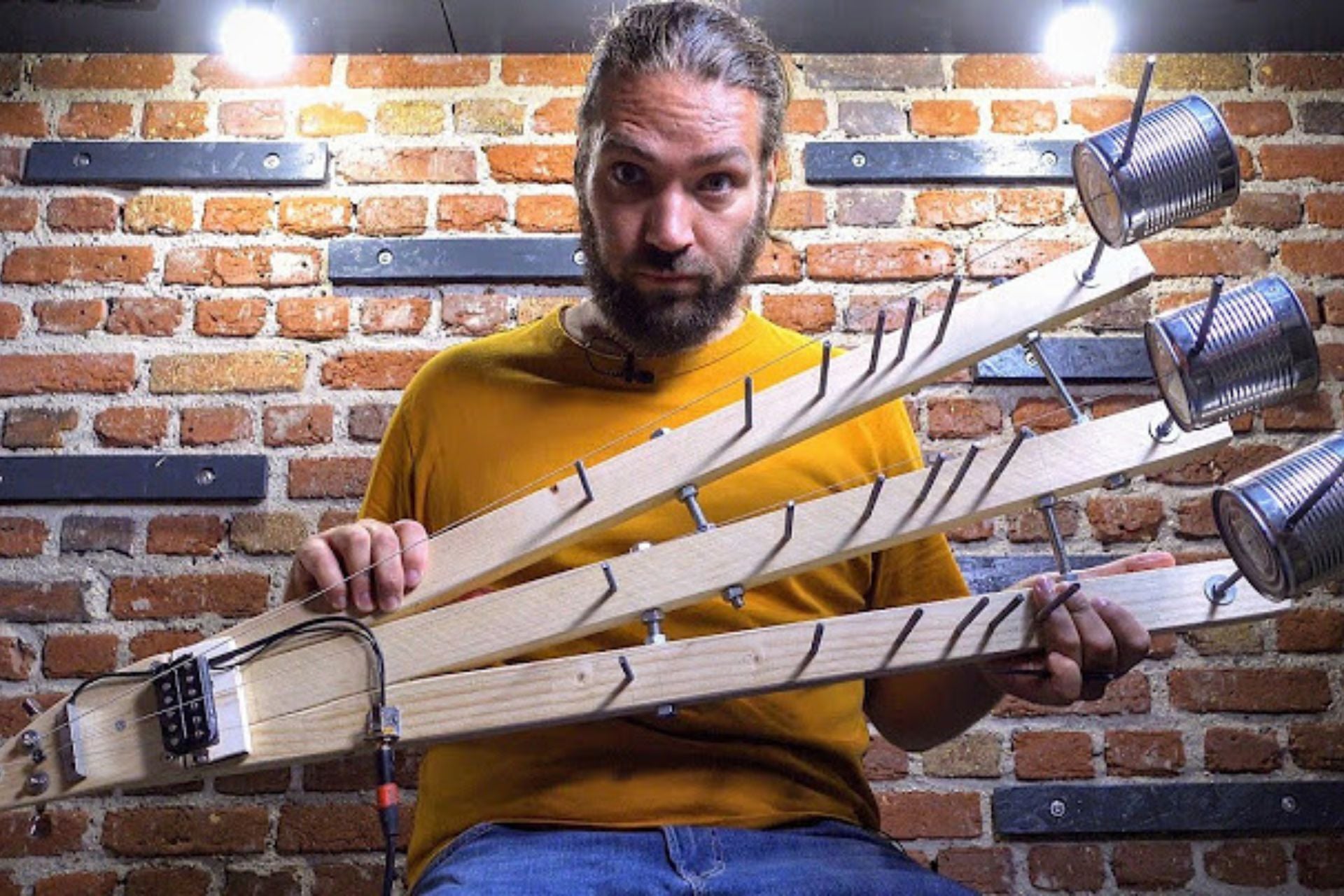
Bras recently found his calling as a classroom musician, leading kids through workshops using his homemade instruments. Though he initially crafted a hundred noisemakers and simple percussion instruments to hand out during his lessons, the freedom to experiment compelled him to develop his first PVC overtone flute, an idea he would continue to iterate on in the years to come.
Today, Bras is known for that flute, which consists of a modular body and a recorder-style head that plays only the harmonic scales. The description of the flute on his website offers the reassuring line: no holes, no fingerings, and no wrong notes possible.
Bras’ creations have made him something of an icon in France, with directors reaching out to collaborate on projects across the media landscape. He still spends much of his time tinkering in his lab, designing instruments for movies and video games, and posting downloadable files for people to print on his website. We reached out to Bras to talk about how he navigates the often-fraught intersection of art and technology and the impact of AI in music.
This interview has been edited for length and clarity.
Gizmodo: How has 3D printing changed what you’re able to create?
It was a big change. Before 3D printing, I had to work with plumbing parts I could find at DIY stores. There were parts I desperately wanted that simply didn’t exist because no plumber would ever need them.
Why is experimentation so important to your process?
I don’t really know what I’m doing, so I have to try things and learn from those attempts. I use a lot of observation from existing musical instruments, but I don’t know whether those ideas will work on something new. I don’t know if a modification will be interesting until I try it. Experimentation is really how I learn.
How much of your work is engineering, and how much is play?
I think I build a lot more than I play. I have instruments in my collection that I might play for five minutes, then put on a shelf with the others. But they’re still important because I wanted them to exist.
Sometimes I’ll come back to one 10 years later, and it becomes the star of a new composition or recording.
What kinds of projects are your instruments being used for now?
Right now, I’m actually designing instruments for cinema, for video games, and classical performance on stage. I’ve got an instrument with 300 plastic flutes connected to kilometers of yellow pipes that will be performed with an orchestra of 30 musicians on one of the biggest classical music stages in Paris.
Is there an instrument or project so ambitious that you’re still waiting for the right moment to build it?
I have a lot of instruments already built in my mind that I haven’t made yet.
Some ideas would require maybe six months of full-time work and a lot of money for materials. In the end, I’d have an instrument 10 feet [three meters] tall that wouldn’t be useful for much except the satisfaction of making it happen.
If you gave me two weeks and $1,000, I know exactly which instrument I’d build. If you gave me six months, 10 people, a giant space, and $100,000, I know exactly which instrument I’d build then, too. I’m just waiting for the opportunity.
Do people romanticize the craftsmanship of instrument-making?
Maybe. Instrument-making isn’t unlimited creativity because physics is very restrictive. You can’t just improvise everything and expect it to work.
But there’s still some magic in making it happen because it becomes music and sound. It’s like building the perfect tool to do the perfect job. I don’t think it’s less cool because it has to work. Maybe it’s cooler when it does.
What do you like about making your instruments modular?
That’s what I’ve been experimenting with for 20 years in my workshop. I have a lot of parts that fit together very quickly, so I can improvise a build: assemble one part with another, try it, remove it, cut something, change something.
When I make modular kits that can be shared or sold, people get to experience a little bit of what I experience as a craftsman.
If you’re finished exploring what I put in the box, you can get some more pipes, connect them to the parts you already have, and expand the instrument.
Where do you draw inspiration from when designing instruments?
I’ve gotten ideas from a lot of creators—street musicians, experimental musicians, craftsmen.
What I love is that I can borrow ideas from very traditional instruments made from natural materials and mix them with industrial design and experimental sounds.
In the end, the object itself isn’t the most important thing. It’s about what vibrates, what resonates, and how you organize those things into something interesting to play.
Does the type of 3D-printing material affect the sound of a wind instrument?
With wind instruments, the material itself isn’t very important to the sound. It’s more about the precision of the shape. I started with PLA (polylactic acid) filament because it was precise and easy to print. It worked perfectly, so I kept using it. Some of my flutes have very tiny passages inside the flute head, and any imperfection can ruin the instrument. PLA is very reliable for that, so for now I don’t see a reason to change.
Where do you draw the line between an acoustic instrument and a piece of electronic technology?
For my own work, I usually stop when the instrument stops being acoustic. I need something physically vibrating.
I work with pickups, microphones, and magnetic pickups—things where a physical vibration is still being transmitted into electricity.
While amazing instruments are being made when the object itself is just a controller for a synth or a MIDI controller, that’s not really my path.
What I would really like to explore is bringing more robotics into my instruments while keeping the final sound acoustic.
Do you think AI could design an interesting, playable musical instrument?
It could be fun, but so far when I’ve asked it to do that, it hasn’t been very relevant.
It’s quite easy to imagine an instrument. The difficult part is making it produce a sound, then making that sound good, and then making an instrument that sounds good and is actually playable. There are a lot of constraints.
AI could probably propose shapes or experiments, but that isn’t really the difficult part.
Do you think any musical instrument is ever truly invented from scratch?
In a way, all instruments have already been invented. We’re making modifications and variations on maybe 10 basic principles of physics for how to make something ring or resonate.
Even when I make an instrument and say I invented it, if you trace it back, you can probably find 10 different instruments or creations that I borrowed tiny pieces from.
Nothing is really created from scratch.
Do you think AI could create a genuinely new sound?
Probably. In a way, every sound is already new.
Every acoustic note is unique and will never happen exactly the same way again. With a computer, you can create infinite sounds, so it’s easy to create something new.
But the sound needs a purpose. It’s also very easy to create uninteresting sounds. Every sound needs the right context and the right use to become something meaningful. Simply creating a sound is easy.
Can AI-generated music be art?
I would say it can’t really be art because art is very human. Even if it looks like art, there’s no purpose behind it. There’s music that isn’t made to be art, too. Sometimes I need a 20-second backing track for a video, so I quickly make something functional. I don’t think that’s art because I didn’t make it to express anything.
I feel the same way about my instruments. They’re tools for making noises. Then you can give those noises to a musician or composer, and they can make art with them.
I think art is ultimately a decision made by the person who created something. If the person says, ‘This is art,’ you have to trust them. And if they say it isn’t, you have to trust them, too.