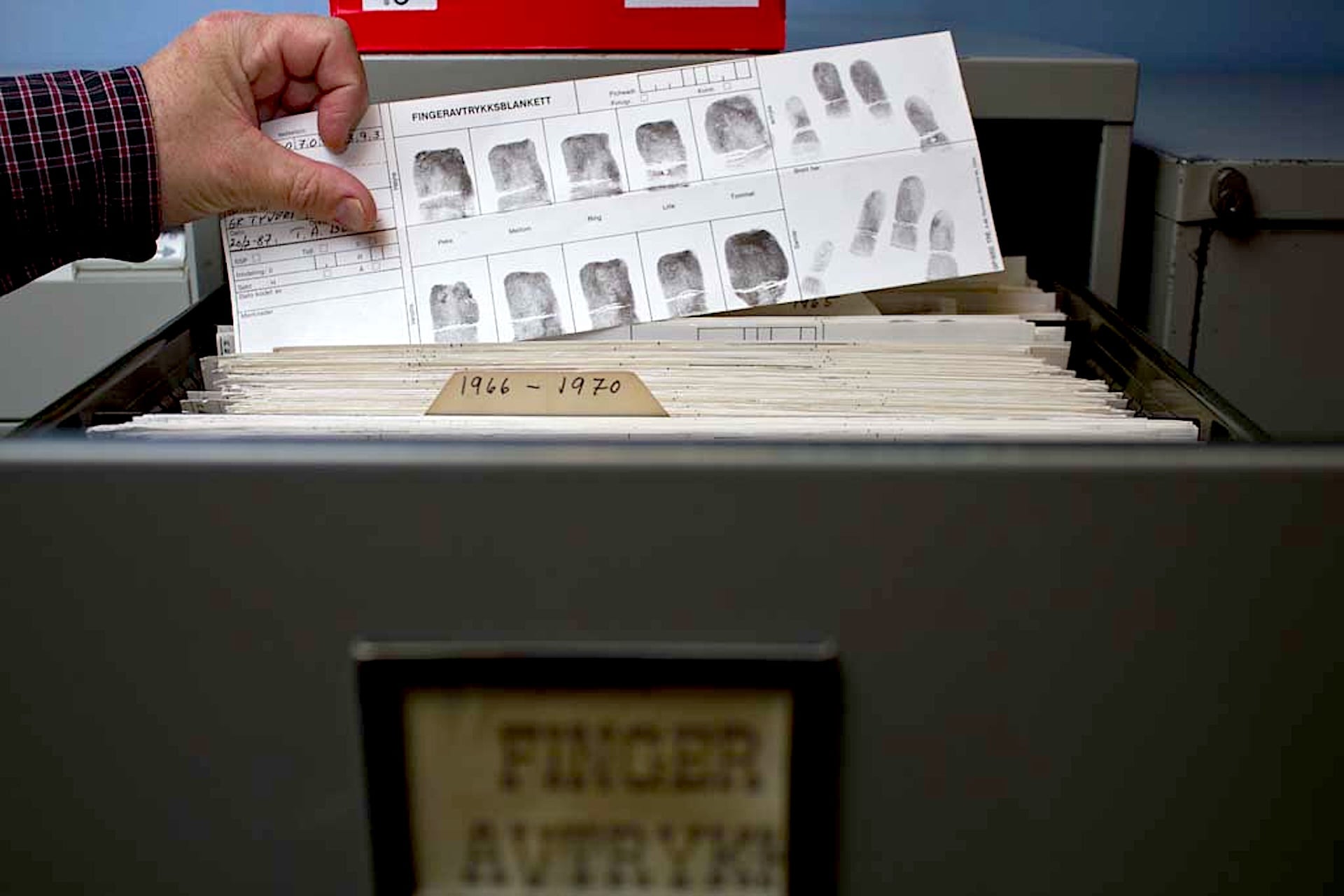
Over a dozen conference papers and peer-reviewed journal articles have been published in the past three years promising a teasing correlation sure to captivate both forensic scientists and the kinds of health-conscious people who obsessively upgrade their wearable fitness trackers. Simple scans of human fingerprints, so these studies contend, are enough to classify a person’s blood type thanks to AI models trained on datasets posted publicly online.
Much of this was pitched as a boon to ordinary people with a natural aversion to needles or blood. One 2025 study published in Franklin Open, for example, touted the advancement as a “non-invasive, pain free, and efficient alternative for blood group classification.” Unfortunately for those sharing those phobias, two academics in Australia have traced several of these studies back to a single dataset of 6,000 fingerprints from 600 human subjects that, they report, never even tied those prints to any blood-type information at all. The nonprofit Retraction Watch dove into the details of the drama on Monday.
“The papers are produced under false pretence with fake data and should therefore be retracted,” according to a joint statement emailed to the nonprofit by mechanical engineer Lars Kooijman, an adjunct research fellow at Melbourne’s Monash University, and psychologist Stephanie Summersby, a postdoc and adjunct with the University of New South Wales.
Computer scientist Sanivarapu Prasanth Vaidya, a lead author of the contested Franklin Open study, acknowledged in an email to Retraction Watch that his team did source its fingerprint and blood-type information from one of the suspect datasets, which was posted to Google’s platform Kaggle.
But Vaidya emphasized that his team had been unaware of the source’s inaccuracies and had sourced the data “in good faith.”
Blood count
Elsevier, the publisher of Franklin Open, told the nonprofit watchdog that an investigation “is underway, and therefore no further information can be shared at this point.” And the Institute of Electrical and Electronics Engineers (IEEE), which published several of the suspect studies as part of conference proceedings archived with its IEEE Xplore database, said it was also “currently evaluating the papers in question.”
But, judging from Kooijman and Summersby’s efforts, those investigations are likely to find that the studies sourced fingerprints from a collection known as the “Sokoto Coventry Fingerprint Dataset” (SOCOFing), which had never tied the prints to the subjects’ respective blood types.
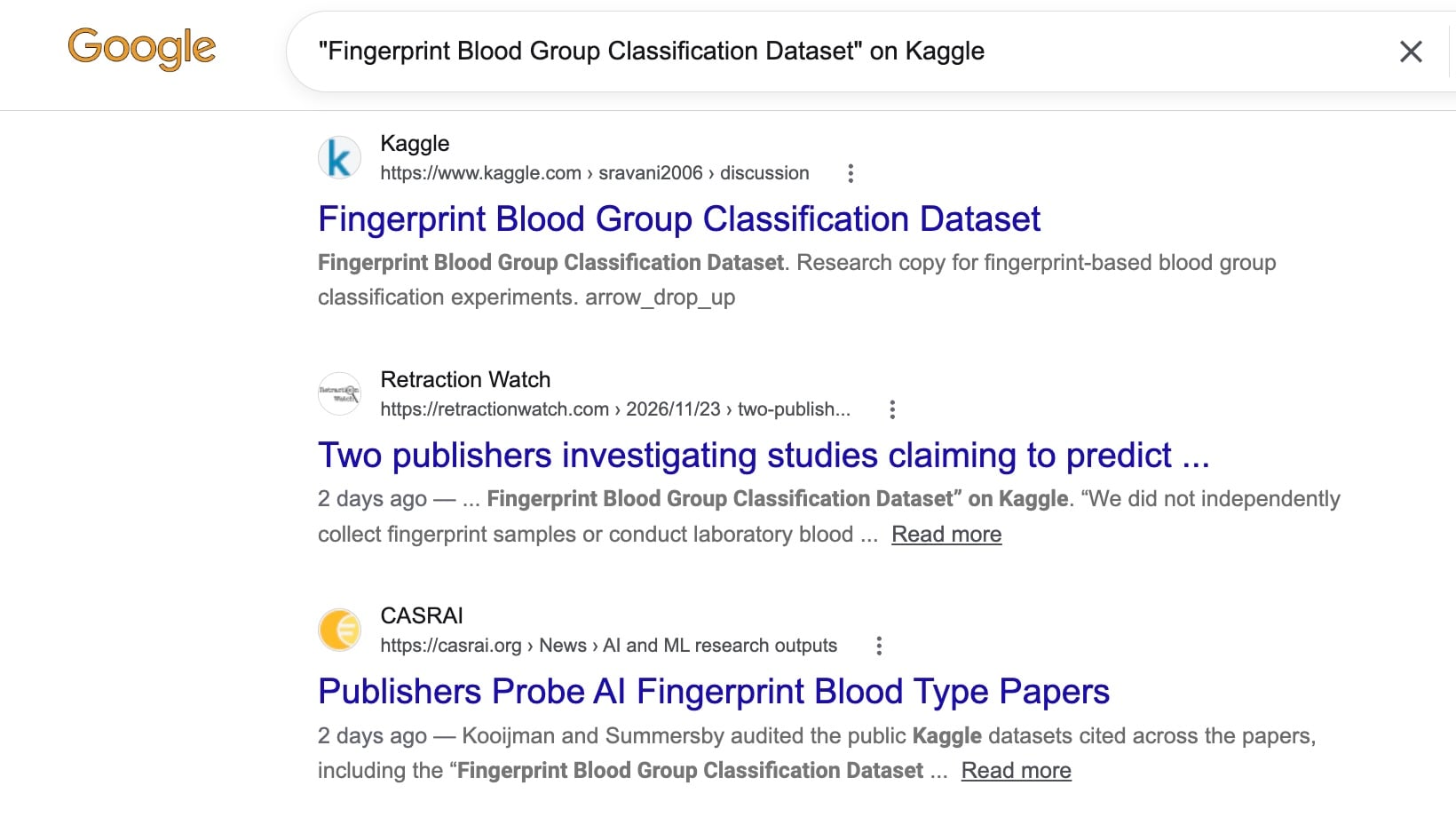
Vaidya’s team apparently used a collection posted to Kaggle that falsely linked those prints to blood types, the “Fingerprint Blood Group Classification Dataset,” which now routes to an error page. Vestiges of the dataset are still visible via Google search, however.
Blood simple
There’s a bit of a rhyming quality to the controversy over these papers, with the hype and wishful thinking that helped Theranos founder and convicted fraudster Elizabeth Holmes persuade investors that her tech could do complex biomedical testing from a single drop of blood. As Holmes said repeatedly across public speaking engagements, her own “traumatic fear of blood” and needles inspired her to launch her infamous startup in the first place.
While Kooijman and Summersby’s critique of these studies focused on the data and not the premise underlying these papers, at least one group of medical researchers also found the concept wanting after conducting their own independent analysis. Physiologists working with the GMERS Medical College in Gujarat, India, examined actual blood tests and fingerprinting conducted on 224 test subjects for their own study published with the European Journal of Cardiovascular Medicine in 2024.
“This study discovered no correlation between fingerprint patterns and blood types in both males and females,” their study reported.