When you’re walking down a crowded street and trying to avoid bumping into other people, science says you’re probably going to turn left. As for why, scientists aren’t sure yet.
That was the gist of a recent study published in Nature Communications. According to the study, there seems to be a real counterclockwise bias in pedestrian behavior, regardless of age, gender, and social dynamics. Across five experiments with 573 participants, the team tested various hypotheses as to why this was happening—but to no avail.
“This was completely unexpected as, at least instinctively, when people walk around randomly, you imagine people turn as their needs suit them with little sign of an overall preference,” Claudio Feliciani, the study’s co-author and a researcher at Waseda University in Japan, said in a statement. “But there was a definite, measurable tendency for people to turn counterclockwise over clockwise, all things being equal.”
Sorry, excuse me
According to the study, walking along a crowded street represents a unique instance of collective behavior that emerges from a “simple individual behavior adopted independently by many people,” that is, not wanting to bump into other people. These emerging phenomena, as they’re called, don’t necessarily need leaders or intentional movement, and “people are often not even aware of the pattern they are creating,” the paper added.
These tendencies became strikingly apparent to the team a few years back, as it was studying social distancing behaviors. For some reason, participants in 32 out of 33 experiments conducted “noticeably preferred to turn counterclockwise,” recalled Feliciani, who was affiliated at the time with the University of Tokyo in Japan.
To the left?
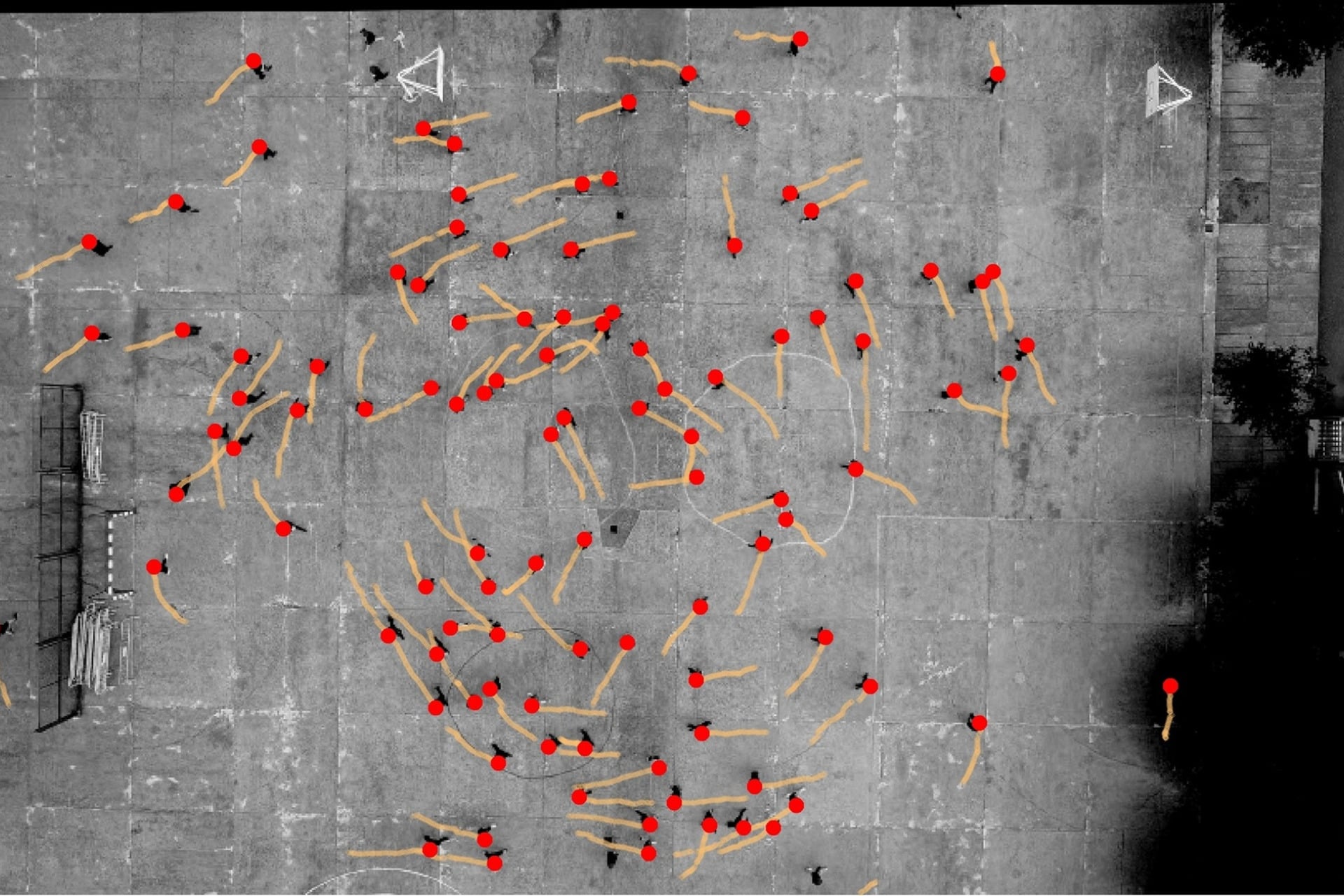
The researchers instructed participants to walk around however they wished, and a drone recorded their movements from above. A counterclockwise bias emerged “almost immediately” for about 80% of participants, Iñaki Echeverría-Huarte, the study’s first author and a physicist at the University of Navarra in Spain, explained to The New York Times.
When the team tested participants alone as opposed to in a group, 75% of participants still veered left. When they tested pedestrians in Japan—where the norm is to walk on the left—still, more people turned left. When they tried to compare whether children yet unaware of social conventions acted differently, the evidence showed that kids, too, preferred to swerve left. Even when the team tried patching one eye of a participant, not much changed, Feliciani said in the statement.
Just vibes, maybe
The team writes in the paper that the bias, although quite evident, “should not be construed as evidence of a universal law.” It’s also unknown whether similar behaviors would emerge in more extreme situations, such as that of emergency evacuations, as well as with individuals with limitations in physical or psychological functions. Overall, the exact mechanism is “still an open question,” Echeverría-Huarte told The Guardian.
But other experts uninvolved in the research say the findings could have significant implications for crowd control. For instance, this leftward bias “may have far-reaching consequences for everyday pedestrian traffic, but we simply have not looked for them yet,” Karol Bacik, a mathematician at the Massachusetts Institute of Technology, told The Times.
What’s more, these behavioral patterns, even if they’re unintentional, should be of interest for designing everyday spaces and for efficient evacuation plans, the study noted.
“We don’t know why it happens, but we think that by understanding the reasons, we could better understand how we perceive the world,” Feliciani said to The Guardian. “It can help us make other discoveries which may be more important than this one.”