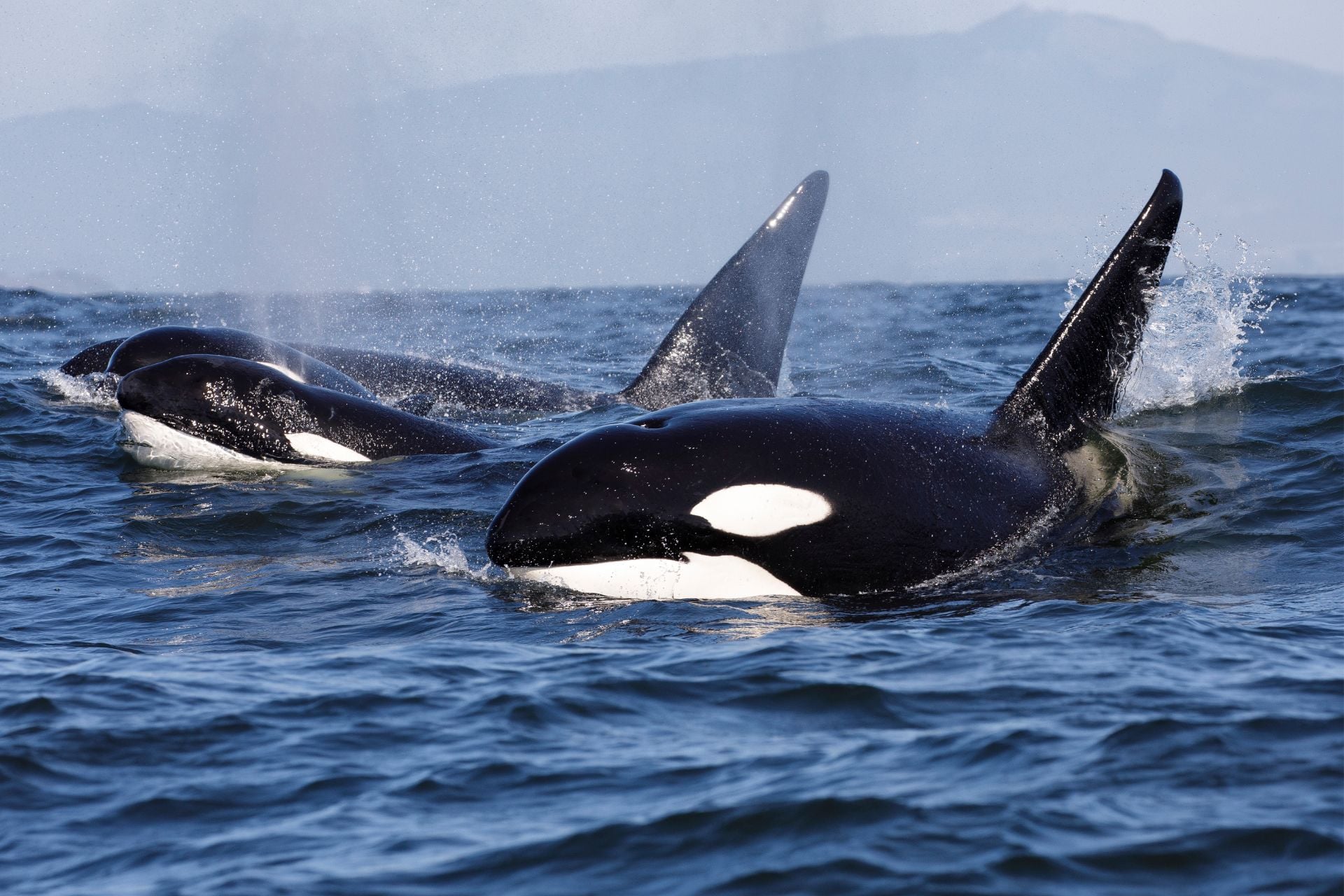
Despite living their entire lives in the water, killer whales share a lot in common with humans. Research out today shows that some can pull off the sort of antics you’d expect to see on an episode of Jackass.
For the first time ever, marine scientists have documented orcas (Orcinus orca) ramming into an already dead fish and blowing it into pieces. The mysterious behavior may be a sign of parental assistance among these killer whales as well as an example of these creatures having a good time.
“We propose that this ‘ram-to-fragment’ behavior may have multiple functions, including facilitating foraging for juvenile orcas or reflecting play behavior,” the researchers wrote in their paper, published Thursday in the journal Frontiers in Ethology.
A fortuitous discovery
Despite the nickname, orcas are actually a type of dolphin, though dolphins and whales are part of the same broad order of marine mammals called cetaceans.
The researchers, some of whom are based at the ocean conservation non-profit Beneath the Waves, weren’t looking to discover a new kind of orca hijinks. They actually first caught wind of this behavior in December 2021. However, they wanted to wait until they had clearer footage of what was going on to tell the rest of the world—something that finally happened while they were observing a pod of orcas in the Gulf of California that had killed a sharp-tailed sunfish (Masturus lanceolatus) in July 2024. Sunfish are one of the largest and heaviest groups of bony fish, with some members extending up to 11 feet long and weighing up to 4,400 pounds.
The team recorded one female orca holding onto the sunfish by its tail fin as another male rushed toward the two. The female then let go of the sunfish just before the male collided into it, causing the corpse to burst open like a flesh piñata. More than a year later, in September 2025, a third party caught a similar event on camera in the Gulf of California, once again featuring one killer whale holding onto a sunfish while another rammed into it.
“The single biggest scientific surprise was the sequence of timing. Our frame-by-frame analysis of both events completely refuted the ‘killing blow’ assumption. The sunfish were already deceased, and their nutrient-rich internal organs, or viscera, had already been removed prior to the impact,” study researcher Erick Higuera, a marine biologist and conservationist, told Gizmodo. “Discovering that this immense expenditure of energy was used purely as a post-mortem processing technique to shatter a structurally compromised, elastic collagen carcass—rather than to kill active prey—completely shifted our understanding of orca behavioral mechanics.”
But why?
The repeated and coordinated movement of these whales strongly suggests it’s an intentional behavior, the researchers say. Yet there are still many questions about its nature.
Orcas can’t chew their food, so for larger prey they’ll tear away chunks that are then swallowed whole. The killer whales’ ramming might be used to break the sunfish into more digestible pieces for the youngest members of the pod, akin to a parent cutting up a steak for their child. Orcas have been observed using complex group movements to rip apart their prey, then sharing those chunks with the rest of the pod (and even humans). Notably, in both the December 2021 and July 2024 events, a juvenile whale in the group ate some of the smaller sunfish pieces that flew off post-ramming, while the adults ate from the largest remnant of the body that stayed intact.
That said, it’s possible this behavior may instead or also be an instance of these orcas literally playing with their food. Orcas have observed doing other strange things with their prey, like tossing sea lions up in the air or swatting stingrays around like a soccer ball. Though these tricks can help them successfully catch their prey without injury, sometimes they’ll do it without even eating their kill. Some scientists theorize this play behavior is used to help younger orcas learn how to hunt or simply to bond socially. And there may yet be additional explanations for the orca ramming, such it helping the orcas get covered in the unique microbiomes of their sunfish prey.
“Because sunfish are slow-moving and defenseless, they present a perfectly low-risk opportunity for the pod—especially subadults—to practice strike precision and reinforce social bonds,” Higuera said. “In intelligent predatory mammals, play is rarely just ‘entertainment;’ it is the primary mechanism for practicing complex motor skills and sharing a collective experience. It acts as an innovative, playful shortcut that doubles as a communal meal.”
Much like humans, different populations and individual pods of cetaceans can have substantial differences from one another in how they behave and communicate. These differences are passed down socially, similar to how humans teach their young long-lasting traditions and languages. So another interesting question is how extensive this ramming behavior might be among orcas living in the Gulf of California or elsewhere, and if it only applies to this particular species of sunfish. Unfortunately, the researchers weren’t able to tell whether the same pod was involved in both events they documented.
Whatever the explanation, it’s clear there’s still plenty we don’t know about killer whales, the researchers say—mysteries that will take better data to solve, though hopefully not at the expense of the orcas themselves.
“As wildlife tourism rapidly grows in the Gulf of California, it introduces a critical risk of disturbing these apex predators. Mexico’s recent formal management plan to regulate swimming with wild orcas, established by SEMARNAT 2025 as a pilot program in the La Ventana region, Baja California Sur, is absolutely essential,” said Higuera. “Moving forward, our follow-up strategy is to continue utilizing these non-invasive, community-driven monitoring methods. If we can protect these animals by maintaining a respectful distance, this ongoing partnership will allow us to safely document hidden mysteries of marine life that would otherwise remain completely closed to science.”
In any case, it’s comforting to know that humans aren’t the only animals to occasionally be weird with their food. And now I’m wondering if orcas have ever tried to mimic a walrus with the ocean version of French fries.
This article has been updated with comments from one of the study’s authors.