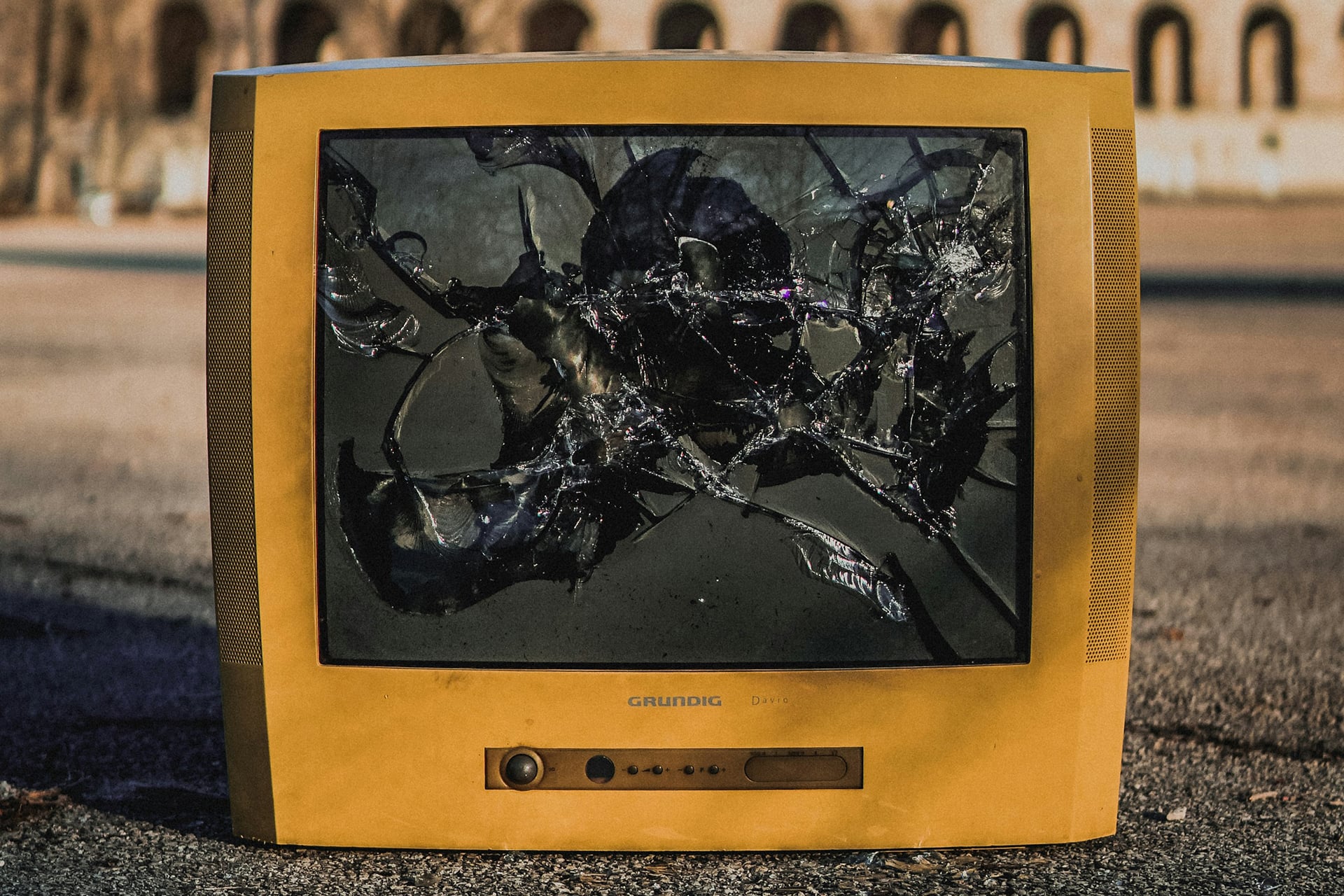
As a certified (late) Gen X-er, I like to consider that I have largely kept pace with technology—but curiously, if there’s anything that makes me feel old, it’s a technology that has existed all my life: the humble television. Gather round, children, because back in my day, you had five channels to choose from, and if none of them were showing anything good, you went back to trying to guess your way past the questions that stood between you and the forbidden world of Leisure Suit Larry.
Today’s “smart” TVs, by comparison, are a goddamn nightmare. I inherited one such hellish device from my late mother, and trying to navigate its endless cascading menus, bewildering array of subscription services and weird sort-of-but-not-really operating system made me yearn for the days of just being able to turn on the TV and watch the cricket. (God only knows what my mother made of the thing, considering that her generation was old enough to recall the actual advent of television in Australia.)
Happily, it seems I’m not alone—and if a trendpiece about people “using AI to make their smart TVs dumb again” is to be believed, people are taking matters into their own hands. (It’s not just TVs, either: behold this piece from 404 Media about people using AI’s zest for reverse engineering to hack all sorts of other devices, including—and this is a real sentence that exists in the world—”[bricking] Lululemon mirrors to bring them back to life with new software.” Um.)
Anyway, back to TVs: it seems that Claude et al find it fairly straightforward to knock together a launcher that bypasses at least some of the cruft that plagues modern TV sets, restoring them to a state when they were at least somewhat dumb. The desired level of dumbness seems to be somewhat subjective, though—take one such project, entitled dumbtv, whose author is clearly pining for an era somewhat different to the one for which I find myself yearning. “Your TV should do what you paid for,” he writes, “Your apps, your HDMI inputs, and nothing else.” Given that much of what I loathed about the smart TV was navigating its apps and inexplicably large array of unlabelled inputs, this made me wonder: what other terrible things are televisions doing these days?
I’m sure this won’t come as news to Gizmodo readers, but the answer is: all manner of obnoxious nonsense. Today’s TVs come with a volume of bloatware that’d make an early 2000s big box store PC blush, and when they’re not serving you a nice hot tray of horseshit, they’re finding all sorts of ways to spy on you (and probably pulling double time as part of a botnet, too.) The sheer amount of cruft on such devices can be startling: the person behind another such TV-dumbening project, entitled CleanYourTV, explains that he “vibe coded my parents’ TV this afternoon” because “it was showing a sponsored ad before you could even get to Netflix.” He ended up “[removing] 25 Xiaomi packages and [writing] a new launcher.” I mean… what even? It’s just supposed to show the moving pictures!
Of course, the days of televisions doing any such thing are gone—and, in a remarkably frank interview with The Verge a few years ago, Vizio’s CEO basically admitted that the whole reason TVs are “smart” is that the resultant data and ad revenue subsidizes the cost of the hardware. As with many other aspects of today’s tech dystopia, the promise of subscription services and smart TVs was one big bait-and-switch: it’s left us with an even more atomized content ecosystem, a user experience that’s inferior to the one that out parents enjoyed in the freaking 1950s, and TVs that spy on us while refusing to do the one thing we actually want them to do. What a time to be alive!