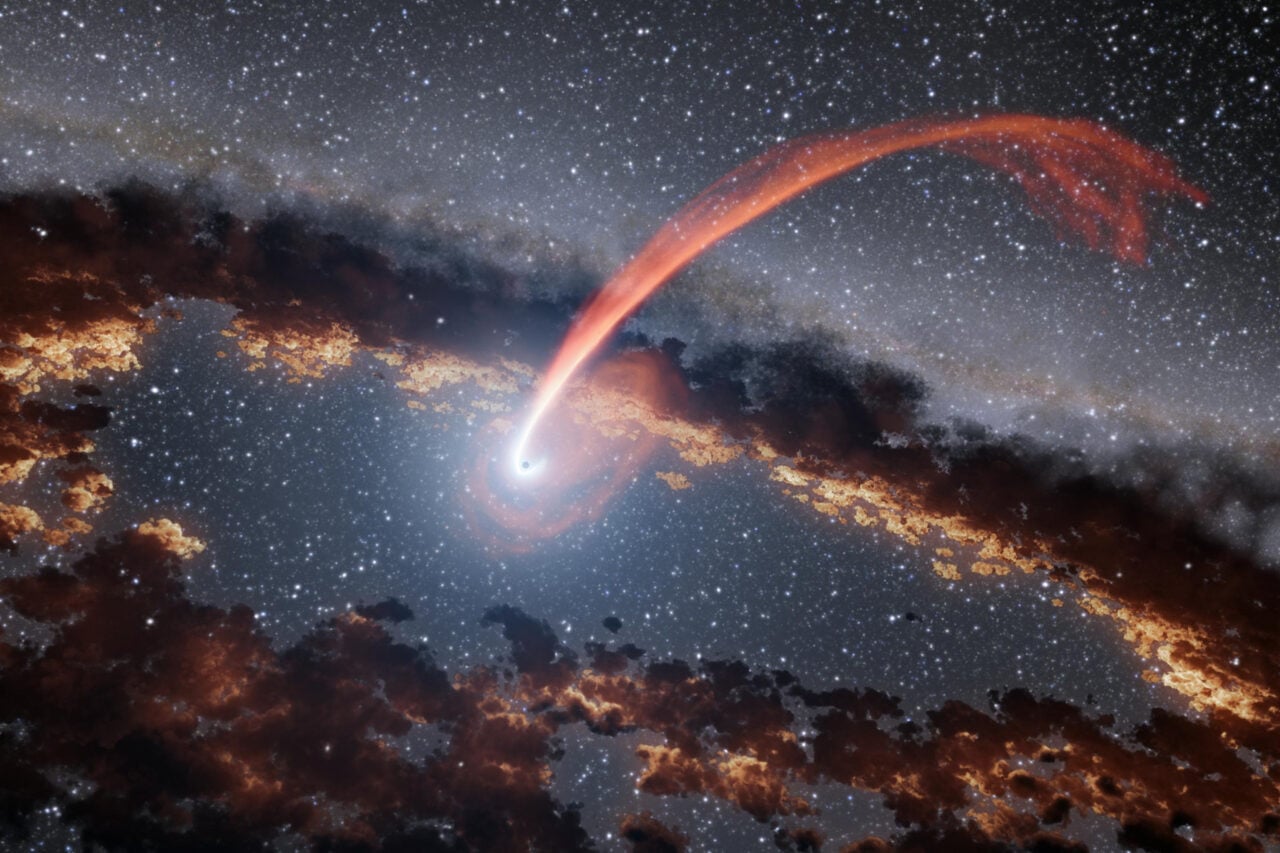
Theoretically, black holes emerged from the principles of Albert Einstein’s general relativity (gravity as distortions of spacetime), but the man himself doubted black holes, saying their singularity “brings so much arbitrariness into the theory that it actually nullifies its laws.”
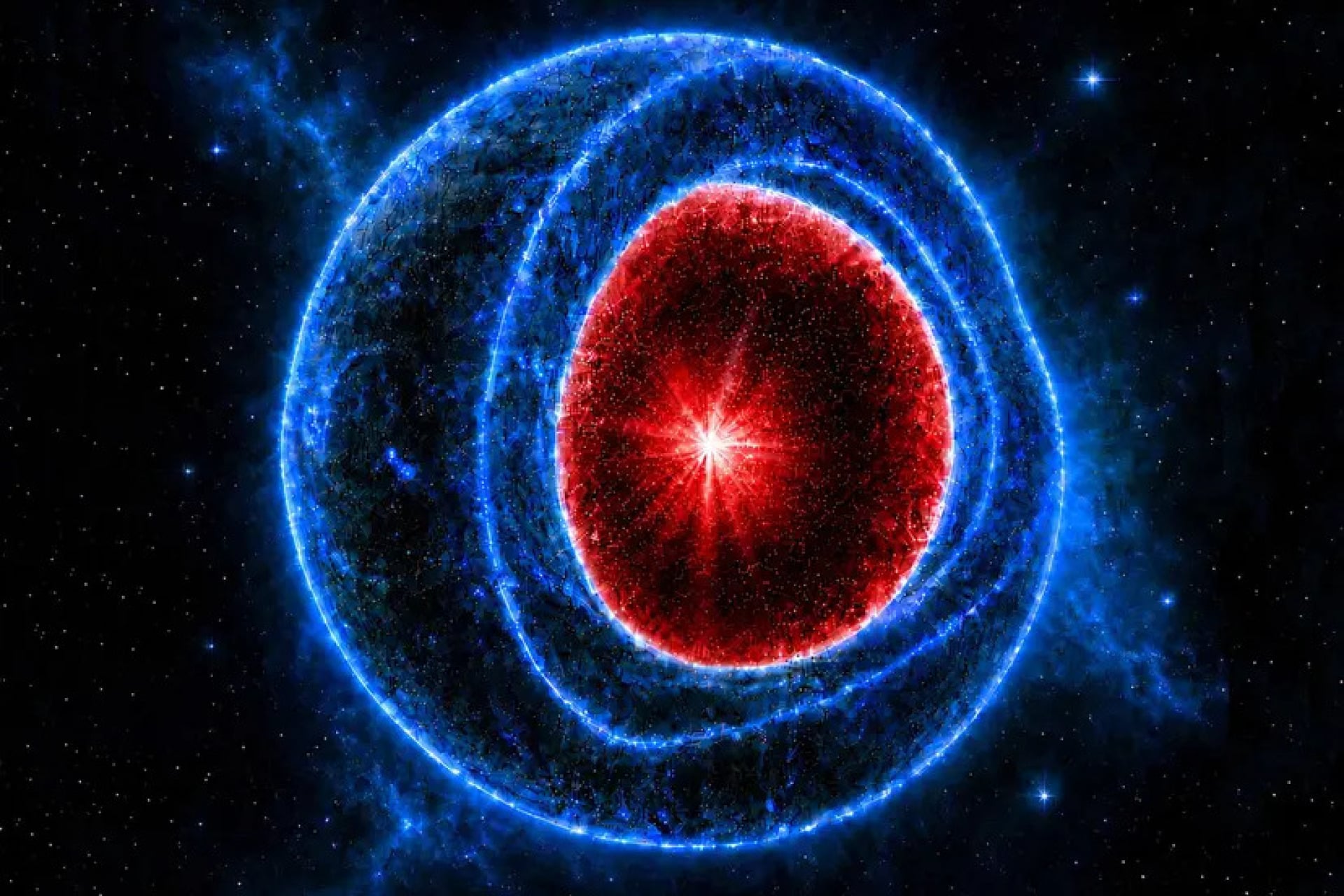
Thanks to the Event Horion Telescope, we now know black holes exist, but a new study published recently in Physical Review D suggests Einstein might have been onto something in his doubts. In the paper, theoretical physicists seriously consider the possibility of gravitational vacuum condensate stars—gravastars for short—which are ultra-compact stars with a thin shell of ordinary matter and an interior of dark energy. As a result, a gravastar externally resembles a black hole, but doesn’t form a singularity or an event horizon. This also means the rules of general relativity don’t break down, either.
“An aspect of gravastars that has so far not been addressed, mostly because of the challenges it poses, is their genesis from a generic spherical distribution of matter,” co-authors Daniel Jampolski and Luciano Rezolla of Goethe University in Germany write in the paper. “We here present, for the first time, a model for the creation of a static gravastar following a gravitational collapse of a spherical cloud of matter.”
The black hole lore
A singularity in astrophysics refers to a single point that remains after a dying star collapses under its own mass. Einstein’s issue with black holes emerged from the singularity, as the legendary scientist had a very mathematical view of spacetime. The idea that a star potentially billions of solar masses could concentrate on a tiny point while infinitely curving spacetime appeared to him “an unimaginable misfortune [malheur] for theory.”

Enter gravastars. The concept for this black hole alternative was first introduced in 2001, as something that gave a “new final endpoint of complete gravitational collapse.” Gravastars would be almost as massive and compact as black holes, but without a singularity or event horizon. The key to its stabilization would be outward pressure exerted by dark energy, a hypothetical force said to drive the expansion of the universe.
Making gravastars work
As ideal as that sounds, physicists had yet to actually work out how gravastars could form in reality. The latest paper claims to have a solution that aligns nicely with the rules of general relativity, as well as well-accepted principles in astrophysics describing the environment near black holes.
A fascinating implication of the solution is that the collapse of gravastars may trigger an explosion “not very different from the Big Bang from which our universe has emerged,” according to a press release on the study. As dark energy drives the expansion of this new “mini-universe,” it counteracts the force of gravity and halts the star’s collapse before a black hole starts to form.
An option, not a rejection
That said, as the team noted in the study, such processes would require ideal, fine-tuned conditions to unfold as the researchers predict. Until we actually observe something very similar out in the universe, the model is just a theory. It’s also worth noting that gravastars aren’t necessarily replacements for black holes, which, as Rezzolla notes, remain the “most natural and simplest solution to the fate of gravitational collapse.” Rather, it posits an additional scenario for what could happen to a dying star besides becoming a nuetron star or a black hole.
There is still much we don’t understand about the extreme conditions associated with gravitational collapse, so it’d be wise to “maintain an unbiased approach towards what we do not know and hence explore both the accepted wisdom and the more exotic interpretations,” Rezolla added. “History teaches us that it is not unusual for the latter to become the former.”