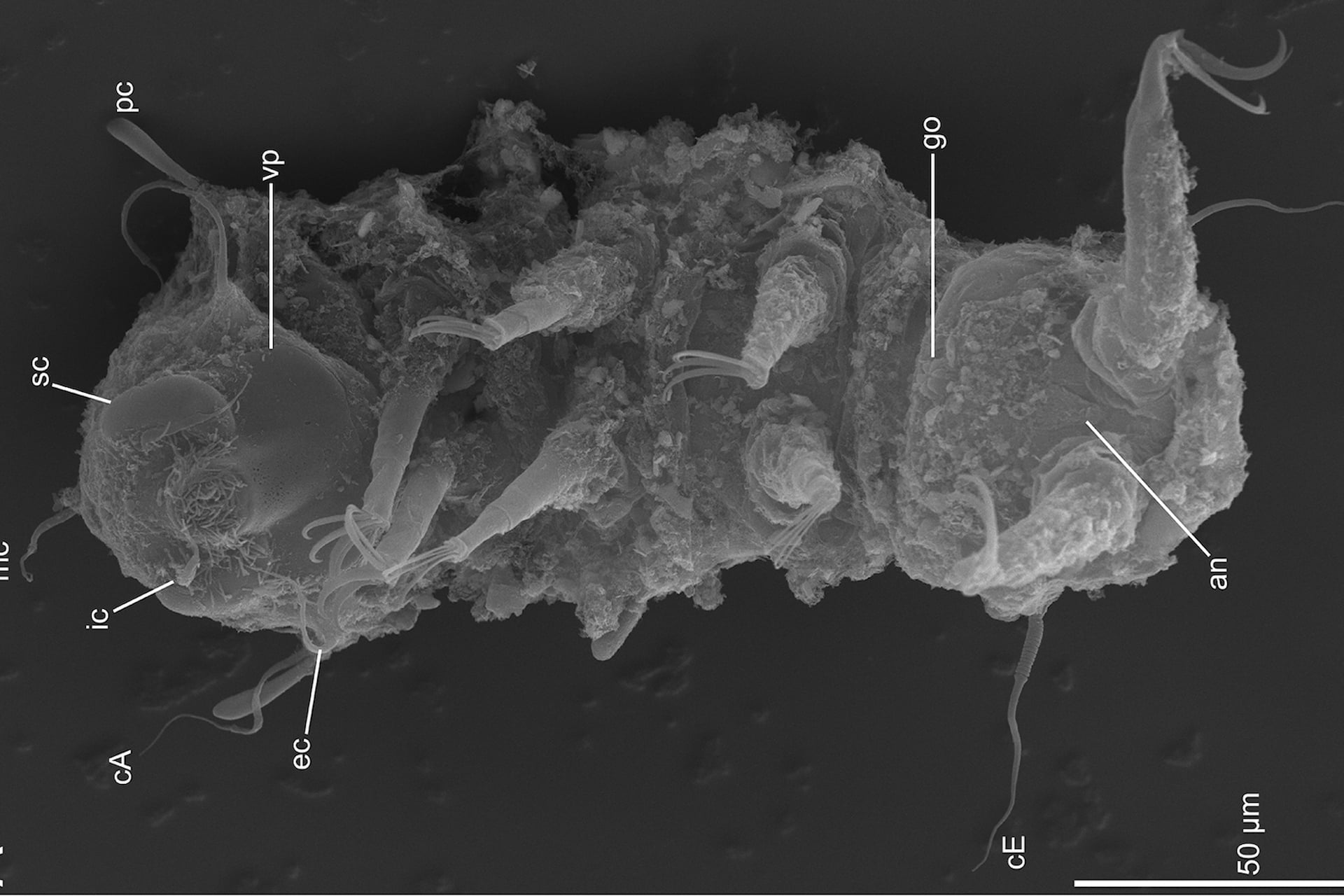
Tardigrades may be adorably tiny, but they have quite a big reputation. These microscopic, eight-legged creatures are famous for their ability to survive conditions that would spell doom for most other animals. And yet, despite all the attention they’ve received for their extraordinary survival skills, there’s still plenty we don’t know about them. Researchers have now discovered two previously unknown species lurking in the sediments of an underwater mountain in the Atlantic Ocean.
The two newcomers are members of a group known as armoured tardigrades, but each has a rather unusual physical feature. Megastygarctides hekatae sports a pair of rare genital spines: short, hollow projections with tiny hooks connected to its reproductive organs. Meanwhile, its newly discovered neighbor, Parastygarctus potercha, appears to have held on to some childhood features into adulthood.
In a recent study, published in ZooKeys, a team of researchers describes the unusual attributes of the marine tardigrade species found in an underwater mountain.
Eight-legged bears
Tardigrades are chubby little creatures with eight stubby legs and an unbreakable will to live. They have evolved to live in harsh environments that almost no other organism can withstand.
The most well-known defense mechanism for tardigrades is their ability to enter a death-like state of dormancy in which they tuck in all eight of their limbs and curl up into a ball while depleting nearly all of their internal water supply. This dehydrated state allows them to live through the most extreme conditions for decades or possibly longer, surviving freezing temperatures, intense radiation, or the vacuum of space.
Unlike their more familiar terrestrial cousins, marine tardigrades live in the ocean, where they inhabit everything from sandy beaches to deep-sea sediments. Many species have evolved to thrive in submerged environments, often squeezing between tiny grains of sediment on the seafloor.
The two newly described species were found in Senghor Seamount, an underwater mountain in the eastern tropical Atlantic near Cape Verde. The researchers behind the new study collected sediment samples in 2009 during an expedition aboard the research vessel Meteor. The samples were preserved and archived, with this analysis being the first close look at the newly described tardigrades.
They were particularly interested in the seamount’s summit plateau, where sediments contain fragments of corals, sea urchins, bryozoans, and snails. These biological remains create a relatively coarse, complex sediment environment compared with the fine sediment found on the surrounding deep-sea floor.
The team of researchers examined a total of 219 individual tardigrades, most of which were collected from the summit of Senghor Seamount. Their analysis revealed 20 different tardigrade taxa, including three previously identified species, 15 groups that could not be confidently identified to species level, and the two new species.
The researchers also spotted five other groups that could potentially represent new species, although the specimens were too poorly preserved to confirm their identities.
Weird little guys
The newly discovered species belong to a group of marine tardigrades known as heterotardigrades, which are known for distinctive body plates and armour-like structures. Each of them has distinctive features that set them apart.
M. hekatae was found at a depth of about 330 feet (100 meters). The female specimen measures about 0.008 inches (193 micrometers) long, and its body is covered by a series of plates, including three main body plates and three smaller accessory plates. Its most distinctive feature is a pair of short, hollow spines with tiny hooks at their tips. These are extensions of the ducts connected to its seminal receptacles, which are reproductive structures.
P. potercha, on the other hand, is smaller at just 0.003 inches (69 micrometers) long. It also has fewer claws than many of its relatives, retaining physical traits usually associated with younger tardigrades even after reaching sexual maturity—a phenomenon known as pedomorphosis. Its body is divided into several plates, with pairs of sharp, spine-like projections extending from the sides and rear.
The two tiny newcomers have just joined the tardigrade family tree. Scientists have described around 1,550 tardigrade species so far, but that number continues to grow as researchers explore habitats that have received relatively little attention, including the deep sea.