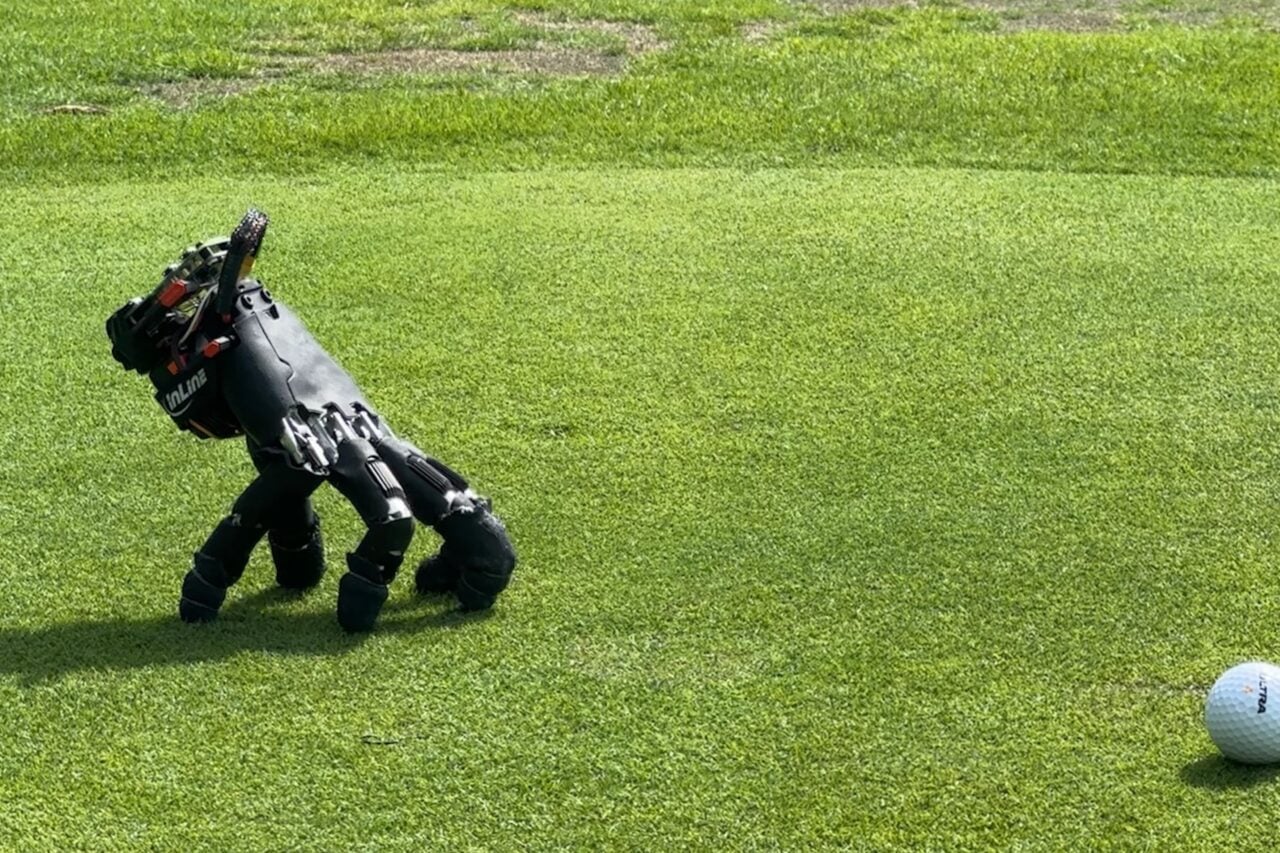
There’s a green robot dog named Chappie wandering around Buckley Space Force Base in Colorado. It can sniff out nuclear and chemical weapons.
The Space Force calls the robot dog a quadrupedal unmanned ground vehicle or QUGV. But readers will recognize it as the kind of Boston Dynamics-style robot dog drone. There are a dozen different models of this thing out there. They’re so common you can buy them on Amazon. But Chappie, which is named after the 2015 science fiction movie, is special.
Chappie was designed specifically to aid in the detection of chemical, biological, radiological, and nuclear materials (CBRN). It’s outfitted with special sensors that help it detect dangerous materials. But Chappie is remarkable in another way—it’s the product of one Airman’s idea and not the result of a 10-year development cycle between the Pentagon and private industry.
“The idea came after a deployment to Syria where we were locating and destroying ISIS chemical weapons while facing novel chemicals,” U.S. Air Force Master Sgt. Dominic Garcia—the human brain behind Chappie—said in a press release. “I thought there had to be a safer and faster way.”

The Air Force has a grant program called AFWERX which lets individual Airmen, regardless of rank, collaborate with outside business to bring an idea to fruition while sidestepping the typical Pentagon red tape. Garcia applied for a research grant in 2022 and received $1.24 million to develop the robot dog. “Within 20 months, we reached 90% of our goal, conducting tests at the Defense Threat Reduction Agency and Dugway Proving Ground,” Garcia said.
According to the Space Force press release about Chappie, this is only the beginning. “The development of the [chemical weapon sniffing robot dogs] is ongoing, with plans to enhance CHAPPIE’s agility, competitiveness and effectiveness in the Great Power Competition,” it said. “Future upgrades aim to further improve its mobility, enabling it to navigate more complex environments. Additionally, advancements in sensor technology and artificial intelligence will allow CHAPPIE to detect and respond to threats with unprecedented accuracy and speed.”
The Space Force press release did not note who, exactly, Garcia collaborated with to develop Chappie and the agency did not immediately return Gizmodo’s request for comment. But robot dogs of this design are ubiquitous now and being used by law enforcement and militaries around the world.
In 2023, U.S. Marines published a video on YouTube demonstrating an exercise with a robot dog at a training ground in Twentynine Palms, California. The Marines had strapped a rocket launcher to the thing and taught it how to fire the weapon. In the video, the Marines called the dog creepy and one commented that there was another similar project where they’d strapped a goat mask to a larger robot dog. “It’s able to growl, bark, and even throw sirens.”
Kyiv has also deployed an army of robot dogs in its war against Russia. In August, German news sources ran video and images of the machines in action on the frontlines.
The Ukrainian military has begun using a robotic scout dog to assist in various tasks. This robotic device aids in reconnaissance, conducting operations, and gathering intelligence on the battlefield. This new technological tool enhances the capabilities of the military and… pic.twitter.com/nsI8Y5GGpN
— NOELREPORTS 🇪🇺 🇺🇦 (@NOELreports) August 10, 2024