Solar Orbiter captured the most detailed view of a solar flare, observing the build-up of events that lead to the explosion.
Scientists observed the most active solar region in decades for a record-breaking 94 days.
A recent Venus flyby pushed the spacecraft out of Earth's orbital plane, allowing it to gaze at the solar poles.
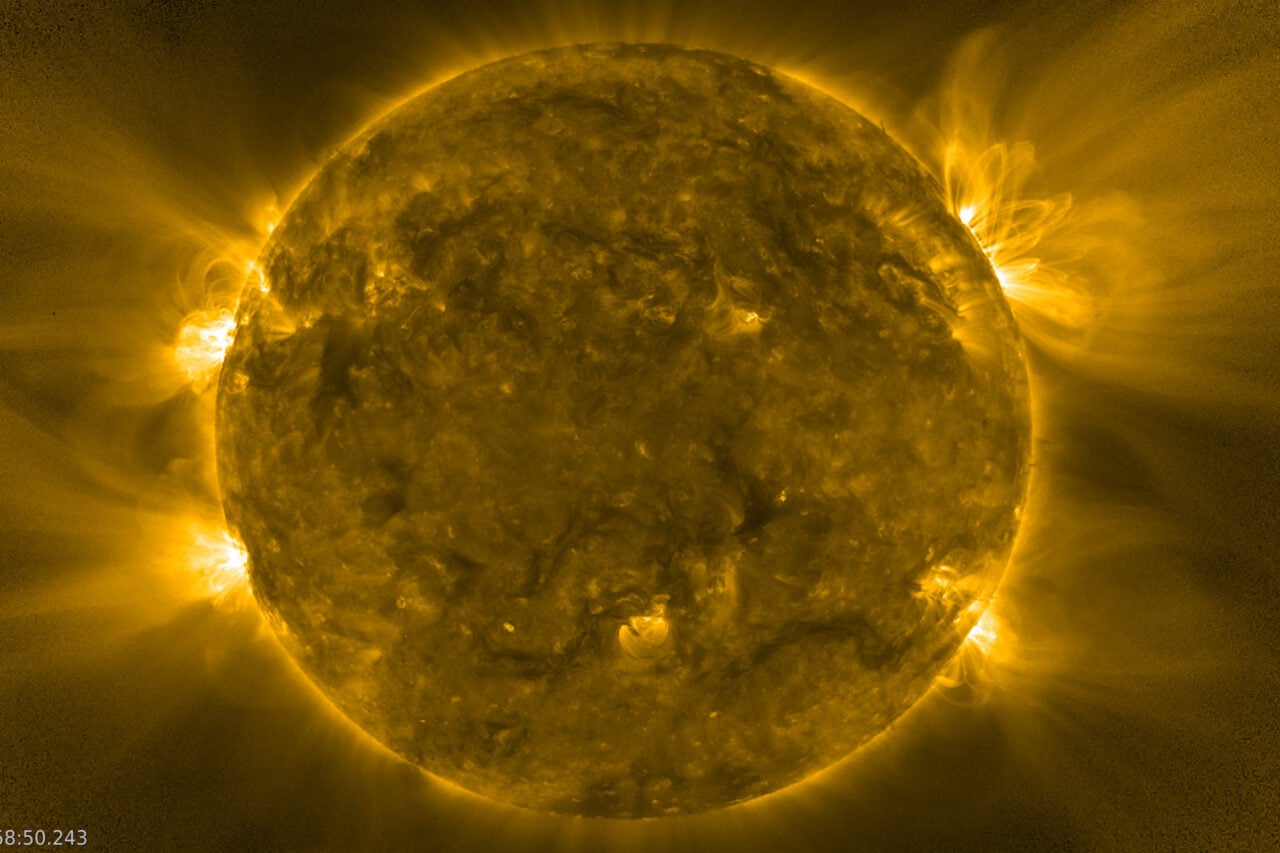
Solar Orbiter pieced together 200 ultraviolet images to show our star’s million-degree atmosphere in all its glory.
The ESA/NASA Solar Orbiter's instruments captured an extreme stream of wind from our host star.
The jets were first discovered in 2023, and new evidence reveals they drive both fast and slow solar wind.
Europe’s Solar Orbiter has captured surreal video of the Sun’s atmosphere, revealing a slew of fascinating—and jaw dropping—stellar features.
The upcoming eclipse, occurring during the solar maximum when the Sun regularly expels material into space, could offer a unique viewing experience.
Researchers utilized a camera hack on the Solar Orbiter to reveal a part of the Sun's atmosphere that was previously impossible to see.
Both solar flares were X-class events, the most intense and energetic storms the Sun can emit.
The unprecedented detection, made possible by a fleet of spacecraft, could inform future mitigation techniques to protect astronauts from radiation sickness.
The innermost planet to the Sun looks astonishingly close—and small—in the latest view from an extreme probe.
Here's what Solar Orbiter saw during its recent close approach of the Sun.
The Solar Orbiter probe was 46 million miles from the Sun at the time the extraordinary image was taken.
The blast of hot gas stretched 2 million miles—and probably more.
The brightest comet of the year will make its closest approach to the Sun on January 3, and then return from whence it came.
The ESA translated acceleration data from BepiColombo's Venus visit this week into a spooky audio clip.
The European-Japanese mission BepiColombo was one of two spacecraft to pass by the hot, toxic planet this week.
The Solar Orbiter and BepiColombo will pass on either side of our neighboring planet.
Comet ATLAS fell apart last April, but its fragments are still offering opportunities to learn.