At least 18 people have died in France, including two children left in a hot car, as an unprecedented heatwave bakes Europe this week. Temperatures are forecast to climb well above 100 degrees Fahrenheit (37.8 degrees Celsius) across the continent, forcing several countries to issue rare “red alerts,” close schools, and place restrictions on public activities.
France, Spain, and Britain are suffering the most extreme conditions today as temperatures approach record-breaking highs. People have flocked to beaches, rivers, and lakes in search of some relief, resulting in a surge of drowning deaths. In France alone, 40 people have drowned since last Thursday, according to Prime Minister Sébastien Lecornu.
Extreme heat is a growing public health risk in Europe, the fastest-warming continent in the world. While climate change sets the stage for deadly heatwaves, we need to look at real-time atmospheric conditions to understand what’s driving this event.
The dreaded omega block
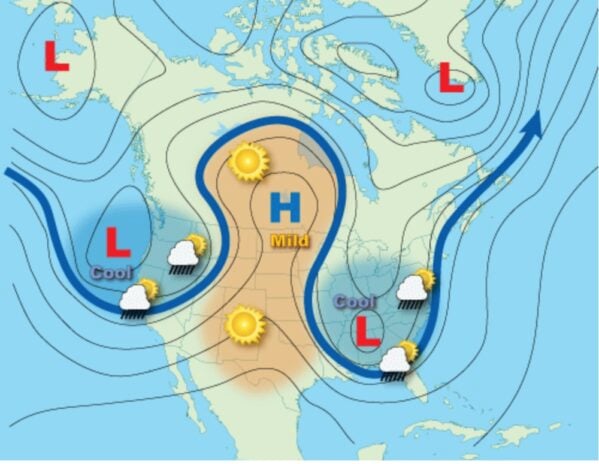
According to meteorologist Marko Korosec, an “omega block” has locked in an enormous heat dome over Europe. Named for its resemblance to the Greek letter omega, this weather phenomenon forms when a strong high-pressure system becomes sandwiched between two neighboring low-pressure systems.
Due to their size, omega blocks can be quite persistent. This one over Europe is acting like a lid, trapping a stagnant mass of hot, dry Saharan air and relentlessly compressing it downward, Korosec reports for Severe Weather Europe. That means the impact of this heat dome will be both intense and prolonged, with excessive temperatures lasting several days.
“The intensity of the heat dome is so powerful, with the ongoing pattern, that the compression of air masses causes temperatures to rise exponentially day after day, with no atmospheric ventilation underneath,” Korosec explains.
This extreme heatwave comes just a few weeks after the late-May heatwave that broke monthly temperature records across Europe, including in Spain, Italy, the United Kingdom, Germany, France, and Ireland. That event, coupled with a stark lack of precipitation, stripped the topsoil of all moisture, eliminating the landscape’s natural ability to cool itself and turning cities into “concrete ovens,” according to Korosec.
“Major European cities will experience excessive heat, with Paris, London, Hanover, Frankfurt, and Brussels at its core,” he reports.
Heat and humidity make a dangerous combo
Extreme heat is dangerous on its own, but when unprecedented temperatures couple with high humidity, conditions can quickly become life-threatening. That’s because sweat cools the body by evaporating. Humidity slows this process down, increasing the risk of heat-related illness.
Parts of Europe will suffer from above-average humidity this week, with the worst conditions expected in London. According to meteorologist Ben Noll, the city recorded its highest humidity level on record when the dew point reached 69.8 degrees F (21 degrees C) today.
“Even higher, tropical levels of humidity are expected across the region in the days ahead,” Noll wrote on X.
The United Kingdom is breaking humidity records.
On Tuesday, London recorded its highest humidity level on record when the dew point reached 69.8 degrees Fahrenheit (21 degrees Celsius).
Even higher, tropical levels of humidity are expected across the region in the days ahead. pic.twitter.com/grUXZWN03z
— Ben Noll (@BenNollWeather) June 23, 2026