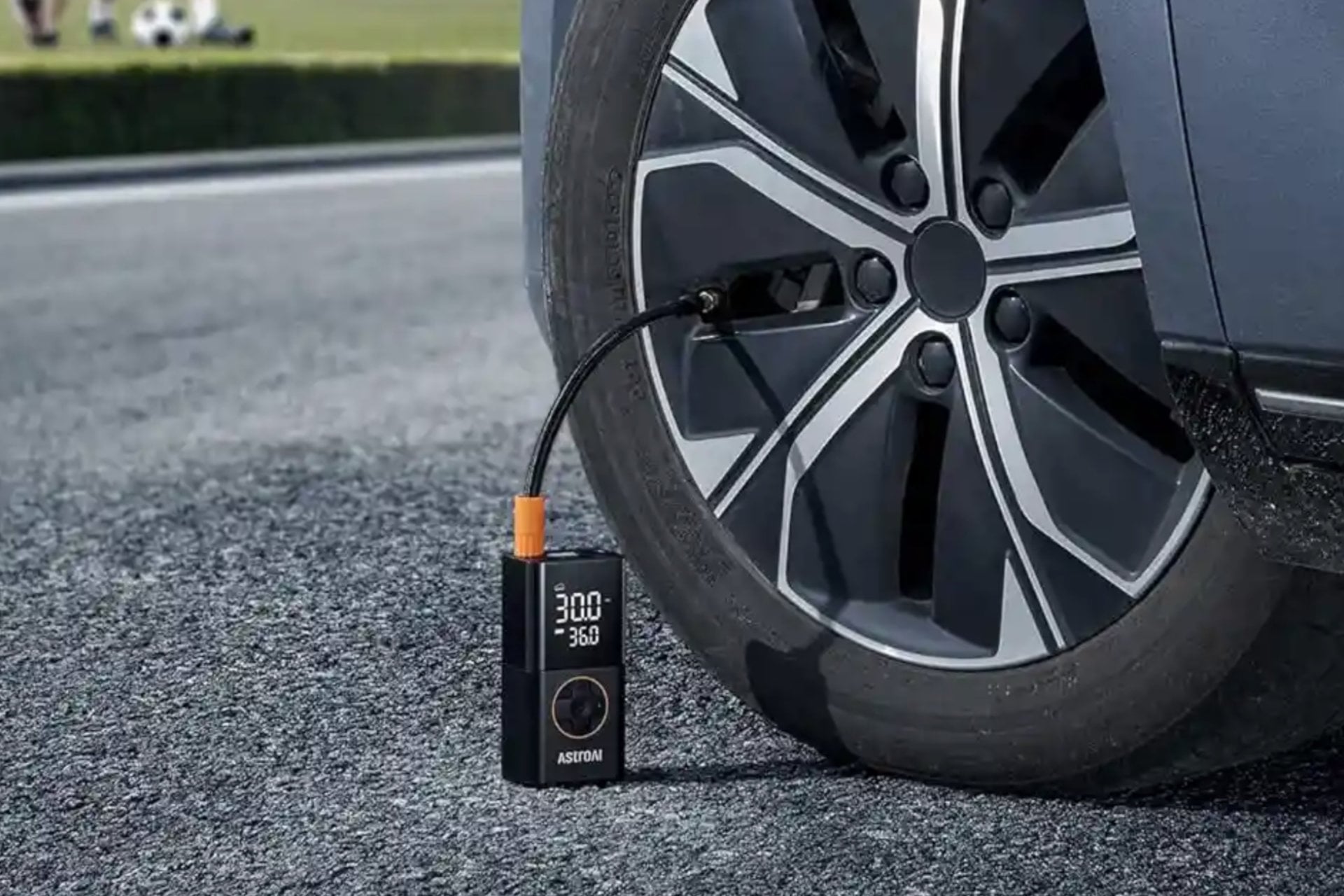
A tire that’s four PSI low costs you fuel, tread and, eventually, a roadside wait for someone with an air hose. AstroAI’s L7 is the compact cordless answer that has quietly become Amazon’s #1 best-selling tire inflator, and it just dropped in price: Amazon currently has it on sale for $23.49, down from its $39.99 list price, a 41% cut on a sub-one-pound inflator with a 150 PSI ceiling, a 4,000mAh battery good for eight car tires per charge and auto shut-off at your target pressure.
Why a Glove-Box Inflator Beats the Gas Station Hose
The L7 is built around a simple promise: set the pressure, press the button, walk away. Its updated sensor samples pressure 200 times per second and feeds a bright digital display readable in daylight or on a dark shoulder at night. Once the tire reaches the number you dialed in, the pump stops on its own, which removes the over-inflation guesswork that plagues cheap hand pumps and gas station machines with broken gauges.
Speed is respectable for something this small. AstroAI rates it at taking a standard 195/65R15 tire from 30 to 36 PSI in about a minute and a half, and the 4,000mAh battery has enough capacity to do that eight times on a single charge. That covers a full set of tires with juice to spare for a bike or a football afterward. The company is candid that it is a top-off tool rather than a rescue pump; inflating a completely flat car tire from zero will take a long time and drain the battery, and heavy-duty truck tires are off the table.
Five preset modes cover cars, motorcycles, bicycles, balls and a custom setting, and pressure can be displayed in PSI, bar, kPa or kg/cm². The custom range runs from 3 to 150 PSI, wide enough for a soft soccer ball at one end and a road bike tire at the other. Adapters for Presta valves, sports balls and inflatables come in the box, and the L7 handles common bike sizes from 700x23C road tires up to 29×2.25 mountain bike rubber, plus e-bike tires.
Weighing under a pound, the L7 lives in a glove box, a backpack or a bike frame bag without complaint, and it charges over USB-C. Those same ports make it a modest power bank in a pinch, enough to give a phone a partial charge if you’re stranded. There is also an integrated LED with flashlight, SOS and strobe modes, which sounds like a gimmick until you’re changing a tire on an unlit road at midnight.
A couple of honest caveats. At around 80dB it is not quiet, roughly the level of a garbage disposal, so expect neighbors to notice a late-night top-off. And like every battery inflator, it needs to be kept charged to be useful, which means plugging it in every couple of months whether you’ve used it or not. Neither is a dealbreaker for what is fundamentally a maintenance tool, but they are worth knowing before it goes in the glove box and gets forgotten.