At its core, a lot of modern technology depends on relatively simple patterns to receive and relay information. Incidentally, living things have also functioned this way for billions of years—a comparison that hasn’t gone unnoticed by engineers.
In electrical circuits, transistors switch or amplify electric signals, but researchers at the Massachusetts Institute of Technology have swapped in electrical signals for biological ones, using three strains of the bacteria Pantoea agglomerans to “carry” signals across circuits. It takes the cells a lengthy eight hours to perform each calculation, but the findings, published this week in Nature Chemical Biology, demonstrate the potential of biotechnology in unexpected ways.
“We’re not trying to replace computers, but rather put computational control into biology,” Christopher Voigt, head of MIT’s Department of Biological Engineering and the study’s senior author, told MIT News. “If you have bacteria on the root of a plant, or the plant itself is doing the computing, running a simple calculation overnight is fast enough relative to a growth season.”
Organic limits
According to the paper, similar approaches in the past primarily focused on using enzymes to run (relatively) large, singular cells hosting an entire circuit. But it’s been very tricky to get a tiny cell to perform calculations in the exact way researchers want, which puts a strict limit on the level of complexity that is allowed.
On the other hand, transistors “do not define circuit logic” but “conditionally enable signal propagation,” the researchers wrote. If they could make these transistors work, then it would be possible to combine the bio-transistors in different arrangements to create more diverse circuits.
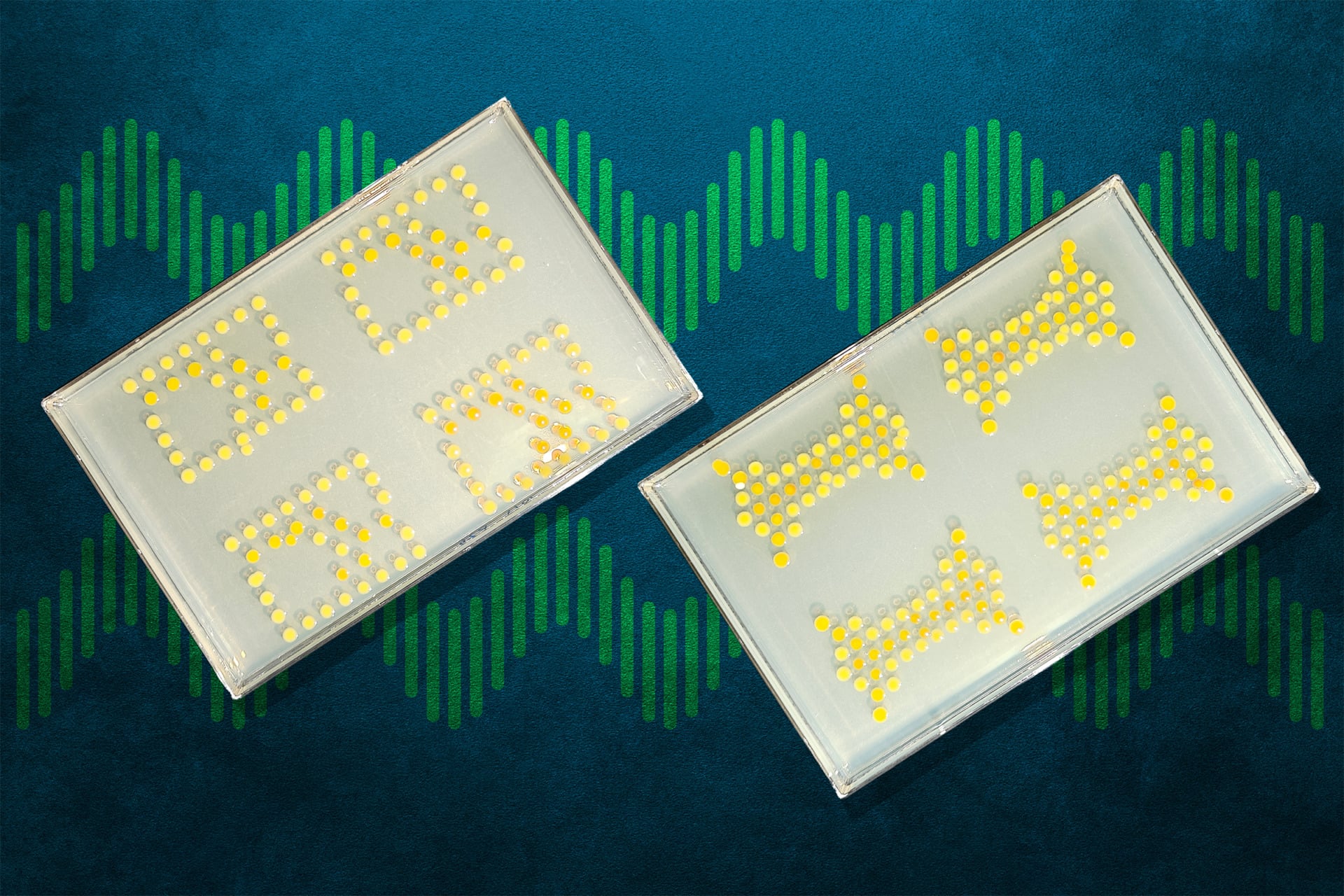
To create their prototype, the researchers printed colonies of bacteria onto tiny plates, with each colony living around 5 millimeters apart from each other. The mechanism behind these transistors involved a family of molecules used in biochemical research. One molecule served as the switch, another as a “target” molecule indicative of whether the switch is active. If the target molecule is present, the transistors produce an output molecule.
Finally, the signal representing the output molecule relays it to another transistor, effectively creating a chain of transistors that relay information. Test runs of the transistor revealed that it could perform a fair number of logical operations using only five strains, with the largest circuit holding up to 24 bacterial colonies wired together.
That said, the team noted several limitations on the maximum size of these circuits. For one, these are living organisms, so they’re bound to grow and change over time. The circuit’s speed is also generally slow, as the setup depends on the natural molecular diffusions between colonies. Overall, these limitations make it so that the “living computer” operates for around three days.
Not coming to a computer near you
Then again, the researchers aren’t trying to make living computers for an office setting, though such designs could be useful in agriculture. For instance, the circuit could sit near the roots of plants to detect different stresses or autonomously respond to the presence of pests or other environmental threats.
“This work shows that we can get toward more complicated functions by linking up simpler functions in individual cells,” Voigt added. “Computationally, there’s nothing that your iPhone can do that these circuits couldn’t do.”