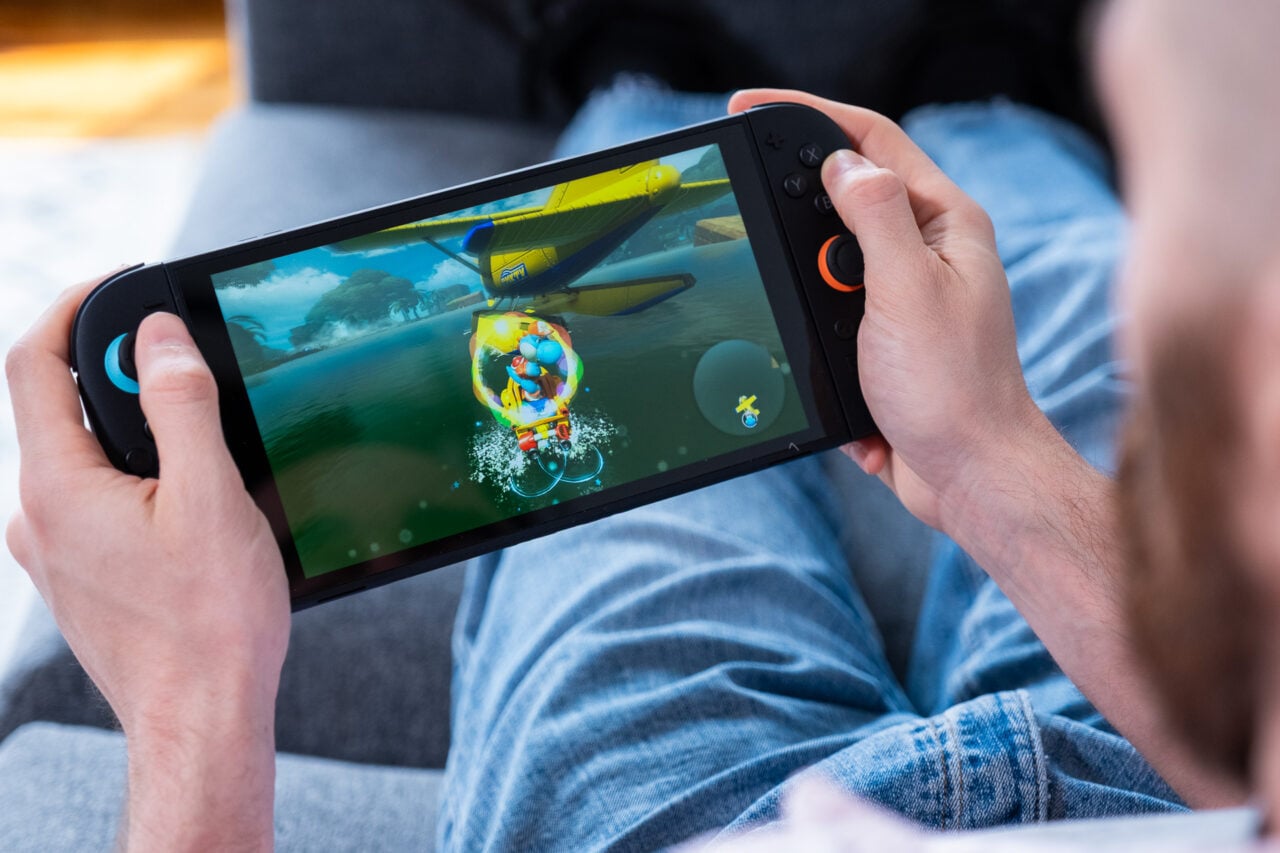
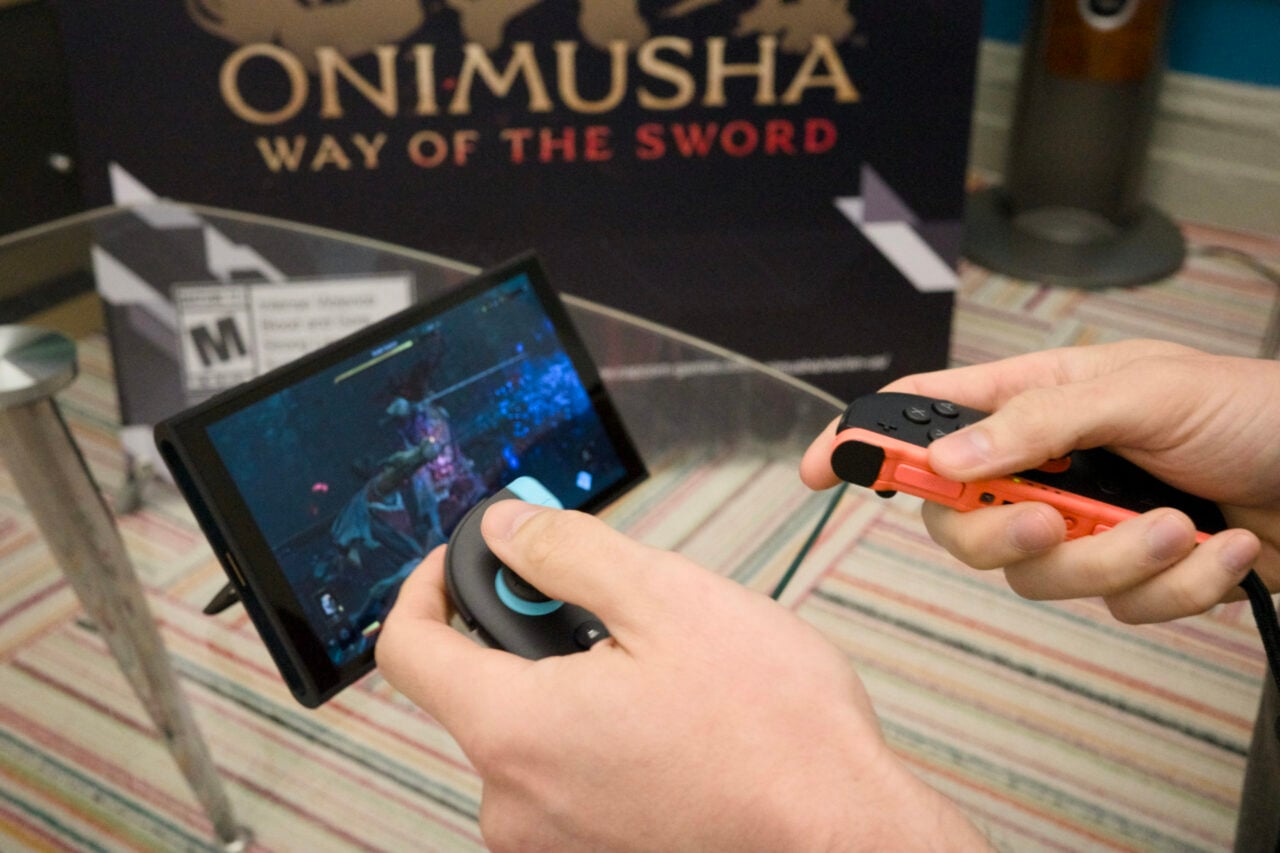
The starting gun for 2025 also marked the footrace toward the Nintendo Switch 2 launch has entered its final lap sprint. Leaks of the Switch 2’s motherboard, combined with a recently revealed patent, offer a hint of the handheld’s power, but they may show us how Nintendo’s popular handheld may finally hit the fabled 4K resolutions without maxing out your hard drive space.
The Nintendo Switch 2 has long been earmarked for a new, special Nvidia chip. This was supposedly the T234—though modified to fit the smaller Nintendo chassis—and renamed to T239. Based on these rumors, chip aficionados speculated this would be equivalent in power to the PlayStation 4 generation of consoles.
Images posted to Reddit Wednesday show what could be the motherboard for Nintendo’s upcoming console, including the CPU socket, maybe. The chip doesn’t mention any naming for the T239, but the SOC could use a different serial number or codename.
The original Switch was based on the Nvidia Tegra X1 SOC. Even for its time, back in 2017, the console felt out of date in terms of raw graphical performance. Thanks to its versatility and portability, it has become one of the most popular gaming devices. Still, the console would only output in 720p in handheld mode and a max of 1080p , when docked and connected to a TV. To achieve 4K, the Switch sequel would need to be able to output a resolution four times that of the original Switch.
If you remember your console history, the original PlayStation 4 did not support 4K. It wasn’t until the PS4 Pro arrived in 2016 that we saw support for higher resolutions. We don’t know enough about Switch 2’s chip to know how well it performs at higher resolutions. However, a patent filed by Nintendo last year proposes a solution in the form of AI upscaling.
Nintendo filed the patent for “Systems and methods for machine learning image conversion” in July 2023, though the U.S. Patent and Trademark Office published the document on Dec. 31, 2024. The paper describes a system for converting images with AI to upscale them to a higher resolution. Upscaling is now prolific among PC games, with companies such as Nvidia DLSS (the company may reveal DLSS 4 this month), AMD, and Intel offering different varieties of upscaling tech.
AI upscaling is making its way to consoles. The PS5 Pro offers its own blend of upscaling, dubbed PlayStation spectral super-resolution, or PSSR. The tech converts every frame played at a lower resolution to a higher resolution, letting you keep the performance of the original image.
Game journalist Laura Kate noted this on Bluesky. The patent references allowing them to fit games on “smaller capacity physical media.” If you can get 4K out of your portable console without maxing out limited drive space, Nintendo—and I, for that matter—would call that a win. Kate noted that the patent notes upscaling from 520p to 1080p and 1080p to 4K.
Nintendo’s first 8-inch handheld may indeed be more powerful than the 2017 rendition, but Nintendo has confirmed it will also be backward compatible to some extent. For many Switch owners, cartridge compatibility is a must-have if you want to call it backwards compatible. The leaked motherboard for the Switch 2 shows it includes a USB-C port and a slot for Nintendo’s slim physical media. That poses a problem for playing at higher resolutions when you can only put a limited amount of data on a physical cartridge. It’s why even when you buy a disc for a game nowadays, you still need to download tens or hundreds more gigabytes of data not included on the disc just to play it.
The legacy Japanese console maker previously said it plans to reveal the Switch 2 before the end of its fiscal year, which ends in March. We’re crossing our fingers for a January reveal, but if all these leaks are real, it shows that Nintendo is already well into full-scale production.