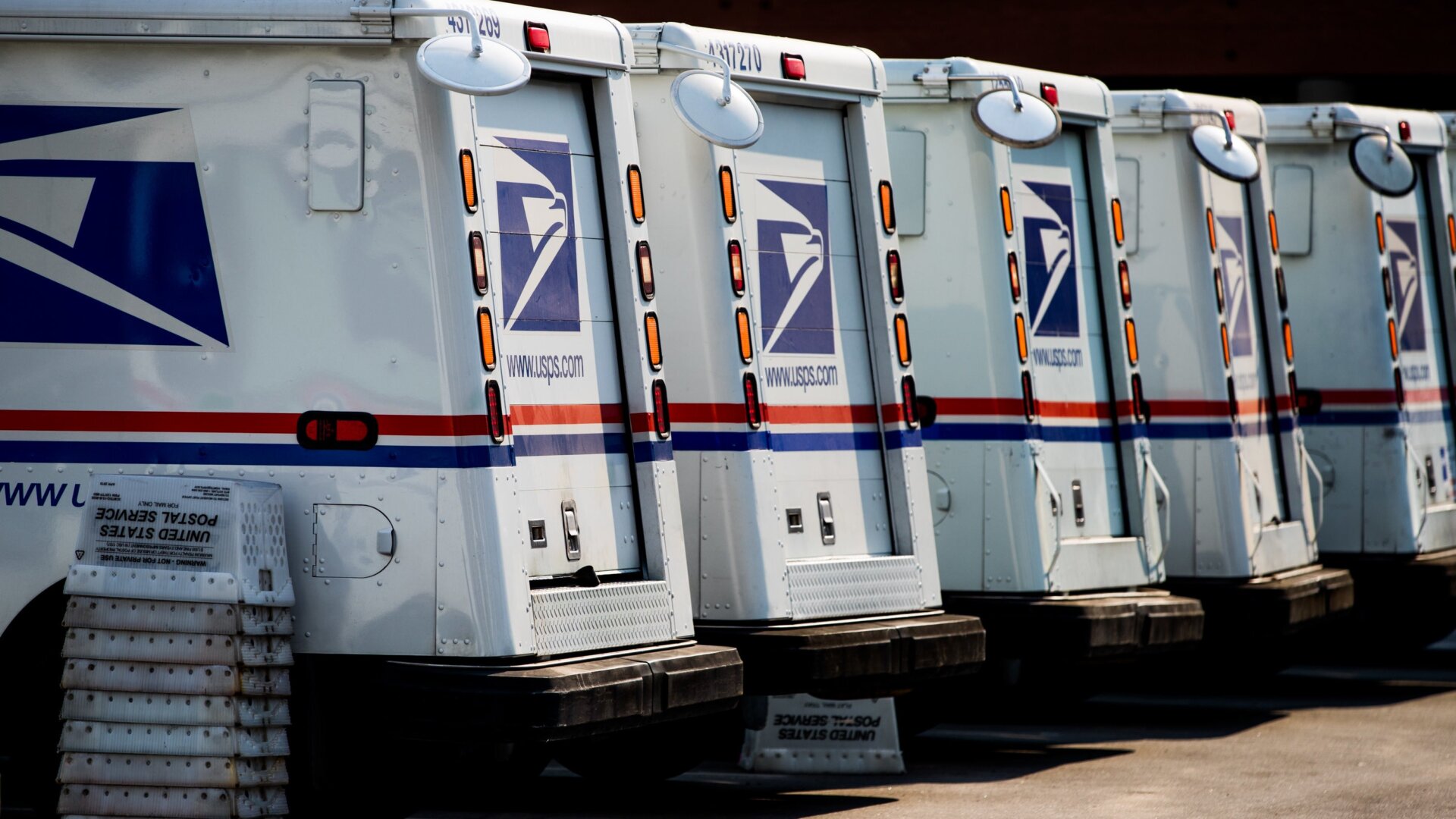
Plans for President Donald Trump’s administration to muscle more control of election procedures away from state governments via the U.S. Postal Service were even wilder than previously reported, according to a new investigation by ProPublica.
Earlier this month, the Supreme Court threw out Trump’s March 2026 executive order that effectively deputized the Postal Service to control voting by mail. That order would have required all ballots be shipped in special envelopes that require new equipment to print, and the Postal Service would have to approve nearly 10,000 voting jurisdictions’ designs in advance.
Trump’s order also demanded that Postal Service workers only deliver ballots to pre-approved lists of mail-in voters (that election officials in each state would again have to submit in advance). If even a single envelope had a mistake, the order required the entire batch be sent back to local voting officials for review and re-submission.
These proposed changes would have effectively created an arbitrary federal bureaucracy for mail-in ballots controlled by Trump—his order mandated that the Postal Service, an independent agency, coordinate enforcement with DHS and Commerce Secretary Howard Lutnick. In this plan, the postmaster general would be demoted to “effectuating all relevant aspects of the implementation,” which sounds a lot like “Do what Howard says.”
Yet even this scheme to take over ballot processing seems quaint in comparison to the White House’s initial demand, according to ProPublica, that the Postal Service require ballots be delivered by Certified Mail. To receive certified mail, Postal Service workers have to physically obtain a signature from the addressee, who is also required to present an ID.
That’s effectively an attempt not just to transform the purpose of an entire federal agency, but to create a de facto, national voter ID requirement for mail-in voters by fiat.
The Postal Service was apparently able to dissuade Trump from ordering the use of certified ballots by explaining its impossibility. Over 48 million people voted by mail in the 2024 general elections, and USPS employees would need to reach a similar number of people on top of their normal mail delivery duties. USPS site also establishes the per-item fee for certified mail is $5.55; ProPublica’s report indicated that the White House intended on pushing any costs on local governments.
Members of the USPS Board of Governors feared pushing back on Trump would be “its last action,” a source told ProPublica, referring to Trump’s regular invocation of the authority to fire officials who displease him regardless of whether their agency is independent. (SCOTUS dramatically expanded the White House’s power to do so earlier this year.) So they instead reportedly waited for SCOTUS to squash it.
The White House did not ultimately back down from using security as a smokescreen to advance measures that were virtually guaranteed to generate confusion and delays leading into Election Day. Nor did it stop trying to conscript the Postal Service and its staff as de facto human shields against blowback. The idea to have Postal Service workers vet ballots made it into the final order thrown out by SCOTUS, as did a section mandating bulk returns of shipments containing even one ballot with an error.
“That means if four addresses don’t align in a mailing of one million, 999,996 other people don’t get their ballot tomorrow,” a former official tied to the discussions told ProPublica.
SCOTUS allowed another element of Trump’s plan on Sept. 25, allowing the Department of Homeland Security to let states use a federal database to search for alleged non-citizens on voter rolls. The plaintiffs in that suit, the League of Women Voters and the Electronic Privacy Information Center, argued that the system was riddled with errors and that the feds are withholding data on just how many.
Federal law prohibits “systematic” removals of registered voters in the 90 days before an election. It should come as no surprise that Trump and Republican allies in Congress have embraced novel legal arguments that might enable them to do it anyway, such as claiming that purges of alleged non-citizens are individualized and thus allowed.
There is no evidence that voter fraud is anything but exceedingly rare throughout the U.S., including both in person or via mail. A recent PBS/NPR/Marist poll found that while virtually no one but the MAGA faithful seems to believe Trump’s rhetoric on voter fraud, about 40% of both Democrats and Republicans are united in little to no confidence that election-related mail will arrive on time this year.
In a statement to ProPublica, administration spokesperson Lauren Bis denied that the proposals were improper interference with the Postal Service. She also denied that the Certified Mail plan was “unworkable,” adding that officials went “in another direction” for completely unrelated reasons. Sure, whatever.