The first launch and reentry of the European Space Agency’s unoccupied Intermediate eXperimental Vehicle (IXV) went off this morning after a slight delay. The mini spaceplane made splashdown in the Pacific Ocean after a quick but flawless journey.
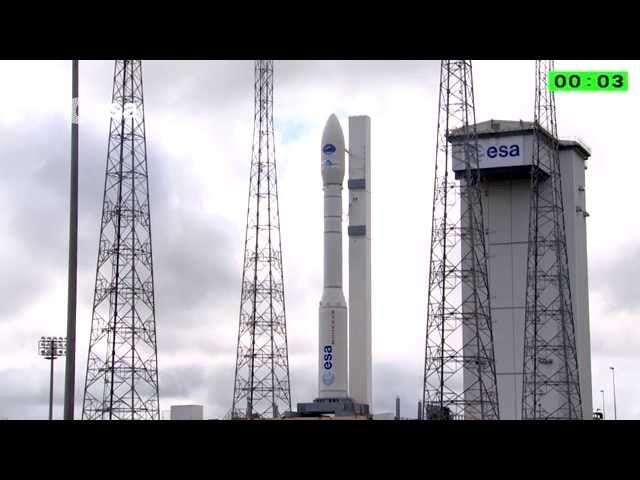
The spaceplane, which looks like a miniature version of NASA’s Space Shuttle, took off on a Vega rocket this morning at 14:40 CET (08:40 EST) from French Guiana.
And … liftoff for #IXV onboard ESA’s VEGA launcher for its #100minutemission reentry flight #VV04
— Space Rider (@esa_SpaceRider) February 11, 2015
The wingless, wedge-shaped spacecraft will be used to test technologies and critical systems required for reentry. It’s hoped that the reentry vehicle will pave the way for Europe’s first reusable launcher. Here’s the video of the Vega launch with the IXV onboard:
After following a semi-equitorial path, its brief 100-minute mission ended with a splashdown in the Pacific Ocean, where it is currently awaiting recovery by ship.
The suborbital flight saw IXV reach a maximum height of about 256 miles (412 km) and an entry speed of 27,000 km/h (or 7.5 km/s), which is the same speed for a space vehicle returning from low orbit. Temperatures on the surface of the vehicle reached 1,700 degrees C.
The spacecraft flew autonomously and was closely monitored from its Mission Control Center, located at the Advanced Logistics Technology and Engineering Centre in Turin, Italy.
Operations Director at Turin: all #IXV systems green following Malindi loss of contact. Nominal splashdown expected! pic.twitter.com/tGGNkDRqF0
— ESA Operations (@esaoperations) February 11, 2015
Splashdown confirmed! #IXV is back on Earth.
— Space Rider (@esa_SpaceRider) February 11, 2015
Now it’s for the recovery part – the Zodiacs will reach #IXV shortly. #100minutemission
— Space Rider (@esa_SpaceRider) February 11, 2015
IXV will be collected by the recovery ship Nos Aries. It’s expected to land about 1,860 miles (3,000 km) west of the Galapagos Islands.
The ESA says the US$169 million prototype is a prelude to the PRIDE spaceplane, which will be a smaller and cheaper version of the American X-37B.
All images: ESA.